
What if your unused healthcare dollars could be the key to walking without pain, rather than just a balance that disappears at midnight on December 31st? Many New Yorkers feel a familiar sense of anxiety as the year winds down, watching their Flexible Spending Account balances sit idle while they struggle with persistent heel pain or plantar fasciitis. You might wonder if those funds can actually cover professional medical devices, or if you’re stuck with generic store-bought inserts that don’t quite do the job. Learning exactly how to use FSA for orthotics in NYC is the first step toward reclaiming your mobility without the stress of a denied claim.
We understand that the difference between a retail purchase and a clinical solution can feel confusing, especially with the 2026 FSA contribution limit rising to $3,400. This guide will show you exactly how to secure high-quality custom orthotics at our Brooklyn and Queens clinics before your hard-earned money expires. We’ll walk through the 2026 carryover rules, which allow you to move up to $680 into the next year, and the essential documentation your podiatrist must provide. We’ll also outline the specific steps we take to ensure your foot support is both medically effective and fully reimbursable, helping you return to your daily routine with confidence.
Key Takeaways
- Understand why custom-molded orthotics qualify as an IRS-approved medical expense while generic retail inserts often fall short of reimbursement standards.
- Discover how to use FSA for orthotics in NYC by scheduling a biomechanical evaluation at our Brooklyn or Queens clinics to secure a professional diagnosis.
- Learn the specific requirements for a Letter of Medical Necessity (LMN) and itemized billing to ensure your FSA provider approves your claim without delay.
- Navigate the 2026 contribution and carryover limits to maximize your pre-tax savings before your hard-earned funds expire at the end of the plan year.
- Follow a clear, step-by-step roadmap for securing personalized foot support that restores your independence and relieves chronic pain.
Understanding FSA and HSA Eligibility for Custom Orthotics in NYC
Managing your healthcare budget in 2026 requires a clear strategy, especially when it involves specialized medical devices like custom orthotics. A Flexible Spending Account (FSA) is an employer-sponsored benefit that lets you set aside pre-tax dollars for qualified medical expenses. For the 2026 plan year, the IRS has increased the contribution limit to $3,400. A Health Savings Account (HSA) functions similarly but is paired with high-deductible health plans, offering even higher contribution limits of $4,400 for individuals and $8,750 for families. Because the IRS recognizes custom orthotics as a legitimate medical necessity when prescribed by a podiatrist, these accounts are the most efficient way to pay for your care.
The financial advantage is significant. When you use pre-tax dollars, you effectively reduce the out-of-pocket cost of your treatment by 30% or more, depending on your tax bracket. It’s essentially a built-in discount on the professional clinical care you need. However, for many NYC professionals, the biggest hurdle isn’t the cost, it’s the calendar. Most FSA plans operate on a strict “use it or lose it” basis. If you don’t spend those funds by December 31st, the money often reverts to your employer. Understanding how to use FSA for orthotics in NYC before that deadline hits is vital to ensuring your benefits don’t go to waste while you continue to suffer from foot discomfort.
FSA vs. HSA: Which One Should You Use for Foot Care?
While both accounts cover custom orthotics, they handle unused balances differently. HSAs are excellent for long-term orthotic maintenance because the funds roll over indefinitely. You can use your HSA to cover your initial biomechanical evaluation and then keep a reserve for future adjustments or replacements. FSAs are more time-sensitive. While some plans allow a carryover of up to $680 into 2027, many do not. We often help patients use their remaining FSA balance for their primary orthotic devices while utilizing HSA funds for co-pays or related treatments like diabetic foot care. Both accounts are fully accepted at Local Foot Doc for all diagnostic fees and medical devices.
Why Custom Orthotics are a Smart Year-End Investment
Living in New York means walking miles on unforgiving concrete. This constant impact can exacerbate conditions like flat feet or chronic heel pain. As the holiday season approaches, our Forest Hills and Astoria locations see a surge in patients looking to maximize their remaining benefits. We recommend checking your specific plan balance in early October. This gives you enough time to complete your gait analysis and have your custom-molded devices fabricated before the December rush. Booking your appointment early ensures you beat the holiday crowd and secure your medical evidence for a successful reimbursement claim.
Criteria for Orthotic Reimbursement: Medical Necessity and Prescription
Securing reimbursement for your foot care isn’t as simple as submitting a store receipt. FSA and HSA administrators require clear evidence that your orthotics are a medical necessity rather than a lifestyle preference. According to IRS Publication 502, medical expenses must be primarily for the prevention or alleviation of a physical defect or illness. This means that “arch supports” or comfort insoles purchased from a pharmacy shelf usually don’t qualify. To successfully navigate how to use FSA for orthotics in NYC, you must obtain a formal diagnosis and prescription from a board-certified podiatrist who can document the specific biomechanical reasons for the device.
Our team at Local Foot Doc focuses on providing the clinical data needed to justify these claims. We don’t just look at your feet; we analyze your entire gait cycle and bone structure. This professional documentation proves to your plan administrator that the devices are essential for your mobility and long-term health. Understanding this distinction is the key to ensuring your claim is approved on the first attempt.
Common Conditions That Qualify for FSA Orthotics
Many New Yorkers live with chronic discomfort that they’ve simply accepted as part of city life. However, conditions like what is plantar fasciitis often require specialized support to prevent further tissue damage. When we treat patients for persistent heel pain or Achilles tendonitis, we provide the specific medical coding required for reimbursement. Similarly, professional flat feet treatment and bunion management are recognized clinical justifications for custom-molded devices. These diagnoses move your orthotics from the category of “retail accessory” to “prescribed medical equipment,” which is a vital distinction for your 2026 tax-advantaged accounts.
The Difference Between Custom-Molded and Over-the-Counter
You’ve likely seen the kiosks at the local drugstore promising “custom” fit insoles. While these might offer temporary cushioning, they lack the structural integrity and medical precision of a true clinical device. Over-the-counter inserts are mass-produced to fit a general foot shape. They don’t account for the unique pressure points or structural misalignments that cause your pain. A prescription device is fabricated from a precise 3D scan or mold of your foot, designed to correct your specific alignment issues. This level of customization is why they are eligible for FSA funds while generic inserts are not. If you’re ready to invest in lasting relief, we can help you determine the best path forward during a comprehensive foot evaluation at our Brooklyn or Queens offices.
The prescription process involves a detailed biomechanical exam where we measure joint range of motion and identify the root cause of your symptoms. This clinical rigor ensures you receive a device that actually works, while also satisfying the strict documentation requirements of your healthcare plan. By choosing custom-molded support, you’re choosing a solution that is tailored to your body and your budget.
The Step-by-Step Process to Getting Orthotics at Our Brooklyn or Queens Clinics
Starting your journey toward pain-free movement shouldn’t feel like a bureaucratic hurdle. At our Brooklyn and Queens clinics, we’ve refined a clinical process that ensures you receive the highest standard of care while satisfying the strict requirements for eligible FSA expenses. Unlike mail-order kits that rely on subjective home impressions, our in-office approach provides the medical evidence your plan administrator expects to see for a successful claim.
We follow a structured roadmap to ensure your custom foot support is both medically sound and perfectly fitted to your unique anatomy. This professional oversight is why understanding how to use FSA for orthotics in NYC starts with a doctor’s visit rather than a website checkout. Our process includes:
- Step 1: Initial Consultation. Your clinical journey begins at one of our NYC locations where we identify the specific biomechanical triggers of your distress.
- Step 2: Biomechanical Evaluation. We conduct a comprehensive gait analysis. We observe how your feet, ankles, and knees move in sync to determine the root cause of your pain.
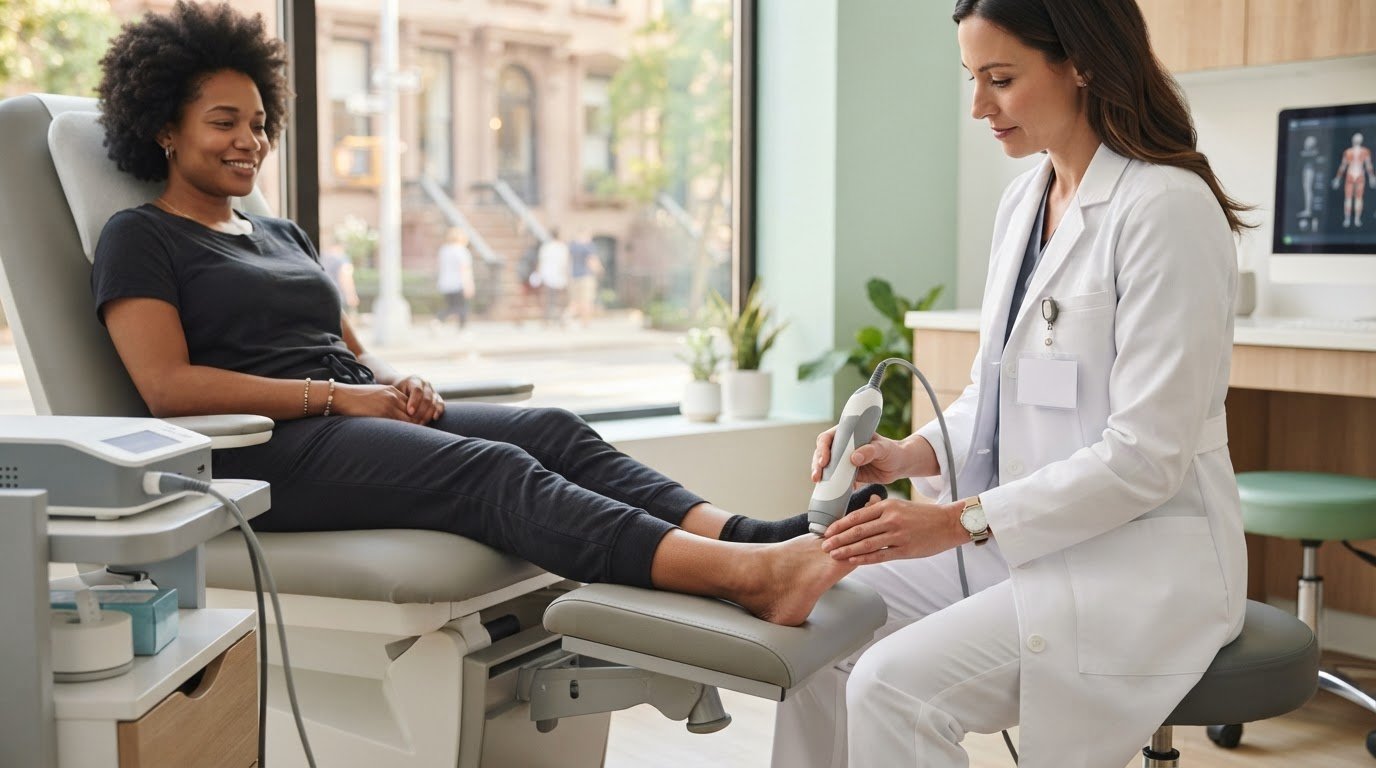
- Step 3: Precision Scanning. Dr. Majdanski performs precision casting or 3D scanning of your feet to capture their exact topography in a corrected position.
- Step 4: Custom Fabrication. Your data is sent to a specialized medical laboratory where your devices are crafted from high-grade materials chosen for your specific activity level.
- Step 5: Final Fitting. We bring you back to the office to ensure the fit is perfect and make any necessary adjustments for immediate comfort.
Your Initial Consultation: What to Expect
During this first meeting, we review your medical history and specific pain points, such as discomfort during long NYC subway commutes. We perform a physical examination of your foot structure and joint mobility to see if your issues might require more than just support. For instance, we often discuss how custom orthotics can support recovery or even delay the need for bunion surgery. This holistic view ensures we’re addressing your overall mobility and long-term independence.
Precision Casting and 3D Scanning Technology
We utilize modern 3D scanning technology to provide a more accurate fit than old-fashioned foam boxes or home impression kits. While mail-order companies claim convenience, they can’t replicate the “neutral position” casting we perform in-office. This clinical technique captures your foot’s ideal structural alignment. By having a board-certified podiatrist supervise this process, you gain a device that corrects your gait rather than just cushioning a flawed one. This precision is the foundation of the reliable care we provide to our local community.

Documentation You Need for a Successful FSA Claim
Paperwork often feels like the most stressful part of medical care, but it’s the essential bridge between your clinical treatment and your financial reimbursement. Many patients worry about claim denials, but these usually happen because of missing details rather than a lack of eligibility. When you learn how to use FSA for orthotics in NYC, you’ll find that success depends on a clear paper trail that proves medical necessity to your plan administrator. Our team simplifies this by providing pre-formatted documents that meet the rigorous standards of major insurers.
The most vital document in your file is the Letter of Medical Necessity (LMN). This isn’t just a standard note; it’s a formal clinical justification that explains why a retail insert wouldn’t suffice for your specific condition. Administrators look for precise language and specific medical codes to validate the expense. Without this, your claim might be flagged as a “comfort item” rather than a medical device, which is a common reason for rejection in the 2026 plan year.
The Letter of Medical Necessity (LMN) Checklist
A valid LMN must be comprehensive to satisfy the IRS and your insurance provider. We ensure every letter we write includes these critical elements:
- Patient Identification: Your full name and date of birth as they appear on your insurance card.
- Clinical Diagnosis: Specific ICD-10 codes, such as M72.2 for plantar fasciitis or other relevant codes for your condition.
- Medical Justification: A clear statement that the custom orthotics are “medically necessary” for the treatment of your diagnosed ailment.
- Professional Validation: The signature, date, and credentials of a board-certified podiatrist.
Beyond the LMN, you’ll need an itemized receipt. This document must clearly state the date of service, the provider’s information, and the specific medical codes (CPT codes) associated with the fabrication and fitting of your orthotics. If you use your FSA debit card at our office, keep this receipt anyway. Plan administrators often request “substantiation” weeks after the transaction. We recommend keeping digital and physical copies of your prescription and receipts for at least three years to satisfy potential tax audits.
Filing Your Claim: Tips for NYC Residents
Most major NYC insurers, including Aetna, Cigna, and BlueCross, offer streamlined online portals for submitting claims. Uploading your LMN and itemized receipt directly to these portals often results in faster processing. If your claim is initially denied, don’t panic. Denials are often due to simple clerical errors or a request for more information. You have the right to an appeal process where we can provide additional clinical notes to support your case. If you’re ready to secure the documentation you need for a successful claim, schedule your clinical evaluation today at one of our local offices.
Maximizing Your Health Benefits at Local Foot Doc
Choosing a local podiatrist over a generic online retailer is about more than just convenience. It’s about precision. Online kits often result in a device that feels like a compromise, but your mobility shouldn’t be negotiable. When you partner with us, you’re getting a medical device backed by a professional evaluation and a guaranteed paper trail for your insurer. Understanding how to use FSA for orthotics in NYC effectively means choosing a provider who understands both the clinical requirements and the local pace of life. We’re here to ensure your investment leads to real results.
We’re committed to the long-term health of our neighbors. Our process ensures that your orthotics aren’t just a purchase, but a part of a collaborative care plan. We treat you as a person, not a transaction. This individual attention is why so many patients trust us to manage their foot health throughout the year. We take pride in being a trusted local institution that combines modern methodology with a personal touch.
Comprehensive Foot Care Beyond Orthotics
Foot health is rarely about a single issue. We often integrate custom support into broader recovery strategies, particularly in sports medicine for athletes who need to return to the field or the pavement quickly. If you’re dealing with aesthetic or comfort issues like fungal nail treatment or hammertoes, we can address those during the same clinical cycle. This holistic approach ensures every aspect of your foot health is managed professionally.
This commitment to specialized, high-quality care is a standard across many medical fields; for example, those seeking advanced restorative or cosmetic work often turn to Saby Dental for expert results that prioritize patient health and aesthetics.
Booking Your Appointment in Brooklyn or Queens
We’ve made it simple to access expert care right in your neighborhood. Whether you’re in Forest Hills, Astoria, or Woodhaven, our clinics are positioned to serve you without a long commute. The 2026 FSA deadline is a firm one. Don’t wait until the final week of December to realize your funds are about to expire. Scheduling your evaluation now ensures we have enough time to scan, fabricate, and fit your orthotics before the year ends. It’s the best way to avoid the holiday rush and ensure your claim is processed smoothly.
You deserve to walk through New York City without pain holding you back. Regaining your mobility starts with a single step. Contact us today to secure your custom support and make the most of your hard-earned benefits. We’re ready to help you move forward with confidence and comfort. Let’s work together to restore your independence and get you back to the activities you love.
Secure Your Mobility and Your Benefits Today
Walking through the streets of New York shouldn’t be a source of chronic physical pain. By now, you understand that your 2026 FSA or HSA funds are a powerful tool for securing custom medical support that retail inserts simply can’t provide. We’ve discussed the importance of professional documentation, from the Letter of Medical Necessity to precise 3D scanning. Mastering how to use FSA for orthotics in NYC ensures that your hard-earned benefits translate into real-world relief before the year-end deadline passes.
Our team, led by board-certified surgeon Dr. Waldemar Majdanski, brings over 20 years of clinical experience to every consultation. Whether you visit us in Forest Hills, Astoria, or Woodhaven, we’re dedicated to helping you regain your independence and move with confidence. Don’t let your healthcare dollars expire while you continue to struggle with discomfort. Schedule your orthotic consultation in Brooklyn or Queens today and take the first step toward a more active, pain-free lifestyle. We look forward to partnering with you on your journey to recovery.
Frequently Asked Questions
Are custom orthotics 100% covered by FSA?
Custom orthotics are fully eligible for reimbursement through your Flexible Spending Account as long as they are prescribed to treat a specific medical condition. You can use your pre-tax funds to cover the entire cost of the clinical evaluation and the devices themselves. We provide the precise documentation required to ensure your plan administrator recognizes the expense as a valid medical necessity.
Can I buy over-the-counter insoles with my FSA card?
Over-the-counter insoles are generally not covered by FSA funds because they are classified as comfort items rather than medical treatments. While some specific plans may allow them with a written prescription, most administrators require the clinical rigor of a custom-molded device. This is why we focus on professional biomechanical evaluations to justify your healthcare spending and ensure claim approval.
What is a Letter of Medical Necessity for orthotics?
A Letter of Medical Necessity is a formal clinical document written by your podiatrist that explains why custom orthotics are essential for treating your specific ailment. It must include your formal diagnosis, relevant ICD-10 codes, and a professional explanation of why retail alternatives are insufficient. This document serves as the most critical piece of evidence for a successful and smooth reimbursement process.
How long does it take to get custom orthotics after my NYC appointment?
The fabrication process typically takes between two and four weeks after your initial 3D scan or precision casting in our office. Once your custom devices arrive from the specialized medical laboratory, we schedule a final fitting to ensure the alignment is perfect. We recommend starting this process at our Brooklyn or Queens clinics at least six weeks before your year-end deadline.
Do I need a referral to see a podiatrist for orthotics in NYC?
You generally do not need a primary care referral to see our podiatrists, though some specific HMO insurance plans may require one for the initial consultation. For the purpose of using your FSA or HSA, the prescription provided by our board-certified surgeons is sufficient documentation. We can help you clarify your specific plan requirements during your first visit to our local office.
Can I use my 2026 FSA funds for orthotics I ordered in 2025?
No, you cannot use 2026 funds for services or devices provided in 2025 because FSA expenses are strictly tied to the date the medical service was rendered. To use your 2026 balance, your evaluation and the ordering of your orthotics must occur within that specific calendar year. This is a firm IRS rule that all plan administrators are required to follow.
What happens if my FSA claim for orthotics is denied?
If your claim is denied, you have the right to file an appeal with your plan administrator to provide additional clinical evidence. Denials are often caused by simple clerical errors or a request for more detailed medical notes regarding your diagnosis. We regularly assist our patients by providing supplemental documentation to help overturn these decisions and secure your hard-earned reimbursement.
Can I use my HSA for orthotics if I don’t have an FSA?
Yes, you can absolutely use your Health Savings Account (HSA) to pay for custom foot support. Learning how to use FSA for orthotics in NYC is very similar to using an HSA, as both accounts recognize these devices as qualified medical expenses. The primary difference is that HSA funds do not expire at the end of the year, providing more flexibility for your care.