Last Tuesday morning, Sarah discovered that her usual walk to the Union Square subway station was suddenly impossible due to a sharp, stabbing sensation in her heel. Like 10% of the United States population will experience at some point, she was facing the primary symptoms of a common but debilitating condition. You might be asking, what is plantar fasciitis, and why does it feel like your foot is failing you on the unforgiving NYC pavement? We understand that when every block feels like a mile, your quality of life in the city suffers.
We agree that walking shouldn’t be a source of anxiety, especially in a city that demands over 8,000 steps a day just to run basic errands. This guide promises to demystify your heel pain by identifying its root causes and highlighting the most effective local treatment options to help you find relief. We’ll preview the latest non-invasive therapies, explain when you should consult a specialist, and provide a clear roadmap to get you back on your feet and moving through the boroughs with confidence again.
Key Takeaways
- Gain a clear medical understanding of what is plantar fasciitis by exploring the anatomy of the tissue that acts as your foot’s primary shock absorber.
- Recognize the hallmark symptoms of heel pain, including the classic “first steps in the morning” stabbing sensation and how it changes during daily activity.
- Discover how the unforgiving concrete of New York City and the repetitive strain of subway commutes contribute to chronic foot fatigue and arch pain.
- Explore a range of effective recovery paths, from conservative at-home RICE methods to professional physical therapy designed to restore your mobility.
- Find out how our personalized podiatric care in Astoria, Forest Hills, and Woodhaven can help you finally get back on your feet and return to your active lifestyle.
Understanding Plantar Fasciitis: The Anatomy of Your Heel Pain
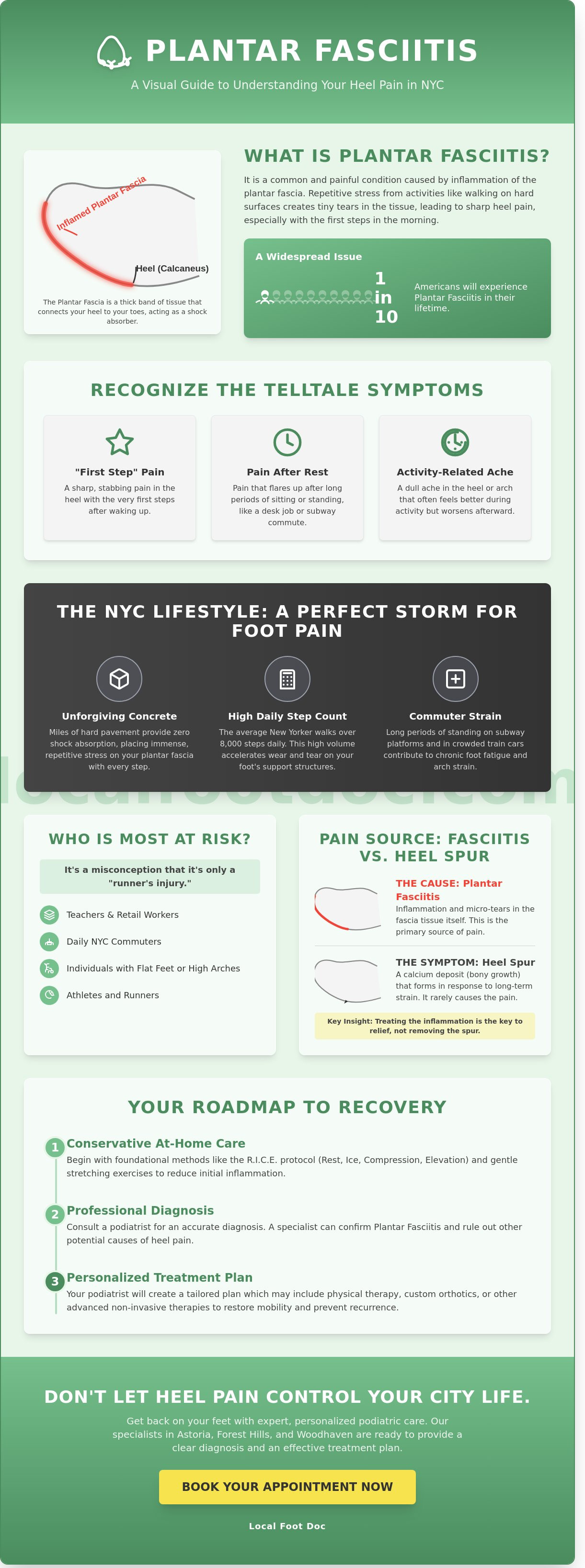
When you step out of bed in the morning and feel a sharp, stabbing sensation in your heel, you’re likely feeling the first signs of a common podiatric condition. To understand what is plantar fasciitis, we have to look at the structural foundation of your foot. The plantar fascia is a thick, resilient band of connective tissue that runs along the bottom of your foot, stretching from your heel bone, known as the calcaneus, to the base of your toes.
This tissue acts as a natural shock absorber. It supports the longitudinal arch of the foot, distributing the weight of your body with every step you take on the hard pavement of Manhattan or Brooklyn. During a normal gait cycle, the fascia stretches and contracts to manage the impact of movement. However, repetitive stress can lead to more than just simple irritation. Over time, the tension creates microscopic tears in the fibers. While the body attempts to repair these, persistent strain leads to chronic inflammation. Research suggests that Plantar fasciitis affects approximately 10% of the population at some point in their lives, making it one of the most frequent complaints we see in our NYC clinics.
Many patients believe this is exclusively a “runner’s injury.” That’s a misconception we hear often. While athletes are certainly at risk, our team frequently treats teachers, retail workers, and commuters who spend long hours standing. It’s an overuse injury that doesn’t discriminate based on your fitness level; it’s about the mechanical stress placed on your feet during your daily routine. Understanding what is plantar fasciitis involves recognizing that any activity that places repetitive pressure on the heel can trigger this painful cycle of micro-tears.
The Role of the Plantar Fascia
The plantar fascia is a vital fibrous ligament that manages weight distribution and maintains the structural integrity of your foot’s arch. Tension reaches its peak during the “toe-off” phase of your stride, which occurs when the heel lifts and the toes push against the ground to propel you forward. If your foot mechanics are slightly off, this tension multiplies. For instance, patients seeking flat feet treatment often find that their fallen arches place excessive, uneven strain on the fascia, which accelerates the wear and tear process.
Plantar Fasciitis vs. Heel Spurs
We often see patients who are worried about a bony protrusion appearing on their X-rays. It’s vital to understand that heel spurs are typically a secondary symptom, not the primary cause of your pain. A spur forms when the body creates calcium deposits to protect the bone from the constant pulling of a tight fascia. Our team prioritizes treating the underlying inflammation because removing the spur itself rarely resolves the actual discomfort. This condition is also distinct from a foot lump on arch, which might be a plantar fibroma or a soft tissue growth rather than a bone-related issue.
Recognizing the Symptoms: Is Your Heel Pain Plantar Fasciitis?
Identifying the source of your discomfort is the first step toward lasting relief. If you’re asking what is plantar fasciitis, you’re likely familiar with a sharp, stabbing sensation at the base of your heel. Many of our patients in Manhattan and Brooklyn describe a dull ache that intensifies after a long day of navigating hard city pavement. While the pain often eases during moderate activity, it typically returns with a vengeance after you’ve been sitting at your desk or standing in a subway car for an extended period.
The location of the pain is a primary diagnostic clue. It’s usually concentrated at the bottom of the heel or along the mid-foot arch. Unlike generalized foot fatigue, this condition involves specific inflammation of the thick band of tissue that supports your foot’s structure. Understanding what is plantar fasciitis helps you realize that the pain isn’t just “sore feet,” it’s a signal that your biomechanics need professional attention.
The ‘First Step’ Phenomenon
The most telling symptom is the intense pain experienced during those initial steps out of bed. While you sleep, your feet naturally point downward, which allows the plantar fascia to contract and tighten. When you stand up, that first step forcefully stretches the ligament; this often feels like the tissue is re-tearing. For a quick self-check, apply firm pressure to the calcaneal tuberosity, the bony part on the underside of your heel. According to the NCBI Bookshelf, this localized tenderness is a hallmark clinical sign used by podiatrists to confirm a diagnosis.
When Pain Signals Something Else
Not all heel pain follows the same clinical path. It’s vital to distinguish fasciitis from other issues like Achilles tendonitis, which causes pain at the back of the heel. Sometimes, the discomfort is located on the outer edge of the foot. This is frequently cuboid pain, a condition involving a small bone in the midfoot that requires a different treatment approach. Other mimics include Tarsal Tunnel Syndrome, where nerve entrapment causes burning sensations rather than a sharp stab.
Watch for these red flags that require immediate evaluation:
- Pain that persists even when you’re off your feet at night.
- Significant swelling or visible bruising around the heel.
- Numbness or tingling that radiates into the toes.
- Inability to bear weight on the foot at all.
Our team sees these symptoms daily across our NYC offices. If your morning routine includes limping to the bathroom, don’t wait for the inflammation to become chronic. We recommend you reach out to a specialist to get an accurate diagnosis and start a personalized recovery plan today.
The NYC Lifestyle and Foot Strain: Why Your Commute Matters
Living in New York means your feet are your primary mode of transportation. Whether you’re rushing to catch the L train or trekking twenty blocks to a midtown meeting, your arches take a beating every single day. Many patients come to our offices confused about their diagnosis. While you can read a high-level overview from Johns Hopkins Medicine on plantar fasciitis, the local reality is often more intense. Our city is built on unforgiving materials that demand more from your body than a suburban lifestyle. We see the impact of the city’s hustle on your heels every day.
Hard Surfaces and Urban Gait
Concrete is roughly ten times harder than natural surfaces like grass or dirt. When you walk 10,000 steps a day on Manhattan pavement, your feet endure thousands of pounds of cumulative pressure. This “pavement pounding” isn’t just a figure of speech; it’s a mechanical reality that thins the protective fat pad on your heel over time. Without that natural cushion, the connective tissue becomes inflamed and painful. Understanding what is plantar fasciitis starts with recognizing this repetitive micro-trauma caused by the urban landscape. At Local Foot Doc, we use advanced sports medicine techniques to help urban athletes and daily commuters recover from these specific environmental stressors. We focus on restoring the shock-absorption capacity that the city’s sidewalks have stripped away.
Footwear Choices for the City Commuter
We often see patients fall into the “commuter shoe” trap. Many New Yorkers swap their office heels for thin, unsupportive ballet flats or flip-flops for the walk to the station. These shoes offer almost zero arch support, which leads to over-pronation. This inward rolling of the foot stretches the fascia beyond its healthy limit. To truly understand what is plantar fasciitis in a city context, you have to look at your footwear and your load. Subway stairs add another layer of strain, forcing the arch to flex sharply while you’re carrying heavy laptop bags or groceries. We recommend professional shoe fittings to ensure your footwear can handle the 40 or 50 miles you might walk in a single week. Proper support is your first line of defense against the chronic inflammation that makes every step feel like a chore.
Our team lives and works in the same boroughs you do. We know the specific physical toll of the morning transfer at Union Square or the long walk across the Brooklyn Bridge. We don’t just treat symptoms; we analyze your specific NYC routine to find a path toward lasting relief. As your “Expert Neighbor,” we combine world-class podiatric training with a deep understanding of the local lifestyle. We’re here to help you get back on your feet so you can keep up with the rhythm of the city without the constant distraction of heel pain.
Treatment Options: From At-Home Relief to Professional Care
Understanding what is plantar fasciitis is the first step toward choosing the right recovery path. Most patients find relief through conservative methods, as nearly 90% of cases resolve within 10 months of consistent non-surgical treatment. We typically begin with the RICE protocol: Rest, Ice, Compression, and Elevation. This helps manage the initial swelling and “burning” sensations that make morning walks to the subway so difficult. Regular stretching of the calf muscles and the plantar fascia itself is equally vital, as it reduces the tension pulling on your heel bone.
When you ask what is plantar fasciitis in a clinical sense, you’re looking at a condition that responds best to early, aggressive conservative care. Night splints are a common recommendation for our patients. These devices keep your foot in a neutral, flexed position while you sleep, preventing the fascia from contracting and tightening overnight. Physical therapy also plays a major role in your recovery. A therapist can help you strengthen the intrinsic muscles of the foot, which provides better natural support for your arch. If these methods don’t provide enough relief, we may discuss a plantar fascia release. This surgical option is generally reserved for the 5% of patients who don’t see improvement after 6 to 12 months of professional care.
The Power of Custom Orthotics
NYC sidewalks are unforgiving. While over-the-counter inserts provide a temporary cushion, they often fail to address the specific biomechanical flaws causing your pain. Our process for custom orthotics in NYC involves detailed digital mapping to create a device tailored to your unique foot structure. These medical-grade supports don’t just add padding; they redistribute pressure and correct your gait. By stabilizing the heel and supporting the arch, orthotics prevent future inflammation and help you stay active on the city’s concrete streets.
Advanced Clinical Interventions
For chronic cases that don’t respond to basic care, we use Extracorporeal Shockwave Therapy (ESWT). This non-invasive “reset” uses high-energy sound waves to stimulate blood flow and trigger a healing response in the damaged tissue. We also offer ultrasound-guided injections, which allow us to deliver anti-inflammatory medication with millimeter precision. Sometimes, your heel pain is linked to how your entire foot functions. Addressing other issues, such as bunion surgery in Queens, can improve your overall mechanics and take the long-term strain off your fascia. Our goal is always to provide a clear, modern path to getting back on your feet.
Ready to find a permanent solution for your heel pain? Book your appointment with our NYC specialists today.
Expert Podiatry in Brooklyn and Queens: Getting Back on Your Feet
Dr. Waldemar Majdanski and the entire team at Local Foot Doc understand that New York City life moves at a relentless pace. Whether you are commuting through Astoria or walking the residential blocks of Woodhaven, foot pain is more than a minor annoyance. It is a direct threat to your independence and livelihood. We provide a sophisticated balance of clinical expertise and compassionate care, ensuring that every patient receives a treatment plan tailored to their specific lifestyle and physical demands.
When patients first visit us, they often ask what is plantar fasciitis and how it differs from standard heel soreness. We define this condition as the inflammation of the thick band of tissue running across the bottom of your foot. To get you answers quickly, we utilize in-office digital X-rays. This technology allows us to rule out stress fractures or bone spurs immediately, saving you from making multiple trips to outside imaging centers. We prioritize early intervention because chronic inflammation can lead to permanent changes in your gait, eventually causing secondary pain in your knees and hips.
Our commitment to NYC residents is reflected in our accessible locations. We operate full-service offices in:
- Astoria: Serving the vibrant community of Western Queens.
- Forest Hills: Providing a central hub for advanced podiatric care.
- Woodhaven: Offering convenient, high-quality treatment for local families.
Why Choose a Local Brooklyn or Queens Specialist?
There is a distinct advantage to seeing a doctor who understands the local environment. We know that a New Yorker’s “daily walk” often involves miles of concrete and steep subway stairs. This context is essential when we discuss recovery timelines and footwear recommendations. Choosing a local specialist makes follow-up care seamless, which is critical for long-term success with custom orthotics or physical therapy. For those in the area, our Forest Hills podiatrist office serves as a premier destination for patients who need a clear path toward recovery without traveling into Manhattan.
Scheduling Your Consultation at Local Foot Doc
We’ve designed our practice to be a patient-centered atmosphere where education is just as important as the treatment itself. We don’t just hand you a pamphlet; we explain the biomechanics of your foot so you understand exactly why the pain started. Our primary goal is getting you back on your feet as quickly as possible. We focus on non-invasive solutions that minimize downtime, helping you stay productive at work and active in your personal life. Understanding what is plantar fasciitis is the first step, but taking action is what leads to relief. Contact our office today to schedule your consultation and take your first step toward a pain-free future.
Take the Next Step Toward Pain-Free NYC Miles
Living in New York City means your feet endure miles of concrete every single day. Understanding what is plantar fasciitis helps you identify that sharp, stabbing sensation in your heel before it limits your life. We’ve explored how the repetitive strain of a subway commute affects your biomechanics and why early intervention with professional care prevents long-term damage. You don’t have to push through the burning or stiffness alone.
Our team combines advanced technology with the personalized care you expect from a local institution. Board-certified surgeon Dr. Waldemar Majdanski brings more than 20 years of clinical experience to every patient interaction. With convenient offices located in Forest Hills, Astoria, and Woodhaven, expert relief is always nearby. We’re dedicated to helping you find a clear path to recovery so you can return to the activities you love without hesitation.
Schedule your consultation with Dr. Majdanski at Local Foot Doc today!
It’s time to reclaim your stride and enjoy everything the city has to offer. We look forward to helping you get back on your feet.
Frequently Asked Questions
Can plantar fasciitis go away on its own?
Yes, about 90% of cases resolve within 10 months with consistent, conservative care. However, walking on NYC’s hard concrete often delays healing if you don’t use proper support. We recommend early intervention to prevent the tissue from thickening or scarring. If you ignore the sharp, stabbing pain in your heel, it can lead to chronic micro-tears that take much longer to repair.
How can I tell the difference between plantar fasciitis and a heel spur?
You can’t distinguish them by feel alone because both conditions cause a sharp, throbbing sensation in the heel. While 50% of people with heel pain also have a bone spur, the spur itself isn’t usually the source of the discomfort. To understand what is plantar fasciitis, you must look at the inflammation of the ligament rather than the bony growth shown on an X-ray.
What are the best stretches for immediate heel pain relief?
The “Great Toe Stretch” and calf stretches against a wall provide the fastest relief for morning stiffness. You should hold each stretch for 30 seconds and repeat the cycle 3 times before you step out of bed. These movements target the 1 millimeter of tension that often causes the ligament to pull against your heel bone, causing that familiar “burning” sensation during your first steps.
Is walking good or bad for plantar fasciitis?
Moderate walking is acceptable, but logging 10,000 steps on Manhattan sidewalks without support will worsen the inflammation. You should limit high-impact activity until your initial pain levels subside by at least 50%. Our team suggests wearing structured shoes rather than flat flip-flops or worn-out sneakers to protect your arch. This approach helps you stay active while ensuring the fascia has the environment it needs to heal.
When should I see a podiatrist in NYC for my heel pain?
You should schedule an appointment if your heel pain persists for more than 21 days or prevents you from completing your daily commute. We see patients who wait 6 months to seek help, which often doubles their recovery time. If you experience a “throbbing” sensation that lasts through the evening, our NYC specialists can provide a precise diagnosis and get you back on your feet quickly.
Will I need surgery for my plantar fasciitis?
Only 5% of patients require surgical intervention to find relief from chronic heel pain. Most of our NYC neighbors recover fully using non-invasive options like shockwave therapy or custom bracing. We prioritize these conservative methods for the first 6 to 12 months before we ever discuss surgical procedures. Our goal is always to use the most advanced technology available to avoid the downtime associated with surgery.
Do custom orthotics really help with chronic heel pain?
Yes, clinical studies show that 75% of patients experience significant pain reduction within 4 weeks of wearing custom orthotics. These devices are molded to your unique foot structure to correct biomechanical imbalances. Understanding what is plantar fasciitis involves recognizing how poor arch support contributes to ligament strain. Our medical-grade inserts address this by redistributing pressure across your entire foot, allowing the inflamed tissue to finally rest and recover.