
Why does your foot feel like it is on fire weeks after an operation, even when your surgical incisions have visibly closed? If resting under a light bedsheet causes intense agony or your toes radiate a deep, throbbing heat, you aren’t imagining things. Developing complex regional pain syndrome after foot surgery is a distressing detour that affects up to 4.36% of elective procedures, and it’s natural to fear that loose hardware or permanent nerve damage has compromised your foot for good.
Standard discharge packets rarely prepare you for an autonomic nervous system misfire that amplifies pain signals out of proportion to your healing tissues. You deserve clear validation and real clinical answers rather than dismissive advice to simply rest more. In this guide, you’ll learn how to differentiate routine post-op inflammation from autonomic nerve dysregulation using validated diagnostic benchmarks. We’ll also examine targeted clinical solutions and therapies designed to reverse these pain loops, charting a clear course so you can regain comfortable weight-bearing and return to an active urban lifestyle.
Key Takeaways
- Understand the neuro-inflammatory origins of complex regional pain syndrome after foot surgery and how Type 1 differs from nerve-lesion-associated Type 2.
- Discover how clinicians use the international Budapest Criteria to distinguish disproportionate nerve loops from expected post-operative tissue inflammation.
- Identify common surgical triggers, such as bunionectomies or corrective osteotomies, and why autonomic hypersensitivity is a physiological misfire rather than surgical failure.
- Explore early multimodal therapies, sensory desensitization techniques, and advanced neuromodulation strategies designed to quiet persistent pain pathways.
- Learn practical self-advocacy steps, including symptom documentation and when to seek an evaluation to safeguard your long-term mobility.
What Is Complex Regional Pain Syndrome After Foot Surgery?
Surgical healing follows an orderly biological schedule. Incisions seal, bone tissue knits, and post-operative swelling gradually subsides. Yet for some patients, recovery takes an agonizing turn. Complex regional pain syndrome is a neuro-inflammatory disorder where the peripheral and central nervous systems fail to reset after physical trauma. Instead of damping down pain signals as tissue repairs itself, local sympathetic nerves lock into a continuous feedback loop. This amplifies distress signals sent to the spinal cord and brain, creating unrelenting discomfort.
When complex regional pain syndrome after foot surgery takes hold, pain stops functioning as a helpful biological warning and becomes its own pathological process. The lower extremity is uniquely vulnerable. Every step forces dense clusters of sensory nerves to interact with gravity and body weight, which can sustain nerve hyperreactivity if post-surgical inflammation fails to clear.
Understanding CRPS Type 1 vs Type 2 in Foot Procedures
Clinicians categorize this condition into two distinct presentations based on whether structural nerve trauma occurred:
- CRPS Type 1: Previously called Reflex Sympathetic Dystrophy (RSD), this variation represents 80% to 90% of podiatric cases. It arises after procedures like bunion surgery, hammertoe correction, or osteotomies without any direct, macroscopic nerve injury. Microscopic sensory fibers simply enter sustained overdrive.
- CRPS Type 2: Historically known as causalgia, this form accounts for 10% to 20% of cases. It develops directly after confirmed, identifiable structural damage to an isolated peripheral nerve trunk, such as the sural, saphenous, or medial plantar nerve.
Despite these differing origins, both variations cause identical autonomic storms, skin temperature shifts, and sensory hypersensitivity throughout the operative foot.
Normal Post-Operative Healing vs. Neuro-Inflammatory Overdrive
Recognizing the difference between typical surgical recovery and neural dysregulation protects your long-term joint function. Routine surgical inflammation responds reliably to limb elevation, ice packs, and structured rest. Discomfort steadily declines week by week.
In contrast, neuro-inflammatory overdrive defies standard recovery rules. The severity of your pain disconnects entirely from actual tissue healing. Your incisions might look completely closed, yet the skin across your midfoot or toes displays mottled purplish hues, localized burning, and abnormal sweating. Identifying this neural hypersensitivity early lets your podiatric specialist intervene before autonomic loops cause joint stiffness or lasting guarded movement.
Key Symptoms and the Budapest Clinical Diagnostic Criteria
Confirming complex regional pain syndrome after foot surgery requires an objective medical framework. Clinicians rely on the Budapest Clinical Diagnostic Criteria, an internationally validated standard endorsed by pain specialists. According to clinical guidance highlighted by the National Institute of Neurological Disorders and Stroke, this framework maintains a 99% diagnostic sensitivity. To meet the standard, a patient must report continuing pain disproportionate to the original surgical trauma, demonstrate symptoms across at least three of four functional categories, and show observable clinical signs during an exam across at least two categories:
- Sensory: Heightened sensitivity to pinprick (hyperalgesia) or excruciating pain from light touch (allodynia).
- Vasomotor: Objective temperature asymmetry between limbs (greater than 1°C difference) or distinct skin color changes.
- Sudomotor / Edema: Noticeable swelling differences or asymmetric, localized sweating patterns across the foot.
- Motor / Trophic: Diminished active toe flexion, localized muscle weakness, altered skin texture, or irregular nail and hair growth.
Sensory Changes: When Even Socks Cause Discomfort
Sensory disruption often surfaces the moment your post-operative dressing comes off. Allodynia transforms harmless tactile sensations into searing agony. The soft brush of a cotton sock, the friction of bedsheets, or a passing breeze can feel like open flame against raw tissue. Hyperalgesia intensifies standard sensations; a light bump against a cast shoe registers as severe trauma. Patients describe this pain as an intense, deep burning accompanied by unpredictable electric shocks radiating through the metatarsals.
Vasomotor and Temperature Shifts in the Affected Extremity
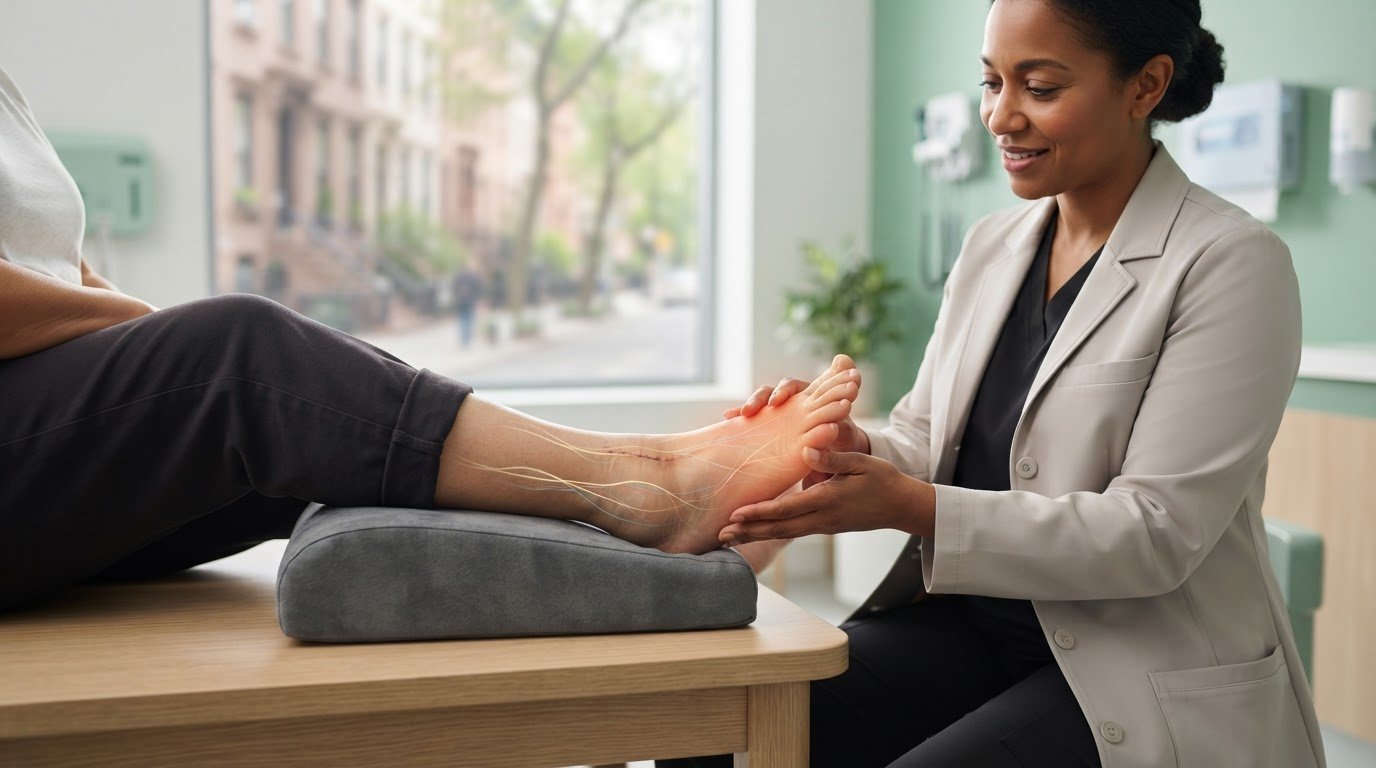
Autonomic dysregulation directly alters microvascular blood flow across your surgical foot. One hour the foot feels feverish and appears dusky crimson; the next it turns icy, pale, or mottled purple. In early presentations, persistent swelling fails to respond to elevation. Over weeks, trophic shifts may emerge. The skin often develops an unnaturally tight, glossy sheen, while toenails turn brittle or grow at abnormal rates compared to the unoperated foot.
If you observe these visible autonomic shifts while managing persistent discomfort, scheduling a timely evaluation at Local Foot Doc can help clarify whether your post-surgical symptoms warrant targeted nerve-calming protocols.
Common Surgical Triggers in Podiatry and Why CRPS Develops
Experiencing severe nerve hypersensitivity after a planned procedure often sparks deep anxiety. Patients worry that a surgical screw shifted, an incision became infected, or the surgeon made an error. We want to reassure you directly: complex regional pain syndrome after foot surgery is an aberrant neuro-immune reaction, not evidence of surgical failure or technical malpractice. The American Academy of Orthopaedic Surgeons highlights that this condition stems from sustained inflammatory signaling and sensory dysregulation rather than flawed mechanical execution.
Elective Podiatric Surgeries Most Frequently Linked to CRPS
Certain structural interventions carry higher statistical susceptibility due to the anatomical density of distal sensory nerves. Surgical procedures involving realignments or deep joint work disrupt microscopic cutaneous nerve branches, which can provoke sympathetic overdrive:
- Forefoot Osteotomies: Forefoot reconstructions account for 52.9% of elective CRPS cases. Procedures requiring metatarsal repositioning, such as those detailed in our guide to bunion surgery in Queens, NY: your guide to lasting relief in 2026, involve delicate tissue retraction near sensitive nerve pathways.
- Digital Corrections: Hammertoe repairs and proximal interphalangeal arthrodesis stretch peripheral nerve endings across contracted joints.
- Hindfoot and Ankle Reconstructions: Ankle ligament repairs, flatfoot reconstructions, and fracture fixations account for roughly 17.6% of presentations, involving extensive soft-tissue dissection.
- Neuroma Resections: Excision of irritated intermetatarsal nerves directly challenges sensory stability.
The Interplay of Immobilization, Genetic Factors, and Inflammation
Why do these procedures trigger lasting dysregulation in some individuals while others recover smoothly? The answer lies in an intersection of biological predisposition and biomechanical rest. Middle-aged females face the highest baseline vulnerability, representing 80% to 85% of cases.
When an operative foot is immobilized inside a rigid fiberglass cast or pneumatic boot, the central nervous system stops receiving standard sensory input. Deprived of normal mechanoreceptor stimulation from walking, the brain’s sensory cortex becomes hyper-vigilant. Simultaneously, local inflammatory cytokines pooling around recovering bone and soft tissue irritate healing nerve endings. Instead of settling down once surgical swelling peaks, this localized inflammatory soup interacts with sympathetic nerve fibers, creating a self-sustaining cycle of pain and vasomotor instability. Recognizing these physiological drivers allows us to intervene calmly, addressing the nerve misfire without unnecessary panic.

Treatment Options for Reversing Post-Surgical CRPS
Reversing complex regional pain syndrome after foot surgery begins with prompt, coordinated medical care. When caught within the first three to six months, this condition remains highly treatable. Our clinical focus centers on calming hypersensitive central pathways, restoring microvascular circulation, and safely reintroducing movement before guarded gait mechanics take root.
Targeted Physical Therapy and Sensory Desensitization Protocols
Aggressive, forced rehabilitation often backfires by aggravating irritated peripheral nerves. Instead, we utilize Graded Motor Imagery (GMI) to retrain how your brain interprets signals from your lower extremity. This protocol progresses through three distinct steps: laterality recognition, imagined foot movement, and mirror visual feedback. By retraining cortical maps before physical contact occurs, you can rebuild neural tolerance without triggering agonizing flare-ups.
Simultaneously, sensory desensitization helps reset tactile processing. You’ll start by lightly stroking the surrounding skin with ultra-soft textures like silk or satin, gradually graduating over several weeks to cotton flannel and textured terrycloth towels. Integrating advanced techniques from sports medicine in New York City allows us to rebuild a balanced, heel-to-toe walking pattern, protecting your posture as you return to neighborhood sidewalks.
Pharmacotherapy and Sympathetic Nerve Blocks
Medications and targeted procedures work alongside physical rehabilitation to lower background neurological chatter:
- Targeted Medications: While no oral drug holds an exclusive FDA CRPS indication, off-label neuromodulators like gabapentinoids quiet hyperactive peripheral signaling. Short courses of oral corticosteroids suppress acute neuro-inflammatory cytokines pooling around operative joints.
- Sympathetic Nerve Blocks: An injection of local anesthetic around the lumbar sympathetic chain temporarily interrupts autonomic vasoconstriction. This restores normal arterial blood flow, brings warmth back to an icy foot, and opens a pain-free window for physical therapy.
- Neuromodulation Devices: For treatment-resistant symptoms, Dorsal Root Ganglion (DRG) stimulation delivers electrical impulses straight to sensory neurons in the L4 and L5 dermatomes, offering targeted lower-extremity relief.
Interrupting nerve overdrive requires proactive, personalized care. If your post-operative recovery has stalled, schedule an advanced second-opinion consultation with our clinical team across Forest Hills, Astoria, or Woodhaven so we can map out your path back to pain-free mobility.
Regaining Mobility: Steps to Take if You Suspect CRPS
Waiting out escalating surgical pain can cost you precious recovery time. If your foot burns relentlessly or shifts colors weeks after surgery, don’t wait for your next standard monthly follow-up. Early intervention serves as your best defense against chronic neural dysfunction. Suspected complex regional pain syndrome after foot surgery requires prompt clinical validation rather than passive patience.
Your Immediate Post-Op Action Checklist
Taking organized, sensible steps at home gives your medical team actionable diagnostic evidence while protecting irritated nerves from unnecessary trauma:
- Photograph daily skin changes: Take daily, well-lit photos comparing both feet side by side. Document color discrepancies, swelling boundaries, and skin sheen differences so your provider can track vasomotor patterns over time.
- Log sensory fluctuations: Keep a simple notebook tracking your worst pain hours, local temperature changes, and sensitivity spikes triggered by socks or bedsheets.
- Avoid intense ice therapy: Extreme cold can shock hypersensitive peripheral nerve receptors and trigger harsh sympathetic vasoconstriction. Stick to gentle limb elevation instead.
- Pause aggressive physical force: Stop performing exercises that push through searing nerve agony. Unguided force can entrench autonomic distress loops.
- Seek an expert second opinion: If your initial concerns were dismissed as standard post-op soreness, consult an experienced specialist such as the best podiatrist in Forest Hills, NY to confirm your diagnosis under Budapest Criteria standards.
How Collaborative Podiatric Care Restores Daily Activity
Safeguarding your long-term mobility requires an intentional balance: protecting your surgical correction while gradually calming hyperactive nerve loops. Effective podiatric rehabilitation never relies on a one-size-fits-all protocol. Instead, our team designs structured recovery pathways that coordinate directly with regional neurologists, pain specialists, and physical therapists.
As acute neurovascular flare-ups settle, we introduce personalized biomechanical interventions. Medical-grade custom orthotics distribute plantar pressure evenly across your metatarsals, cushioning recovering osteotomy sites and shielding sensitive plantar nerves from sharp peak impacts. Backed by over 20 years of clinical podiatric surgical experience across NYC, Dr. Waldemar Majdanski and the Local Foot Doc team provide thorough diagnostic evaluations at neighborhood clinics in Forest Hills, Astoria, and Woodhaven. With targeted care, you can overcome complex regional pain syndrome after foot surgery, rebuild your stride, and confidently return to the vibrant streets of Queens and Brooklyn.
Reclaim Your Stride and Protect Your Recovery
A complicated recovery doesn’t have to define your long-term mobility. While confronting complex regional pain syndrome after foot surgery is emotionally exhausting, early clinical action breaks the autonomic pain loop before it becomes permanent. Distinguishing normal surgical healing from genuine neuro-inflammatory overdrive gives you the power to advocate for your body and pursue therapies that actually calm hypersensitive nerves.
You don’t have to navigate persistent burning, swelling, or touch sensitivity by yourself. With over 20 years of clinical podiatric surgical experience across NYC, Dr. Waldemar Majdanski delivers thorough, patient-centered care. Schedule an expert post-operative evaluation with Local Foot Doc today at our neighborhood clinics in Forest Hills, Astoria, or Woodhaven. Together, we’ll restore your comfort and get you moving confidently across the city again.
Frequently Asked Questions
Is CRPS common after foot and ankle surgery?
No, complex regional pain syndrome after foot surgery remains relatively rare. It occurs in roughly 0.3% to 4.36% of elective procedures, though rates climb higher following traumatic ankle fracture repairs. Middle-aged women face greater statistical susceptibility, yet the vast majority of surgical patients heal without developing autonomic dysregulation.
Can complex regional pain syndrome go away on its own?
Spontaneous resolution is uncommon once established neuro-inflammatory feedback loops take root. While very mild sensory flares occasionally settle, leaving severe burning unattended risks progressive joint stiffness and tissue changes. Early clinical intervention within the first few months offers the most dependable path toward full, lasting remission.
How is CRPS diagnosed after a podiatric procedure?
Clinicians diagnose the condition using the Budapest Clinical Diagnostic Criteria rather than a single blood test or scan. Your specialist evaluates persistent, disproportionate pain alongside documented signs across sensory, vasomotor, sudomotor, and trophic categories. In-office exams confirm temperature variations, swelling boundaries, and abnormal touch sensitivity.
What is the difference between CRPS Type 1 and Type 2?
The core distinction depends entirely on whether a major peripheral nerve trunk sustained structural injury. Type 1 occurs after surgical trauma without direct, demonstrable nerve laceration or transection. Type 2 develops following identifiable injury to an isolated nerve trunk, such as the sural or tibial nerve, though both types cause similar autonomic distress.
What happens if post-surgical CRPS is left untreated?
Untreated symptoms can transition from an acute, warm inflammatory phase to a chronic, cold phase. Over time, prolonged autonomic dysfunction causes skin thinning, brittle nails, muscle atrophy, and severe joint contractures. Delaying care makes central nervous system pathways harder to desensitize, prolonging physical disability.
Can I still walk if I have CRPS in my foot?
You can walk, but gait mechanics must be modified to prevent intense flare-ups. Forcing aggressive weight-bearing through agonizing pain reinforces sympathetic distress loops. Working alongside an experienced podiatric team allows you to introduce gentle, protected motion using specialized padding or custom orthotics that shield irritable nerve endings.
Does CRPS mean my foot surgeon made a mistake?
No, developing complex regional pain syndrome after foot surgery does not indicate surgical error or negligence. It represents an abnormal neuro-immune reaction driven by your autonomic nervous system’s response to incision healing and immobilization. Even flawlessly performed procedures can occasionally trigger this unexpected physiological chain reaction.