
Imagine sitting in a bumper-to-bumper crawl on the Long Island Expressway, traffic lurching forward, and suddenly realizing you lack the reaction speed to slam on the brakes. For many New Yorkers, the most stressful part of recovery isn’t the operation itself; it’s the sudden loss of independence that comes with being grounded. We understand that in a city as fast-paced as ours, waiting to get back behind the wheel feels like life is on pause. You’re likely wondering exactly when can I drive after right foot surgery in NYC without risking your safety or legal liability.
We agree that the transition from walking in a medical boot to operating a heavy vehicle is often confusing, especially when your “walking timeline” doesn’t match your “driving timeline.” This guide provides a clear, medically-backed roadmap for your 2026 recovery. We’ll walk you through a specific week-by-week timeline, share a simple physical test you can perform at home to check your brake-force readiness, and outline the safety criteria our team uses to clear patients at our clinics in Forest Hills, Astoria, and Woodhaven. Let’s get you back on the road with confidence and care.
Key Takeaways
- Understand why most patients wait six to eight weeks before returning to the road and which health factors might speed up or slow down your specific timeline.
- Learn why “walking ready” isn’t the same as “driving ready,” especially when your right foot must withstand over 50 pounds of sudden braking pressure.
- Discover the specific safety criteria for when can I drive after right foot surgery in NYC, including how to handle the unique demands of stop-and-go traffic on the BQE.
- Follow our simple “single-leg stomp” test and medication checklist to ensure you’re physically and legally prepared to regain your independence.
- See how our personalized recovery plans at our Astoria, Forest Hills, and Woodhaven locations help you transition safely from the clinic to the driver’s seat.
The General Timeline: When is it Clinically Safe to Drive?
The question of when can I drive after right foot surgery in NYC often comes down to one critical biological milestone: bone consolidation. For most of our patients, the standard clinical window for returning to the driver’s seat is six to eight weeks. This isn’t an arbitrary number. It’s the time required for the surgical site to bridge with enough new bone to withstand the sudden, jarring force of an emergency stop. While you might feel capable of walking around your apartment in Astoria or Woodhaven by week four, driving requires a much higher level of physical integrity. Clinical driving readiness is the specific point where your reaction time and muscle control return to your pre-surgical baselines.
Individual timelines vary based on your personal health profile. Younger patients with high metabolic rates often heal faster, while certain lifestyle factors can create significant delays. Smoking, for instance, constricts blood flow and can extend the “no-drive” window by weeks. We work closely with you to monitor these variables during your post-op checkups at our local clinics. Our goal is to ensure that when you finally turn the key, your foot is strong enough to keep you and your fellow New Yorkers safe.
Timelines by Surgery Type: Bunion vs. Fracture
The complexity of your procedure dictates your path back to the pedals. Bunion surgery recovery typically sees patients ready for driving evaluations between weeks four and eight, depending on the specific technique used. Fracture repairs are usually more restrictive. Because a broken bone must bear the full brunt of pedal pressure, we often maintain strict weight-bearing limits for the full eight-week duration. Conversely, hammertoe correction involves smaller joints and less mechanical stress, which sometimes allows for a faster return to driving, provided you’ve transitioned out of specialized footwear.
The Role of the Surgical Boot or Cast
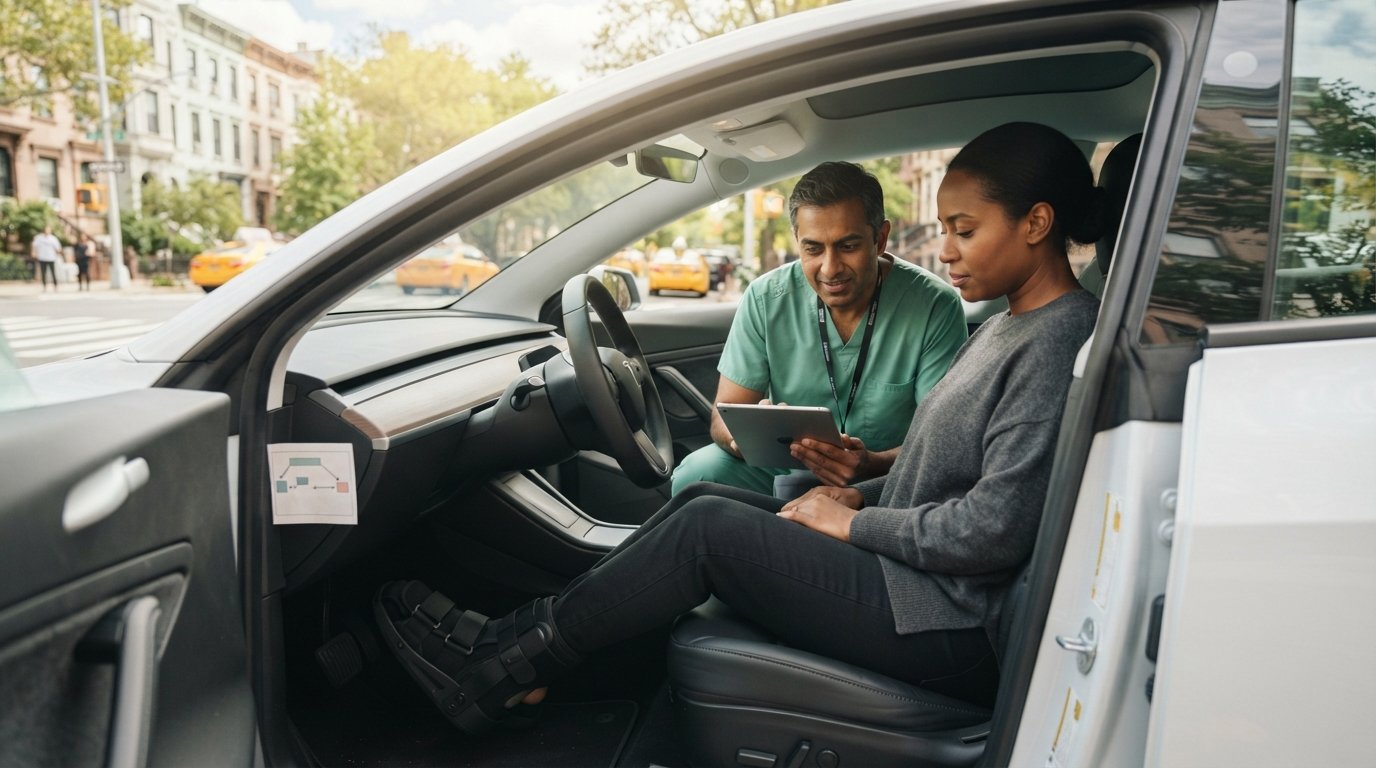
It’s vital to remember that you should never drive while wearing a post-operative boot or cast. These devices are designed to immobilize your foot, which is the exact opposite of what you need for safe driving. A boot is too bulky for the footwell, making it easy to accidentally press both pedals at once or get caught under the brake. The transition period involves moving from the boot into a stiff-soled shoe that protects the surgical site while restoring pedal sensitivity. Without this tactile feedback, you can’t accurately judge how much pressure you’re applying. This lack of control is a major safety risk in the unpredictable flow of city traffic.
The Right Foot Hurdle: Why Your Lead Foot Matters More
If you had surgery on your left foot and drive an automatic vehicle, you might be back on the road in a matter of days. However, for those asking when can I drive after right foot surgery in NYC, the reality is far more complex. Your right foot is your primary tool for both acceleration and, more importantly, deceleration. In a city like New York, where traffic patterns shift in an instant, your “lead foot” must be entirely reliable. Even if you’ve mastered walking in your apartment, the mechanical demands of operating a vehicle are vastly different.
Safe driving requires more than just resting your foot on the pedal. An emergency stop can require you to exert upwards of 50 pounds of sudden, forceful pressure. If your surgical site hasn’t fully consolidated, this level of force can cause sharp pain, structural damage, or a dangerous failure to stop in time. This is why automatic transmissions don’t offer a shortcut for right-foot patients; you still need that specific limb to manage the most critical safety functions of the vehicle. Post-operative weakness can also lead to “pedal confusion,” where a stiff or painful limb moves inaccurately, potentially hitting both pedals or missing the brake entirely.
Brake Reaction Time (BRT) Explained
Brake Reaction Time is the split-second interval between identifying a hazard and physically applying the brake. It’s the primary metric surgeons use to determine clinical clearance. Surgery-induced swelling doesn’t just cause discomfort; it physically slows the brain-to-foot signal by creating mechanical resistance in the joints. Research indicates that BRT remains significantly impaired for up to six weeks after even minor foot procedures. Until this reaction speed returns to your pre-surgical baseline, the risk of an accident remains unacceptably high.
The ‘Pivot’ Test: Can You Switch Pedals Fast Enough?
A successful return to driving depends on your ability to pivot on your heel. You must be able to shift from the gas to the brake smoothly and without any hesitation or pain. A slow or “stuttering” pivot can be the difference between a safe stop and a fender-bender on a crowded street. To prepare, we often recommend gentle ankle mobility exercises once you’ve reached the appropriate stage of recovery. If you’re unsure about your current progress, consulting with our team can help us assess your functional readiness through a professional evaluation.
Driving in NYC: Unique Risks Post-Surgery
Determining when can I drive after right foot surgery in NYC requires looking beyond the calendar and at the actual streets you’ll be navigating. Driving in the five boroughs is significantly more demanding than cruising on a suburban highway. While a driver in a quieter area might only use their brake a few times per mile, a Brooklyn or Queens commute involves constant, repetitive muscle engagement. The stop-and-go nature of the BQE or the Long Island Expressway acts as a relentless stress test for a recovering limb. Every inch forward in traffic requires a precise, controlled release of the pedal, followed by a firm re-application; a cycle that can lead to rapid muscle fatigue and increased swelling in a post-surgical foot.
The “Heavy Brake” requirement is another reality of New York life. Between yellow cabs darting across lanes and pedestrians stepping into crosswalks, you must be prepared for sudden, high-pressure stops. If your foot is still tender or lacks full range of motion, your ability to apply that necessary force is compromised. Managing this physical stress while also dealing with post-operative fatigue can be overwhelming. We often find that patients feel capable for the first ten minutes of a drive, only to find their foot aching and stiff by the time they reach the Midtown Tunnel. It’s essential to listen to these signals of exhaustion before they become safety hazards.
Legal Liability and Insurance in New York
Safety isn’t the only concern; there are serious legal implications to consider. While New York State doesn’t have a specific law forbidding driving in a medical boot, a police officer can still issue a ticket for “reckless driving” or “driving while ability impaired” if they believe your footwear prevents you from safely operating the vehicle. Even more concerning is the potential for insurance complications. If you’re involved in an accident while under medical restrictions, your insurance provider may attempt to deny your claim, arguing that you were not fit to be behind the wheel. We always recommend waiting until you have a written “clearance to drive” from your podiatrist to protect yourself both physically and legally.
Navigating Queens and Brooklyn Without a Car
We know how much New Yorkers value their independence, but taking a break from the driver’s seat can actually speed up your long-term recovery. During those initial weeks when driving is off the table, we encourage our patients to utilize NYC’s Access-A-Ride or local car services. To make your follow-up care as convenient as possible, we maintain multiple locations across the city. If you’re looking for the best podiatrist in Forest Hills, NY, our offices in Forest Hills, Astoria, and Woodhaven are positioned to ensure you can reach your appointments without the stress of a long, painful commute. By choosing a local provider, you reduce the time spent in transit and keep the focus on your healing.

The ‘Return to Driving’ Checklist: Are You Ready?
Determining when can I drive after right foot surgery in NYC is a collaborative process that shifts from clinical healing to functional readiness. While your X-rays might show a perfectly consolidated bone, your muscles and nerves need to prove they can handle the high-stakes environment of New York City traffic. Before you even consider reaching for your keys, you must meet four non-negotiable safety benchmarks. These criteria ensure that your return to the road is a step toward independence rather than a risk to your safety.
- Medication Clearance: You must be entirely off all narcotic pain medications for at least 48 hours. These drugs significantly impair your judgment, reaction time, and motor coordination.
- The Single Leg Stomp: You must be able to perform a “single leg stomp” on flat ground without significant pain. This movement mimics the sudden, forceful pressure required for emergency braking.
- Functional Footwear: You must be able to comfortably wear a standard sneaker or stiff-soled shoe. Driving in socks, slippers, or a surgical boot is unsafe because it lacks the necessary grip and “pedal feel” to gauge pressure accurately.
- The Stationary Test: You must successfully complete a practice run in a stationary vehicle, ensuring you can move between pedals without hesitation.
Meeting these milestones is a major achievement in your recovery journey. If you’re ready for a professional evaluation of your progress, schedule a post-op consultation at one of our NYC locations to receive your formal clearance.
The Stationary Brake Test
Before you pull out of your parking spot in Forest Hills or Astoria, perform a “dry run” with the engine off. Sit in the driver’s seat and practice depressing the brake pedal fully. Pay close attention to any “lag” in your movement or a sense of weakness when the pedal resists. You should also test your range of motion; ensuring your heel can pivot smoothly between the gas and the brake without catching or causing a sharp twinge of pain. If the simple act of holding the brake down causes your foot to tremble or ache, you aren’t ready for a live commute.
The ‘First Drive’ Protocol
Your first outing shouldn’t be a trip across the Queensboro Bridge during rush hour. Start with a five-minute loop around a quiet neighborhood block during daylight hours. We strongly recommend having a licensed driver in the passenger seat for your first three trips to act as a safety net. Avoid peak NYC traffic for at least the first two weeks of your return to driving. This gradual re-entry allows your foot to build endurance without the high-stress demands of bumper-to-bumper congestion.
Expert Post-Op Care at Local Foot Doc
At Local Foot Doc, we recognize that your recovery isn’t just about a successful procedure; it’s about reclaiming your place in the rhythm of the city. Dr. Waldemar Majdanski brings over 20 years of clinical experience to every patient interaction, ensuring that the question of when can I drive after right foot surgery in NYC is answered with precision and care. We don’t believe in “one-size-fits-all” recovery windows. Instead, we create personalized timelines that account for your specific surgery, your individual healing rate, and the unique physical demands of your daily commute through the five boroughs.
Our practice utilizes advanced surgical techniques designed to minimize tissue trauma and post-operative swelling. Whether you’ve undergone hammertoe correction or Bunion Surgery in Queens, NY, our goal is to streamline your path to functional recovery. By reducing the initial inflammatory response, we help you transition out of the surgical boot and back into standard footwear faster. This transition is the essential first step toward regaining your driving privileges, as it restores the tactile feedback you need to operate pedals safely.
Personalized Clearance Consultations
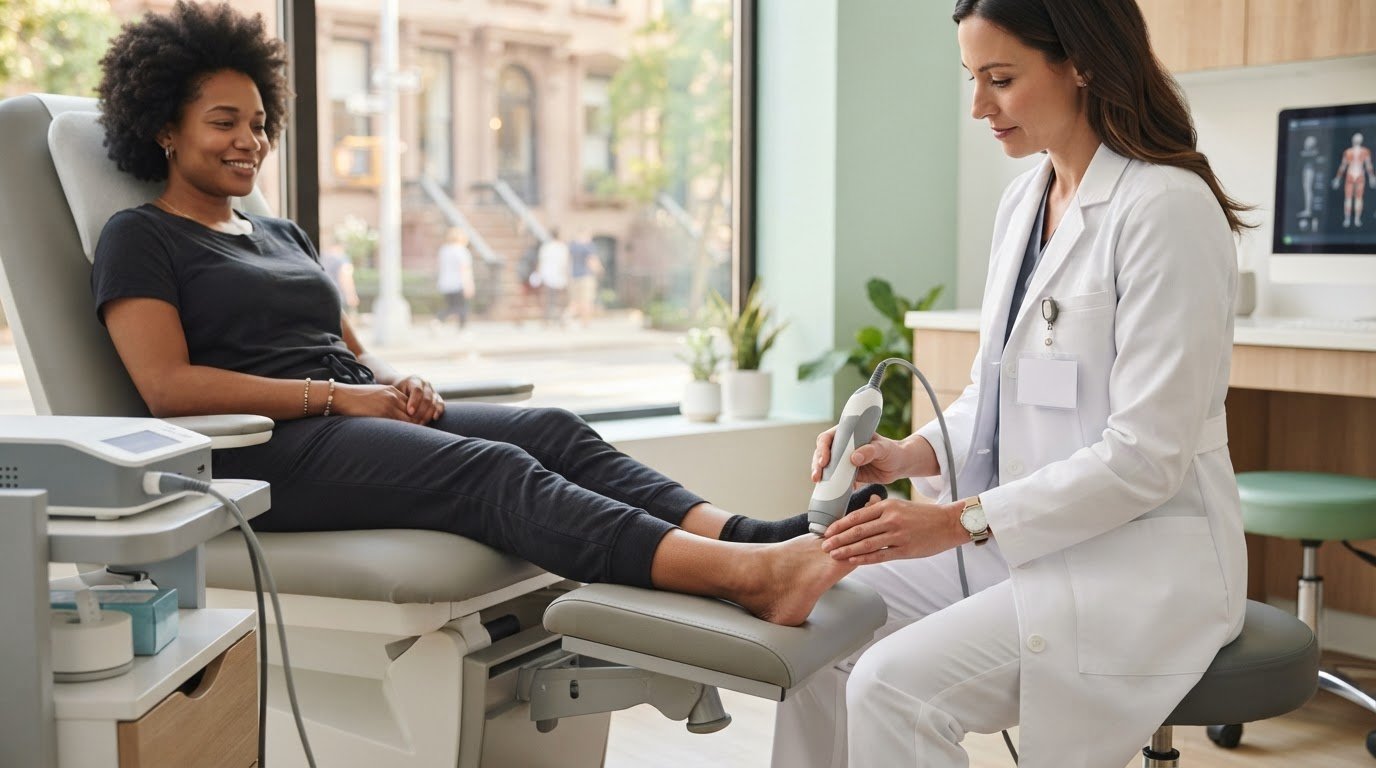
Your clearance appointment at our Brooklyn or Queens offices is a comprehensive evaluation of your readiness for the road. We don’t just check for bone healing on an X-ray; we assess your muscle strength, joint flexibility, and proprioception. If we find that your reaction time or braking force is lagging behind safety standards, we provide targeted physical therapy referrals to help you bridge the gap. This partnership between doctor and patient ensures that you aren’t just guessing about your safety. We prioritize your long-term surgical success and the safety of the community by verifying that your foot can reliably handle the sudden pressure required for an emergency stop in heavy traffic.
Book Your Consultation in Brooklyn or Queens
Regaining your independence is a journey we take together, one step and one mile at a time. With convenient locations in Forest Hills, Astoria, and Woodhaven, accessing expert post-operative care has never been easier for New Yorkers. We invite you into a collaborative healing process where your quality of life and return to activity are our primary metrics of success. Don’t let the anxiety of recovery keep you grounded longer than necessary. Schedule your appointment with Local Foot Doc today and let us help you navigate the road back to full mobility with confidence.
Reclaiming Your Independence on the New York Road
Navigating the transition from recovery to the driver’s seat requires patience and a commitment to safety. We’ve outlined the clinical necessity of the six to eight-week healing window and the specific physical benchmarks you must meet to handle the rigors of city traffic. From passing the “single leg stomp” test to ensuring you have the reaction speed for sudden stops on the LIE, every step is designed to protect your health and your surgical results. Understanding when can I drive after right foot surgery in NYC is about more than just a date on the calendar; it’s about functional readiness.
As a board-certified podiatric surgeon with over 20 years serving the NYC community, Dr. Waldemar Majdanski provides specialized care in sports medicine and bunion recovery to help you heal correctly the first time. We’re dedicated to helping you return to the active lifestyle you love without compromise. If you’re ready to take the next step in your recovery, Book a Consultation with Dr. Majdanski to Discuss Your Surgery Recovery at our Astoria, Forest Hills, or Woodhaven locations. We look forward to seeing you back on the road with confidence.
Frequently Asked Questions
Can I drive with my left foot if I had surgery on my right foot?
Driving with your left foot while your right is recovering is generally unsafe. Most modern vehicles are engineered for right-foot operation of both the gas and brake pedals. Attempting to “cross-pedal” with your left foot often leads to dangerous reaction delays or pedal confusion during emergencies. Unless your vehicle has been professionally modified with a left-foot accelerator, we advise waiting until your right foot is fully cleared for duty.
Is it illegal to drive in a medical boot in New York State?
New York State law doesn’t explicitly ban medical boots, but it does mandate that you must operate your vehicle safely. An officer can cite you for reckless driving if they believe your boot prevents you from braking effectively. Beyond the ticket, your insurance company may use the presence of a boot as grounds to deny coverage if an accident occurs. It’s best to wait for standard footwear clearance.
What happens if I start driving too early after foot surgery?
Driving too soon risks reopening your incision, causing hardware failure, or inducing severe swelling that delays your overall recovery. Physically, you likely lack the necessary emergency braking force required for city life. In the high-density traffic of Brooklyn or Queens, a split-second delay in braking can result in a collision. We prioritize your long-term mobility over the short-term convenience of getting back behind the wheel prematurely.
Will my car insurance cover me if I have an accident while wearing a cast?
Insurance providers often have strict rules about being medically fit to operate a vehicle. If you’re in an accident while wearing a cast or medical boot, your insurer might claim you were driving while physically impaired. This can lead to a complete denial of your claim or significant legal complications. We recommend waiting for a formal written clearance from our team at Local Foot Doc before you return to the road.
How much pain is ‘too much’ when trying to brake?
Any sharp or stabbing pain that causes you to pull back from the pedal is too much. You must be able to apply full, sustained pressure to the brake without any significant discomfort. If you’re wondering when can I drive after right foot surgery in NYC, the answer is only when you can perform a sudden emergency stop without a pain-induced hesitation that could endanger you or other New Yorkers.
Can I drive if I am still taking over-the-counter anti-inflammatories?
You can typically drive while taking standard over-the-counter anti-inflammatories like ibuprofen, provided they don’t cause side effects like dizziness. However, these medications shouldn’t be used to mask pain just so you can operate a vehicle. If you require medication to tolerate the pressure of the brake pedal, your foot hasn’t healed enough to handle the stresses of driving. Pain is a signal that your body isn’t ready.
Does the type of car I drive (SUV vs. Sedan) affect my recovery timeline?
The vehicle type can certainly influence your comfort and ease of entry during recovery. SUVs often have a higher step-in height, which might be challenging if your mobility is still limited. Additionally, heavier vehicles sometimes require more physical force on the brake pedal compared to lighter sedans. We recommend testing your specific vehicle in a stationary position in your Queens or Brooklyn driveway to ensure you can manage the unique pedal resistance.
How do I know if my reaction time is back to normal?
We use functional tests during your follow-up appointments at our Astoria or Forest Hills offices to gauge your readiness. A simple home indicator is the pivot test, where you shift your foot between the gas and brake pedals rapidly without any stutter or pain. If you feel any lag in your brain-to-foot signal or physical hesitation, your reaction time hasn’t returned to its pre-surgical baseline yet.