

Sports Medicine
Sports Medicine Near You
Staying active is an important part of a healthy lifestyle, but repeated exercise and sports activities can place significant stress on your feet and ankles. Pain, stiffness, swelling, or difficulty moving can affect your ability to train, compete, or enjoy your favorite activities. Even without a major injury, repeated strain can gradually lead to problems that require professional attention.
At Local Foot Doc, we provide podiatric care for active patients experiencing foot and ankle concerns. Our podiatrist evaluates your symptoms, activity level, movement patterns, footwear, and medical history to understand what may be affecting your ability to stay active. We then explain your condition and discuss treatment options that fit your needs and goals.

How Sports Can Affect Your Feet and Ankles
Your feet and ankles absorb forces every time you run, jump, change direction, or land. Repeated activity can sometimes place more stress on muscles, tendons, bones, and joints than they can comfortably handle.
Common sports-related concerns include:
Overuse problems
Repeated movements can gradually irritate muscles, tendons, and other tissues.
Sprains and strains
Sudden movements can stretch or injure soft tissues around the foot and ankle.
Stress injuries
Repetitive impact can cause small areas of bone damage over time.
Joint problems
High-impact activity can aggravate existing joint conditions.
Biomechanical issues
The way your feet move can affect how forces travel through your lower body.
When Active Patients Should Seek Care
Not every ache requires immediate treatment, but symptoms that continue or interfere with your activities deserve attention. Continuing to train through significant pain can sometimes make an underlying problem harder to manage.
You may benefit from an evaluation if you have:
Persistent pain
Discomfort continues even after you reduce activity.
Repeated swelling
The same area becomes swollen after exercise or sports.
Movement problems
Pain or stiffness makes normal movement difficult.
Reduced performance
Your foot or ankle symptoms prevent you from performing normally.
Recurring injuries
The same problem keeps returning despite rest.
How We Evaluate Sports-Related Problems
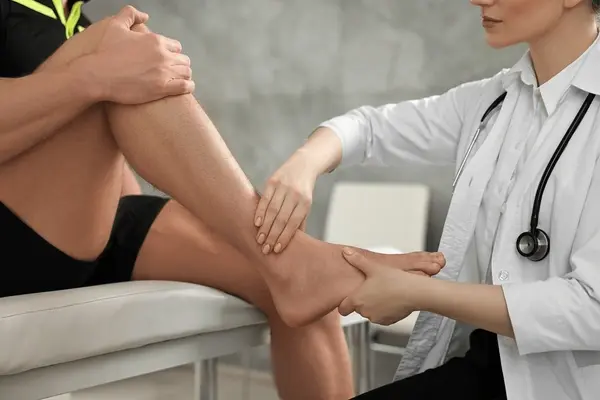
We start by learning how your symptoms developed and what activities may have contributed to them. Your podiatrist may ask about your training schedule, recent changes in activity or footwear, any previous injuries, and the type of sport you participate in.
We also examine the affected foot or ankle and assess strength, flexibility, tenderness, alignment, and range of motion. Imaging may be recommended when necessary to look for a fracture or another structural problem.
Understanding the demands placed on your feet helps us create a more effective treatment plan.
Treatment and Recovery Options
Treatment depends on your specific diagnosis and the demands of your activities. Our goal is not simply to reduce pain, but to help you recover safely and understand how to protect your feet as you return to activity.
Treatment may include:
Activity modification
Temporarily changing training can reduce stress on the injured area.
Physical therapy
Guided exercises can improve strength, flexibility, balance, and movement.
Orthotic support
Custom devices may help manage pressure and improve foot mechanics.
Supportive footwear
Appropriate shoes can provide cushioning and stability during activity.
Medication
Certain medications may help manage pain or inflammation when appropriate.
Gradual return to sports
A step-by-step return can help your body adjust to increasing activity.
Surgical care
Surgery may be considered for select injuries requiring repair.
Reducing Your Risk of Future Problems
Taking care of your feet before and after exercise can support long-term activity. We can help you understand which habits may be appropriate for your condition.
Helpful measures may include:
Proper warm-ups
Preparing your muscles and joints can help ensure safe movement.
Gradual training changes
Increasing activity slowly can reduce sudden stress on your body.
Suitable footwear
Sport-specific shoes can provide support for your chosen activity.
Recovery time
Rest periods give your body time to adapt to training demands.
Locations We Serve
Local Foot Doc provides podiatric care at convenient offices in Brooklyn and Queens.
Howard Avenue Brooklyn Office
Address: 802 Howard Ave 1st Floor, Brooklyn, NY 11212, United States
Phone: (718) 495-3668
Forest Hills Office
Address: 69-39 Yellowstone Blvd, Forest Hills, NY 11375, United States
Phone: (718) 575-3668
Astoria Office
Address: 23-18 Broadway, Long Island City, NY 11106, United States
Phone: (718) 545-0205
Why Choose Local Foot Doc?
At Local Foot Doc, we believe active patients deserve care that considers both their current symptoms and their everyday goals. Our team takes time to explain what may be causing your problem and answer your questions.
You can expect:
Compassionate care
We provide attentive podiatric care in a comfortable and relaxed environment.
Patient education
We explain your condition so you can better understand your treatment.
Personalized attention
Our team considers your activities and individual needs when discussing care.
Open communication
We encourage your questions and input throughout treatment.
Informed decisions
Our podiatrist helps you understand your options so you can participate in your care.
Get Back to the Activities You Enjoy
Foot and ankle problems do not have to mean giving up the activities you enjoy. Our podiatrist can evaluate your symptoms, explain what may be contributing to them, and discuss appropriate care. Contact Local Foot Doc to schedule an evaluation.
FAQs
Can I continue exercising when I have foot pain?
The appropriate activity level depends on the cause and severity of your symptoms, so it is best to have persistent pain evaluated before continuing strenuous exercise.
How can I prevent sports-related foot problems?
Gradual training increases, suitable footwear, proper conditioning, and adequate recovery can help reduce unnecessary stress on your feet.
Do athletes always need custom orthotics?
No, orthotics are not necessary for every athlete; they are recommended when your foot mechanics or symptoms indicate they may be helpful.
When should I see a podiatrist for a sports problem?
Consider an evaluation when pain continues, swelling keeps returning, movement becomes difficult, or an injury prevents you from participating normally.