Imagine walking from the 74th St-Roosevelt Ave station to your favorite dinner spot in Jackson Heights without that sharp, throbbing ache at the base of your toe. For many New Yorkers, the 10,000 steps required to navigate our borough every day have become a grueling endurance test rather than a simple commute. If you’re dreading the walk on hard NYC pavement or struggling to find professional shoes that don’t pinch your feet, you aren’t alone. We understand that the fear of a long, sedentary recovery often keeps people from seeking the help they need. However, modern bunion surgery Queens specialists now utilize advanced techniques in 2026 that can have you back in comfortable shoes much sooner than you might expect.
At Local Foot Doc, we believe your lifestyle shouldn’t be limited by structural foot pain. This guide explores the latest surgical advancements that focus on precision and faster healing. We’ll walk you through the entire process, from the initial 45 minute consultation to your 6 week recovery milestone. You’ll discover how specialized care can eliminate chronic discomfort and help you finally get back on your feet with confidence. Let’s look at exactly how we can restore your mobility and get you back to the active New York life you love.
Key Takeaways
- Learn why the high-impact demands of New York City living, from subway stairs to long commutes, make addressing progressive bunion pain essential for your long-term mobility.
- Compare traditional methods with modern, minimally invasive techniques designed to prioritize smaller incisions and a faster return to your daily routine.
- Identify the specific physical signs and lifestyle limitations-including the “Shoe Test”-that indicate it is time to consider professional bunion surgery Queens.
- Discover the advantage of local expertise with Dr. Waldemar Majdanski, who brings over 20 years of surgical experience to convenient neighborhood locations in Forest Hills, Astoria, and Woodhaven.
- Gain a clear roadmap for your recovery journey, ensuring you have the right preparation and support to get back on your feet and resume your active NYC lifestyle.
Understanding Bunion Pain in the World’s Borough
A bunion is a bony protrusion at the base of the big toe joint that alters foot mechanics. While many people view them as a simple cosmetic bump, our team recognizes Hallux Valgus as a progressive structural deformity. For residents in neighborhoods like Astoria or Forest Hills, this condition isn’t just an eyesore. It is a source of chronic, throbbing pain that can stop you in your tracks. If you are researching What is a bunion?, you will find it involves a complex misalignment where the big toe leans toward the second toe. This shift creates a mechanical imbalance that worsens every time you step onto a subway platform.
Why Bunions Progress Faster for NYC Commuters
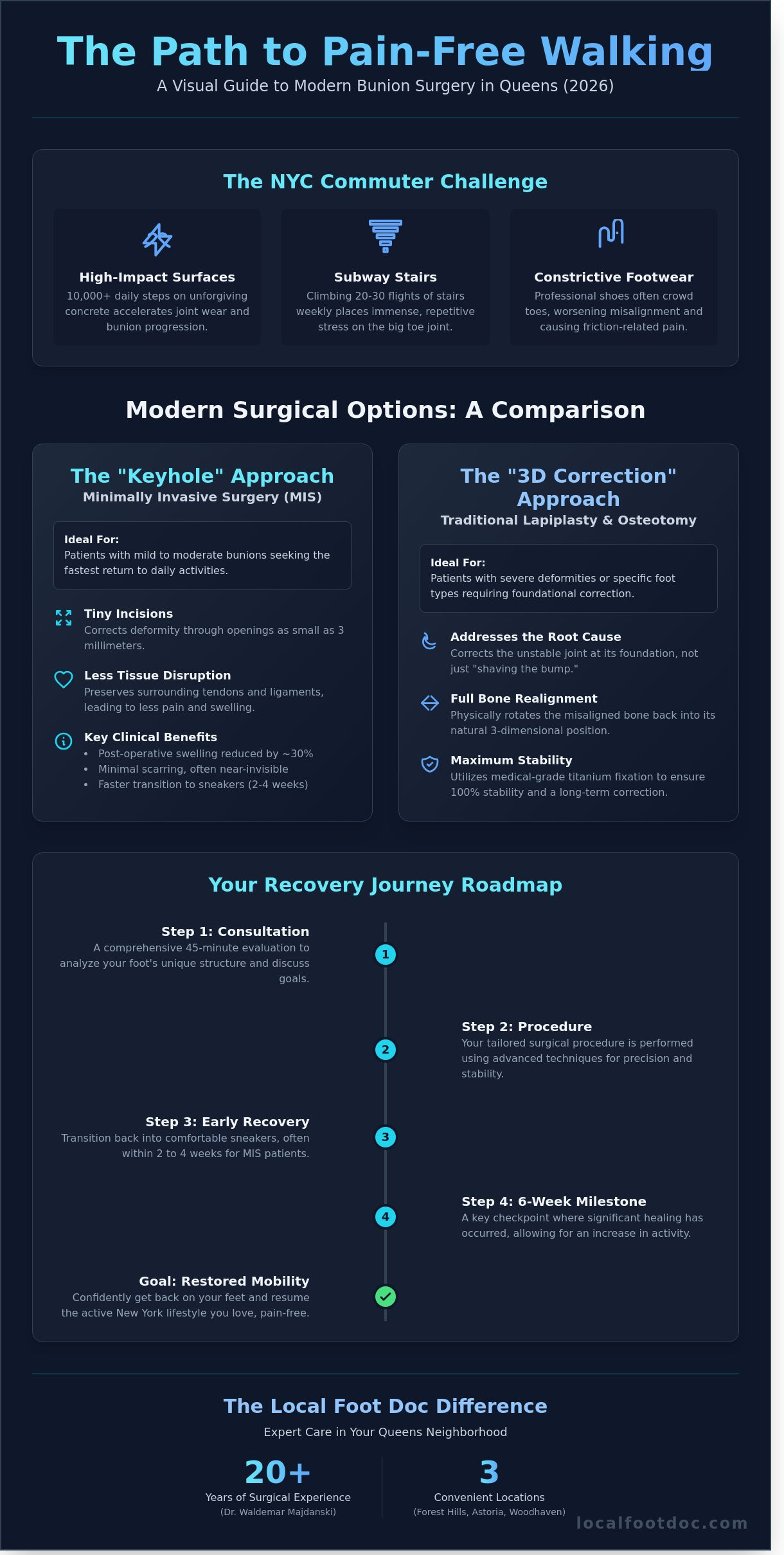
Walking 10,000 steps a day is the standard for a Queens commuter, but doing so on unforgiving concrete sidewalks accelerates joint wear. We see patients whose symptoms have rapidly worsened because of the 20 to 30 flights of subway stairs they climb weekly. When you combine high-impact surfaces with professional footwear that crowds the toes, the joint misalignment speeds up. This often leads to secondary complications. We frequently treat patients for hammertoes or bursitis that developed because they delayed looking into bunion surgery Queens. The constant friction against the side of a shoe eventually causes the joint capsule to thicken, making every block feel longer than the last.
When “Conservative Treatment” Is No Longer Enough
Padding and wider shoes are helpful early on, but they don’t fix the underlying bone structure. There is a specific tipping point where conservative measures fail to provide relief. If your daily activities in NYC are limited because of sharp, burning sensations, it’s time to consider a permanent solution. Custom orthotics can help manage pressure for a few months; however, they cannot reverse the 15 degree or greater angulation often seen in advanced cases. We focus on getting you back on your feet by identifying when bunion surgery Queens is the only way to restore your mobility. Waiting too long often means the deformity progresses to a point where simple movements become a struggle.
Modern Surgical Options: Traditional vs. Minimally Invasive
The field of podiatry has reached a pivotal turning point in 2026. We’ve moved far beyond the outdated approach of simply “shaving the bump,” which often ignored the underlying structural misalignment. Today, bunion surgery Queens focuses on a comprehensive correction of the bone’s position. Our team utilizes advanced fixation technology, including medical-grade titanium screws and plates, to ensure 100% stability. This shift in methodology ensures that once we realign your foot, it stays in that healthy position for the long term. We prioritize techniques that respect your body’s natural anatomy while providing the structural integrity needed for a lifetime of movement.
The Rise of Minimally Invasive Bunion Surgery (MIS)
For many patients at our Forest Hills and Astoria locations, the “keyhole” approach has become the gold standard. Minimally invasive bunion surgery allows us to correct the deformity through incisions as small as 3 millimeters. Because we don’t have to make large openings in the skin, there’s significantly less disruption to the surrounding tendons and ligaments. This precision leads to several clinical benefits:
- Reduced post-operative swelling by approximately 30% compared to open procedures.
- Minimal scarring that often becomes nearly invisible within 12 months.
- A faster transition back into sneakers, often within 2 to 4 weeks.
This technique is ideal for patients with mild to moderate bunions who want to minimize their time away from the office or the gym. It’s about getting you back on your feet with as little downtime as possible.
Traditional Lapiplasty and Osteotomy Procedures
While MIS is revolutionary, severe deformities or specific foot types require a more robust “3D” correction. Dr. Majdanski carefully analyzes your unique biomechanics to see if a Lapiplasty or a traditional osteotomy is necessary. These procedures address the root cause of the bunion by rotating the bone back into its natural alignment and securing it at the foundation. This level of correction is vital for preventing a recurrence 10 or 15 years down the line. We focus on creating a stable, pain-free platform for your entire body. If you’ve noticed your big toe drifting further toward your other toes, it’s time to consult with our Queens podiatrists to find the most effective path forward. We’ll help you choose the procedure that matches your lifestyle and the specific severity of your condition.
Is It Time? Signs You Need Bunion Surgery in Queens
Many patients believe they must wait until their foot pain becomes “unbearable” before considering bunion surgery Queens. This is a common misconception that often leads to avoidable complications. If you find that 600mg of Ibuprofen or standard over-the-counter NSAIDs no longer dull the sharp, throbbing sensation in your big toe joint, your body is signaling that conservative measures have failed. We’ve seen that delaying treatment often results in the bunion pushing against the second toe, creating a cascade of alignment issues throughout the forefoot.
The “Shoe Test” is another practical indicator. If you have visited multiple shops along Austin Street or in Long Island City and can’t find a single pair of professional shoes that don’t cause a burning sensation, the deformity has likely progressed. You should also watch your movement patterns. When you shift your weight to the outer edge of your foot to avoid big toe pain, you change your entire biomechanics. This shift can lead to unexplained aches in your knees or hips within 6 to 12 months of the initial gait change. Many NYC patients who alter their gait to compensate for bunion pain also develop plantar fasciitis heel pain as a secondary condition, since the added stress on the arch and heel can inflame the plantar fascia.
- Persistent swelling that doesn’t subside after 24 hours of rest.
- Inability to bend or straighten the big toe without significant stiffness.
- The appearance of calluses or sores where the first and second toes overlap.
Physical Red Flags and Diagnostic Imaging
In our Queens offices, we utilize weight-bearing X-rays to assess the true severity of the misalignment. This specific imaging is crucial because a foot under pressure reveals the exact intermetatarsal angle. An angle greater than 15 degrees typically indicates a moderate to severe deformity. During your consultation, our team provides an overview of bunion surgery to explain how we realign the bone and address joint inflammation. We also look for signs of cartilage damage or the need for simultaneous hammertoe correction to ensure total foot stability. For patients with diabetes, proper foot care becomes even more critical, as complications can develop rapidly and require specialized attention from professionals who understand diabetic foot care Brooklyn protocols.
The Psychological Impact of Chronic Foot Pain
Chronic pain often shrinks your social world. You might start declining invitations to walk through Flushing Meadows Corona Park or skip a weekend stroll in Astoria Park because you fear the pain that follows. In a city where the average resident walks 3 to 5 miles every day, limited mobility is a major barrier to a fulfilling life. Seeking surgery isn’t just about the physical bone structure; it’s a proactive step toward reclaiming your independence. We’re here to help you stop managing the pain and start fixing the cause so you can get back on your feet with confidence.
The Local Foot Doc Difference: Expert Care in Queens
Choosing where to have your procedure is a major decision that impacts your long-term mobility. Dr. Waldemar Majdanski provides a foundation of trust built on over 20 years of specialized surgical experience right here in New York City. We’ve established our practice as a local institution, operating out of three accessible hubs in Forest Hills, Astoria, and Woodhaven. This geographic footprint ensures you don’t have to trek into Manhattan to receive elite medical standards.
Our “Expert Neighbor” philosophy defines every interaction we have with our patients. We utilize advanced surgical technology and modern techniques, yet we never sacrifice the personal touch that a neighborhood doctor provides. By integrating with leading local surgical centers, we offer a streamlined outpatient experience. Most patients return to the comfort of their own homes just hours after their bunion surgery Queens. We focus on getting you back on your feet quickly, safely, and with the reliability you expect from a long-standing community provider.
Personalized Treatment Plans for Every Patient
We recognize that a marathon runner and a Queens school teacher have vastly different physical demands. Our team tailors every recovery protocol to your specific lifestyle and career requirements. If you’re a commuter navigating the subway stairs to catch the E train, your post-operative plan and activity levels are adjusted to meet those challenges. Because Queens is the world’s borough, we maintain bilingual capabilities to serve our diverse community effectively. We treat you as a collaborator in the healing process, ensuring you understand every milestone of your recovery.
Navigating Insurance and Logistics in NYC
The administrative side of healthcare shouldn’t be a source of stress. Our dedicated staff assists with the complexities of insurance verification and pre-authorizations for all bunion procedures. We’ve strategically located our offices near major transit hubs, including the E, F, M, and R train lines, to ensure accessibility for patients across all five boroughs. Whether you’re coming from a few blocks away or traveling from across the city, we make specialized podiatry reachable. We’re committed to removing the logistical barriers between you and pain-free movement.
Ready to take the first step toward permanent relief? Book your consultation at one of our three Queens locations today.
Preparing for Your Procedure and Getting Back on Your Feet
Deciding to undergo bunion surgery Queens patients rely on is a major step toward reclaiming your mobility. Preparation starts about 14 days before your scheduled date. We require a pre-operative physical exam and specific blood tests to ensure your body is ready for the procedure. Because you cannot drive after receiving anesthesia, you must arrange for a friend, family member, or car service to transport you from our affiliated NYC surgical centers. Our team provides a detailed checklist to ensure your home environment is safe and accessible before you arrive for your 90-minute procedure.
The first 48 hours after surgery focus entirely on pain management and inflammation control. You’ll use a combination of prescribed medication and consistent icing. We utilize advanced surgical techniques that often allow for immediate, protected weight-bearing, but your primary job is to rest. Most patients report that their discomfort peaks within the first 72 hours and steadily declines as they follow our specific elevation guidelines.
These early recovery principles are universal across many types of procedures; for example, the specialists at the Brisbane Hernia Clinic emphasize similar post-operative care for their patients.
The Recovery Timeline: Week by Week
- Week 1-2: You’ll wear a protective surgical boot and keep your foot elevated 80% of the time. For those living in smaller NYC apartments, we recommend clearing all floor clutter and setting up a “recovery station” with chargers, water, and ice packs within arm’s reach.
- Week 3-6: This phase involves transitioning from the boot into wide, supportive sneakers. You’ll begin light stretching exercises to maintain joint flexibility. While you’re moving more, you aren’t quite ready for the long stairs at the 7 train station yet.
- Month 3+: By this point, 95% of patients return to high-impact activities like running or gym workouts. You can finally explore a wider variety of footwear without the throbbing pain of a bunion.
Tips for a Smooth Recovery in a Walking City
Living in Queens means navigating a world built for pedestrians. During the initial 21 days, you should embrace a “car-free” lifestyle by utilizing grocery and pharmacy delivery services. It’s vital that you follow our bunion surgery recovery protocols strictly to avoid swelling from overexertion. We’ll schedule frequent follow-up visits at our Forest Hills or Ridgewood offices to take X-rays and monitor your bone healing. We don’t consider you “subway-ready” until your gait is stable and your strength has returned, which typically happens between weeks 6 and 8. Our goal is to get you back on your feet safely so you can enjoy everything the city has to offer without hesitation.
Take the First Step Toward Lasting Comfort in Queens
You shouldn’t let persistent foot pain dictate your pace in the World’s Borough. Whether you’re walking through Forest Hills or commuting from Astoria, modern medical advancements mean that bunion surgery Queens is more accessible and effective than ever. Our team prioritizes a personalized approach that blends traditional surgical wisdom with minimally invasive techniques to get you moving again. We focus on identifying the underlying cause of your discomfort to ensure the results are both functional and permanent.
Choosing a specialist with deep local roots ensures you receive care that’s both professional and convenient. Dr. Waldemar Majdanski is a board-certified surgeon who brings over 20 years of specialized experience to every patient interaction. With 4+ locations across Queens and Brooklyn, our practice provides the high-level expertise you need without the cold, corporate atmosphere. When selecting the right podiatrist Forest Hills NY residents trust, it’s essential to find someone who combines advanced surgical techniques with personalized care. We’re here to help you resolve the throbbing and stiffness that keeps you sidelined. It’s time to stop managing discomfort and start prioritizing your mobility.
Schedule Your Bunion Consultation in Queens Today
Our team is ready to help you get back on your feet and return to the activities you love with total confidence. For active New Yorkers looking to maintain peak performance after recovery, our comprehensive sports medicine approach for urban athletes ensures you can safely return to running, cycling, and other high-impact activities. Many patients also benefit from addressing other foot concerns during their recovery period, such as seeking professional fungal nail treatment in New York City to ensure their feet look and feel their best. For many, that confidence comes from feeling great from head to toe, and a visit to a premier salon like Hair Bar NYC can be the perfect final step in their recovery journey.
Frequently Asked Questions
How long is the recovery for bunion surgery in Queens?
Recovery from bunion surgery in Queens typically takes 6 to 8 weeks for the initial bone healing phase. During these first 42 days, our team focuses on managing swelling and ensuring the surgical site stabilizes. Most patients return to athletic footwear and high-impact activities within 4 to 6 months. We provide a customized timeline based on your specific procedure to ensure you’re safely getting back on your feet.
Is bunion surgery covered by insurance in NYC?
Yes, most major NYC insurance providers, such as Empire BlueCross BlueShield and UnitedHealthcare, cover the procedure when it’s deemed medically necessary. If your bunion causes persistent pain or limits your mobility, it’s rarely considered cosmetic. About 90% of our patients utilize insurance benefits to cover the costs. We’ll verify your specific plan’s deductible and co-pay requirements during your initial consultation at our office.
Can I walk immediately after bunion surgery?
You can often walk immediately after your procedure using a specialized post-operative boot or surgical shoe. Modern techniques allow for weight-bearing within 24 hours for many patients. While you won’t be running marathons yet, this early mobility prevents stiffness and promotes circulation. Our surgeons will guide your first steps in the clinic to ensure you’re comfortable and stable before you head home to recover.
What is the success rate of minimally invasive bunion surgery?
Minimally invasive techniques boast a success rate between 85% and 95% for patient satisfaction and deformity correction. Studies from the American College of Foot and Ankle Surgeons show that these small-incision methods reduce scarring and post-operative pain. Because we use 3mm incisions instead of traditional 5cm openings, the risk of infection drops by 50%. This advanced technology ensures a faster return to your daily NYC lifestyle.
Will my bunion come back after surgery?
Bunions return in fewer than 10% of cases when the correct surgical procedure is performed and post-operative instructions are followed. Recurrence often happens if the underlying bone structure wasn’t properly realigned or if patients return to narrow shoes too quickly. We use 3D imaging to select the most stable correction method for your foot type. Wearing custom orthotics after surgery can further reduce the risk of recurrence.
How do I choose the best podiatrist for bunion surgery in Queens?
Choose a podiatrist who is board-certified by the American Board of Foot and Ankle Surgery and performs at least 50 bunion procedures annually. Look for a local practice that offers both traditional and minimally invasive options. It’s important to find a team that prioritizes personalized care and has a high volume of positive local reviews. Our office combines decades of experience with a neighborly approach to help you feel confident.
What happens if I leave my bunion untreated?
Leaving a bunion untreated leads to progressive joint degeneration and a 70% higher risk of developing hammertoes in adjacent digits. As the big toe leans inward, it forces the other toes out of alignment and destroys the protective cartilage in the joint. This often results in chronic bursitis or secondary metatarsalgia. Addressing the issue early prevents these permanent structural changes and keeps you active in your community.
How much does bunion surgery cost in New York City?
The cost of bunion surgery in Queens typically ranges from $3,000 to $15,000 depending on the complexity of the correction. This total includes the surgeon’s fee, facility costs, and anesthesia services. Since we accept most local insurance plans, your out-of-pocket expenses may only include your standard specialist co-pay or deductible. We provide a transparent cost breakdown after your physical exam so there aren’t any financial surprises.