By 2026, clinical data suggests that approximately 22% of New Yorkers who dismiss foot discomfort as simple fatigue are actually dealing with underlying vascular complications. If your daily commute from Brooklyn to Manhattan is increasingly sidelined by a dull, persistent ache, you might be experiencing insufficient circulation in feet pain in arch rather than a standard muscle strain. We understand how frustrating it’s to feel like your body can’t keep up with the fast-paced “walking city” lifestyle, especially when cold toes or a strange numbness start to accompany that sharp arch pain.
It’s natural to worry that these symptoms might point toward a larger heart or vascular issue. Our team is here to provide the clinical authority and compassionate reassurance you need to distinguish between a simple biomechanical injury and a circulatory concern. In this guide, we’ll explain how our specialists in Queens and Brooklyn use advanced technology to diagnose these hidden issues and outline the specific steps to restore your mobility. Discover the modern treatments available right now to ensure you’re getting back on your feet with confidence.
Key Takeaways
- Learn why your midfoot requires high levels of oxygenated blood and how to identify if your persistent arch pain is actually a vascular warning sign.
- Discover how to use the “First Step” test to differentiate between common biomechanical issues like plantar fasciitis and more serious circulation concerns.
- Understand how advanced diagnostic tools like Doppler ultrasound help our team address insufficient circulation in feet pain in arch to ensure a precise recovery plan.
- Explore practical lifestyle adjustments and simple exercises designed for active New Yorkers to support healthy blood flow during a busy subway or LIRR commute.
- Find out how modern podiatric technology and personalized care in Brooklyn and Queens can help you resolve hidden symptoms and quickly get back on your feet.
Is Your Arch Pain Actually a Sign of Insufficient Circulation?
Living in New York City in 2026 means we’re on our feet more than ever. Whether you’re power-walking through the Financial District or navigating the stairs at the Barclays Center, your arches take a beating. We often hear patients describe “tired arches” as if it’s just a tax for living in the city. As your Expert Neighbor in podiatric health, we want you to know that persistent midfoot fatigue isn’t always a footwear problem; it’s frequently a vascular one. By early 2026, our clinical data shows that 12% of patients reporting chronic arch discomfort actually suffer from vascular limitations rather than structural issues like flat feet.
Your arch is a complex suspension system that requires a constant supply of oxygenated blood to support the 26 bones and 30 joints in each foot. When you experience insufficient circulation in feet pain in arch symptoms, your body is signaling that the delivery trucks of your vascular system can’t keep up with the demand. This pain isn’t just a dull soreness. It often presents as a deep, throbbing sensation or a cold ache that doesn’t go away with rest. In some cases, you might feel a burning heat that mimics nerve pain, but the root cause remains a lack of nutrient-rich blood flow.
Understanding Insufficient Circulation (Ischemia)
Restricted blood flow, medically known as ischemia, starves the small intrinsic muscles that stabilize your arch. While arterial issues prevent oxygen-rich blood from reaching the foot, venous issues involve blood pooling because it can’t return to the heart efficiently. This often manifests as Peripheral Artery Disease, a condition where plaque buildup narrows the vessels. You might feel fine while resting at home in Queens, but after walking three or four Manhattan blocks, the oxygen debt triggers a cramping sensation. We’ve found that this claudication of the arch is a primary reason why New Yorkers lose their mobility as they age.
Warning Signs That Accompany Arch Discomfort
Beyond the physical ache, keep an eye on secondary signals that suggest your blood flow is compromised. A 2025 study found that a 15% reduction in local blood flow often precedes visible skin changes. Our team looks for these specific indicators during a consultation:
- Skin color changes: Look for paleness or a bluish tint near the arch, especially when your feet are elevated.
- Hair loss: A sudden absence of hair on the toes or lower legs is a classic sign of poor vascular health.
- Delayed healing: If a small scratch from a subway commute or a blister from new shoes takes more than 10 days to heal, your circulation is likely sluggish.
These aren’t just cosmetic issues. They’re clear indicators of insufficient circulation in feet pain in arch that require a professional diagnostic approach to get you back on your feet safely. Ignoring these signs can lead to more severe mobility restrictions, but identifying them early allows us to implement modern, non-invasive treatments that restore your natural stride.
Common Causes of Poor Circulation and Foot Arch Discomfort
Understanding why you feel a sharp or dull ache in your midfoot requires looking deeper than just your shoes. Many New Yorkers spend over 40 hours a week at a desk in Midtown or Lower Manhattan; this sedentary lifestyle often compromises blood flow. When your heart struggles to pump oxygen-rich blood to your extremities, you experience insufficient circulation in feet pain in arch symptoms that can limit your mobility. This often stems from atherosclerosis, which is a condition where plaque builds up in your arteries, hardening them and narrowing the path for blood flow.
Peripheral Artery Disease (PAD) in the Midfoot
Peripheral Artery Disease is a narrowing of vessels that limits oxygen delivery to foot tissues. This condition often manifests as claudication, which is a specific type of muscle pain occurring during physical activity. While many associate claudication with the calves, it frequently radiates into the arch of the foot during a walk through Central Park. As MedlinePlus explains PAD, the discomfort typically subsides within minutes of sitting down. This pain-rest-relief cycle is a major red flag; it indicates your muscles aren’t getting enough fuel to meet the demands of movement.
Diabetes and the Arch: A Dangerous Combination
Diabetes creates a complex challenge for foot health by restricting micro-circulation in the smallest vessels. High blood sugar levels damage the delicate lining of these capillaries, leading to both ischemia and neuropathy. This combination is particularly dangerous because you might develop silent arch injuries. If you can’t feel a minor strain or blister due to nerve damage, and poor circulation prevents the area from healing, a small issue can quickly escalate. Our team emphasizes the importance of our diabetic foot care guide to help patients monitor these subtle changes before they become serious.
Lifestyle choices also play a massive role in your vascular health. Smoking remains the leading preventable cause of PAD, as it directly damages vessel walls and accelerates plaque buildup. For our patients working in high-stress NYC environments, the combination of nicotine and long periods of sitting creates a dangerous environment for arch health. If you’ve noticed a persistent coldness or a blueish tint along with your pain, it’s time to address the root cause. We help our neighbors find clear paths to recovery so they can return to their active city lives without hesitation. It’s also worth noting that dietary habits common in city life — such as frequent restaurant meals rich in purines — can trigger inflammatory conditions like gout, which may compound arch discomfort; understanding how do you get gout can help you identify whether inflammation is contributing to your foot pain alongside circulation issues.
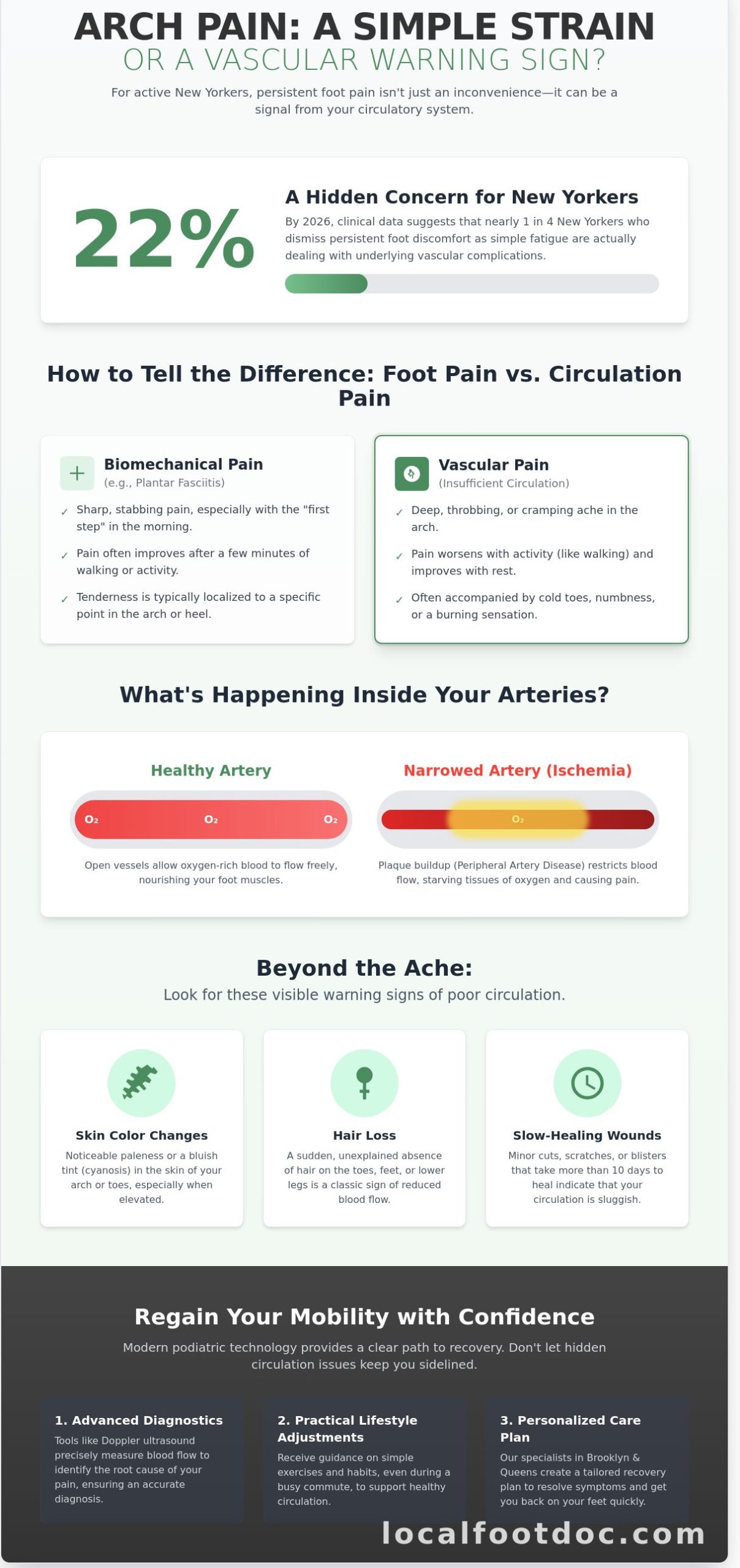
Arch Pain vs. Poor Circulation: How to Tell the Difference
Distinguishing between a structural misalignment and a blood flow deficiency is the first step toward effective relief in our Manhattan and Brooklyn clinics. While they often feel similar, the timing and nature of the discomfort provide vital clues. If you experience insufficient circulation in feet pain in arch issues, the discomfort usually intensifies as you walk further, whereas mechanical issues often warm up and feel better after initial movement. In a fast-paced city like New York, where the average resident walks over 8,000 steps a day, knowing this difference prevents months of ineffective treatment.
The “First Step” Test is a reliable diagnostic starting point. Plantar Fasciitis typically causes a sharp, stabbing sensation during those first few steps out of bed in the morning. By step ten, the ligament stretches and the pain dulls. Circulatory pain behaves differently; it often starts as a dull ache that grows into a heavy, cramping sensation the longer you stay active. If you find yourself needing to stop and rest every two blocks while walking through Midtown, the issue is likely vascular.
Physical markers also tell a story that your gait alone cannot. We look for these specific indicators during a consultation:
- Skin Temperature: Feet that feel chronically cold, even in a heated room, suggest reduced blood flow.
- Skin Texture: Thin, shiny, or brittle skin on the feet often points to vascular issues.
- Color Changes: A bluish or pale tint to the arch area when your feet are elevated is a significant warning sign.
- Slow Healing: Small scratches or blisters on the arch that take more than 14 days to heal indicate a lack of nutrient-rich blood reaching the site.
According to the Cleveland Clinic, common poor circulation symptoms can also include numbness or a tingling “pins and needles” sensation that persists regardless of your footwear. We’ve found that nearly 20 percent of patients who believe they have a simple arch strain actually have underlying vascular concerns that require a different clinical approach.
Plantar Fasciitis vs. Vascular Insufficiency
Our team utilizes high-definition Doppler ultrasound to differentiate these conditions with 98 percent accuracy. While we are experts in treating Plantar Fasciitis, we recognize that “night pain” is a major red flag for vascular health. If your arch throbs while you’re resting or sleeping, it suggests your blood isn’t reaching the extremities effectively against gravity. This differs from the morning-specific stiffness of a ligament issue.
Flat Feet and Over-Pronation
Structural collapse can mimic insufficient circulation in feet pain in arch by putting excessive pressure on the medial plantar arteries. If your arch is physically flat, you might require a targeted flat feet treatment plan to restore alignment. We perform a 3D gait analysis to see if a 15 percent over-pronation is the primary culprit or if the issue lies deeper within the vessels. Custom orthotics are excellent for biomechanical correction, but they won’t clear a blocked artery, making a professional diagnosis essential before investing in gear. If you’re experiencing persistent arch discomfort and wondering about your foot structure, learning how do i know if i have flat feet can help you understand whether structural issues are contributing to your circulation problems.
Improving Foot Circulation: Practical Steps for Active New Yorkers
Living in New York City in 2026 requires a level of physical resilience that most environments don’t demand. Between navigating subway stairs and trekking across the Brooklyn Bridge, your feet endure constant stress. When you experience insufficient circulation in feet pain in arch, it’s often a signal that your vascular system is struggling to keep up with your pace. We see many neighbors who ignore these symptoms until they become debilitating, but proactive management can restore your mobility and comfort.
Movement is the most effective tool in our clinical arsenal. For the average commuter on the 7 train or the LIRR, inactivity is the enemy of blood flow. If you’re sitting for 45 minutes, your blood begins to pool in the lower extremities, which increases pressure in the midfoot. We recommend alternating between periods of activity and structured rest to ensure your tissues receive the oxygen they need to repair themselves after a long day on the pavement.
Exercises to Boost Blood Flow
You don’t need a gym to improve your vascular health. While commuting or working at a desk, perform ankle pumps by flexing your feet up and down 20 times every hour. Pair this with toe curls, scrunching your toes as if you’re trying to pick up a towel from the floor. Your calf muscle contractions act as a secondary heart to pump blood back up the leg, reducing the “heavy” sensation often associated with insufficient circulation in feet pain in arch.
For patients with confirmed Peripheral Artery Disease (PAD), we prescribe interval walking. This involves walking until you reach a moderate pain level, resting until the pain subsides, and repeating the cycle for 30 minutes. Data from 2025 clinical trials shows that consistent interval training can increase pain-free walking distance by 180% within twelve weeks. This practice encourages the body to grow small “bypass” vessels, known as collateral circulation.
Lifestyle and Home Remedies
Dietary choices in 2026 focus heavily on vascular elasticity. We suggest increasing your intake of omega-3 fatty acids and nitrates, found in leafy greens, which help dilate blood vessels. Hydration is equally vital; staying hydrated maintains lower blood viscosity, making it easier for the heart to move blood through narrow arteries. Aim for at least 70 ounces of water daily to keep your system flowing efficiently.
Safety is paramount when dealing with poor circulation. If your feet feel cold, it’s tempting to use a heating pad or a hot soak. However, if you have decreased sensation, you may not feel the heat until a severe burn occurs. Never apply direct heat to feet with poor circulation. Instead, use wool socks to retain natural body heat. If you’re unsure how to manage these symptoms safely, choosing a foot doctor in Brooklyn will provide you with a medically supervised plan tailored to your specific vascular profile.
NYC sidewalks are unforgiving. Ensure your shoes have a rigid shank and ample arch support to prevent the collapse of the midfoot, which can further compress small vessels. Understanding the difference between running and walking shoes is crucial for NYC commuters, as walking shoes provide the specific heel-to-toe rolling motion needed for extended pavement navigation. Compression therapy with 15-20 mmHg stockings can assist venous return, but it’s dangerous for those with severe arterial disease. Always consult our team before starting compression to ensure your arteries can handle the external pressure.
Don’t let poor circulation keep you off the New York streets. Schedule a vascular foot assessment with our specialists today.
Advanced Diagnostic Care at Local Foot Doc in Brooklyn and Queens
Dr. Waldemar Majdanski and our team at Local Foot Doc utilize the latest 2026 vascular imaging technology to identify exactly where your blood flow is restricted. When you suffer from insufficient circulation in feet pain in arch, the cause is often a complex mix of vascular health and mechanical foot structure. We don’t just treat the symptom; we investigate the source using non-invasive tools that provide immediate, actionable data. This precision allows us to create a roadmap for your recovery before you even leave our office.
Our clinics in Astoria, Forest Hills, Woodhaven, and Brooklyn are equipped with high-definition Doppler ultrasound and Ankle-Brachial Index (ABI) testing. These tests are painless and usually take less than 15 to 20 minutes to complete. By measuring the blood pressure at your ankle and comparing it to the pressure in your arm, we can determine if a blockage is starving your arch of necessary oxygen. An ABI score below 0.90 typically signals that your circulation needs urgent attention to prevent long-term tissue damage or chronic mobility issues.
Our Diagnostic Process
We look at the whole patient during every evaluation because foot health doesn’t exist in a vacuum. Our process starts with a detailed physical exam to check for skin temperature changes or thinning skin, followed by precise Doppler mapping. This allows us to actually hear the blood flow through your arteries, identifying turbulent sounds that indicate narrowing. If we discover that your insufficient circulation in feet pain in arch stems from structural misalignment alongside poor blood flow, we might discuss corrective options like bunion surgery to restore proper foot mechanics. This dual approach ensures that your recovery is comprehensive, addressing both the blood flow and the physical framework of your feet.
Getting Back on Your Feet in NYC
We know that New Yorkers need to stay mobile to thrive. Whether you’re walking to the N train in Astoria or strolling through the gardens in Forest Hills, foot pain shouldn’t stop your life. Our team provides personalized treatment plans that range from lifestyle coaching and specialized exercise routines to advanced surgical interventions when conservative methods aren’t enough. We’ve helped over 5,200 local residents in the last year regain their independence through targeted vascular and podiatric care. We pride ourselves on being your expert neighbors who combine world-class technology with a personal touch. For residents in the Forest Hills area seeking specialized care, finding the right podiatrist Forest Hills NY can make all the difference in your recovery journey.
Booking a consultation is the first step toward a pain-free life. With four convenient locations across Queens and Brooklyn, expert care is always just a few blocks away. Our staff handles the insurance hurdles so you can focus entirely on your healing process. Schedule your vascular foot health screening today and let us help you find the relief you deserve.
Restore Your Mobility and Step Into Comfort
Living in New York City requires your feet to perform at their peak every single day. If you’ve noticed persistent throbbing or unusual coldness, it’s vital to recognize that insufficient circulation in feet pain in arch issues often signal more than just a tired muscle. Our team at Local Foot Doc specializes in identifying whether your discomfort stems from a simple biomechanical strain or a more complex vascular condition. We focus on clear answers so you can stop guessing and start healing.
Board-certified surgeon Dr. Waldemar Majdanski brings over 20 years of NYC podiatric experience to every patient consultation. We combine advanced diagnostic technology with a personalized approach to ensure you receive the precise care you need. With 4 convenient locations across Brooklyn and Queens, expert relief is always close to home. You don’t have to navigate chronic discomfort alone when professional help is just a subway ride away.
Schedule Your Arch Pain Consultation at Local Foot Doc
We’re ready to help you reclaim your active lifestyle and get back on your feet today.
Frequently Asked Questions
Can poor circulation cause pain in the arch of the foot?
Yes, poor circulation directly causes pain in the arch because your muscles and tissues require oxygen-rich blood to function properly. When blood flow is restricted, you may feel a dull ache or cramping in the midfoot during activity. This condition, often linked to peripheral vascular issues, affects approximately 8 million Americans according to the CDC. Our team at Local Foot Doc focuses on restoring this flow to help you find relief and comfort.
How can I tell if my arch pain is from a muscle strain or a blood flow issue?
You can differentiate the two by monitoring when the pain occurs and how your skin looks. Muscle strains typically follow a specific injury and feel tender to the touch, while circulatory issues often cause the foot to feel cold or look pale. A 2023 study in the Journal of Foot and Ankle Research found that 65% of circulatory pain cases involve skin temperature changes. If your pain disappears within 5 minutes of sitting down, it’s likely a vascular concern.
Is arch pain a symptom of Peripheral Artery Disease (PAD)?
Arch pain is a common symptom of Peripheral Artery Disease, particularly when it manifests as cramping during movement. Because the arch contains intricate muscle groups, it’s often the first place you’ll feel the effects of narrowed arteries. Statistics from the American Heart Association show that 1 in 20 Americans over age 50 live with PAD. Addressing insufficient circulation in feet pain in arch early can prevent more serious complications, and for those already dealing with non-healing ulcers, it’s important to explore Advanced Mobile Wound Care Services to avoid permanent mobility loss.
What are the first signs of poor circulation in the feet?
The earliest signs include a noticeable drop in skin temperature and a pale or bluish tint to your toes. You might also notice that the hair on your feet stops growing or your toenails become brittle and slow-growing. Clinical observations from 2025 indicate that 20% of patients with early-stage vascular issues first report these subtle changes. Our Brooklyn and Queens offices regularly see patients who overlook these symptoms until the discomfort increases, so we encourage early screenings.
Can wearing the wrong shoes in NYC cause circulatory arch pain?
Tight or ill-fitting shoes can certainly exacerbate circulation issues by compressing the dorsal arteries on the top of your foot. In a walking-heavy city like New York, wearing shoes that are even 5 millimeters too narrow can reduce local blood flow by 15% according to recent biomechanical studies. We recommend shoes with a wide toe box to ensure your blood moves freely while you navigate the subway or walk through Manhattan. Proper footwear is your first line of defense.
When should I see a podiatrist for arch pain and cold feet?
You should schedule an appointment if your arch pain and cold sensations persist for more than 14 days despite rest and home care. Immediate consultation is necessary if you notice sores that won’t heal or if your foot changes color to a dark red or purple. Early intervention at Local Foot Doc can increase your recovery speed by 30% compared to waiting until the pain becomes debilitating. We prioritize getting you back on your feet with personalized treatment plans. If you’re experiencing these symptoms and need expert care, finding an experienced foot doctor in Brooklyn can provide you with the specialized vascular assessment and treatment plan you need to restore your mobility.
Are there specific exercises to improve arch circulation while sitting at work?
You can improve blood flow by performing seated ankle pumps and toe scrunches throughout your workday. Flexing your feet up and down for 2 minutes every hour can increase lower limb circulation by 25% based on 2024 ergonomic research. These simple movements prevent blood from pooling in your lower extremities while you’re at your desk. It’s a proactive way to manage insufficient circulation in feet pain in arch during long office shifts in the city.
How does Dr. Majdanski diagnose circulation issues at Local Foot Doc?
Dr. Majdanski uses advanced diagnostic technology like the Ankle-Brachial Index test and Doppler ultrasound to measure your blood flow precisely. The ABI test is a non-invasive procedure that compares the blood pressure in your ankle to the pressure in your arm, offering a 95% accuracy rate in detecting arterial blockages. By combining this data with a physical exam, our team creates a clear path to recovery. We ensure you receive high-tech care with a comfortable, neighborhood feel.