Last Tuesday, a patient arrived at our Manhattan office after a grueling ten block walk from Grand Central Terminal, forced to limp because a stiff, curled toe joint made every step feel like pressing against a jagged stone. If you find yourself dreading the daily commute or struggling to squeeze into professional shoes due to painful friction and corns, you aren’t alone. We understand that in a city where walking 10,000 steps is a daily baseline, effective hammertoe correction isn’t just a cosmetic preference; it’s a medical necessity for your independence.
We believe that your mobility should never be sidelined by chronic foot pain. This 2026 guide details the most effective non-surgical and surgical options tailored specifically for the high-impact lifestyle of a New Yorker. We’ll examine everything from advanced custom orthotics to the latest minimally invasive procedures designed to straighten your toes and ensure you can return to your favorite fitness classes or weekend gallery walks without hesitation. Our team is here to provide the expert, local guidance you need to finally stop managing the pain and start getting back on your feet.
Key Takeaways
- Learn why New York City’s high-mileage lifestyle demands early intervention for toe deformities to prevent long-term mobility issues.
- Explore non-surgical management strategies, including the strategic use of orthotics and splints, to alleviate stiffness and delay the need for surgery.
- Gain insights into modern hammertoe correction procedures like tendon transfers that offer permanent relief through minimally invasive, outpatient techniques.
- Simplify your path to care by understanding how to navigate insurance authorizations and select a trusted specialist in neighborhoods like Forest Hills or Woodhaven.
- Follow a detailed six-week recovery roadmap tailored for NYC commuters, ensuring you know exactly when you can safely return to the subway and your daily routine.
Understanding Hammertoe Correction in the NYC Context
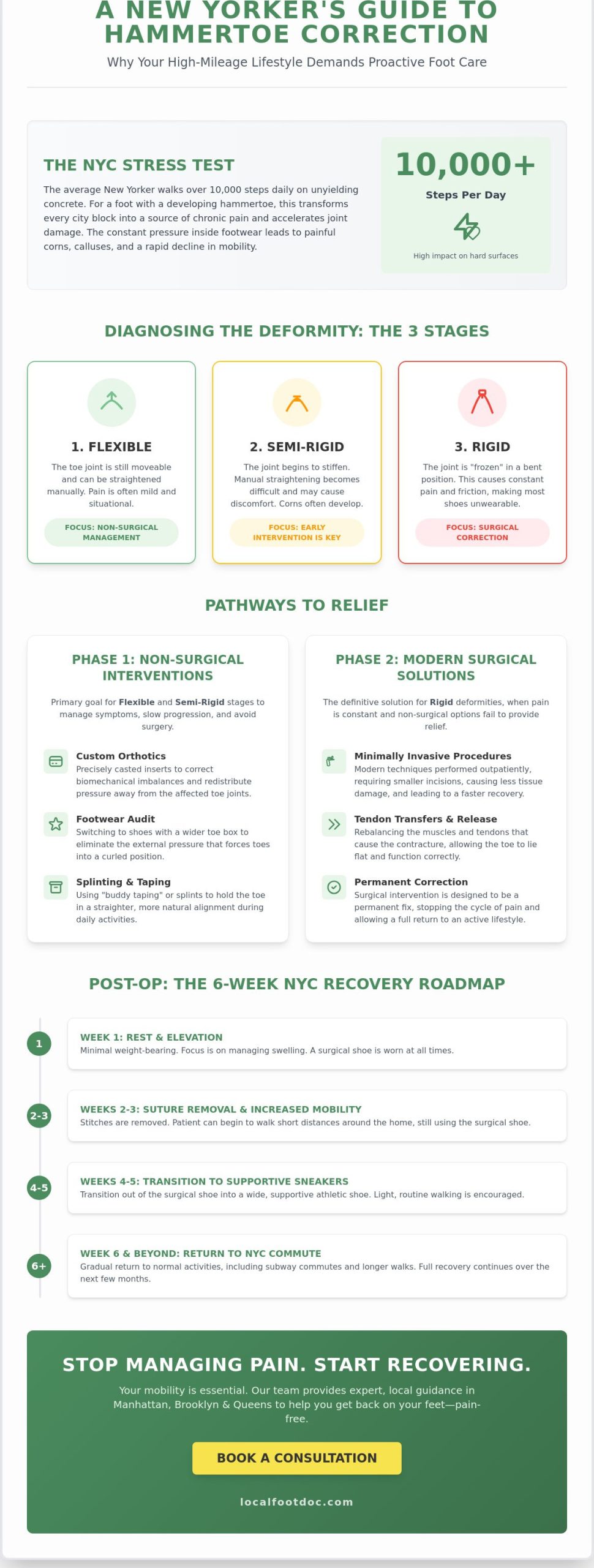
Hammertoe correction isn’t a single procedure; it’s a comprehensive spectrum of care ranging from custom orthotics to advanced surgical intervention. In our practice, we define a hammertoe as a contracture of the toe joints caused by muscle imbalance. While this might seem like a minor cosmetic concern in other cities, the NYC lifestyle transforms it into a significant health hurdle. New Yorkers often clock over 10,000 steps a day on relentless concrete. When your toe is stuck in a curled position, every block from Grand Central to Prospect Park increases the pressure on the joint. For a comprehensive overview of hammertoe causes and symptoms, understanding the biomechanical shift is essential. We categorize these deformities into three distinct stages: flexible, semi-rigid, and rigid.
The urgency of seeking hammertoe correction often depends on how much the condition interferes with your daily commute. In a city where your feet are your primary mode of transportation, even a 15 percent loss in toe flexibility can lead to compensatory pain in the ankles and knees. Our team focuses on identifying the root cause of the imbalance to prevent the deformity from progressing through these stages.
Flexible vs. Rigid: Why Timing Matters
Early intervention is the key to avoiding the operating room. During the flexible stage, your toe still moves at the joint, meaning we can often achieve hammertoe correction using non-invasive methods like splinting or custom-molded inserts. These tools help realign the tendons before they permanently shorten. However, the transition to a rigid deformity happens faster than most patients realize. The constant impact on NYC pavement accelerates joint stiffness, eventually leading to a “frozen” state. Once the joint is rigid, the soft tissues have tightened so much that manual manipulation no longer works; at this point, surgical realignment becomes the primary path to relief.
The Role of Footwear in Brooklyn and Queens
Our team frequently sees a direct correlation between the narrow shoes favored in professional circles and the development of these contractures. High heels and tight toe boxes force the smaller toes into a cramped, “hammered” position for hours. This pressure doesn’t just affect the toe itself. It often leads to pain on the side of the foot as your gait shifts to compensate for the discomfort. When you visit us in Brooklyn or Queens, our “Expert Neighbor” approach begins with a thorough footwear audit. We analyze your daily walking shoes to identify the specific friction points that are driving the deformity. Changing your shoes is the first step toward reclaiming your mobility and getting back on your feet without pain.
- Flexible: The toe can still be straightened manually.
- Semi-Rigid: The toe is beginning to harden and is difficult to move.
- Rigid: The joint is “frozen” in a bent position and causes constant friction against shoes.
Non-Surgical Correction: Managing Symptoms at Home
For many New Yorkers, the first sign of a problem is a subtle stiffness in the second, third, or fourth toe. While the ultimate goal is hammertoe correction, surgery isn’t always the first step. We focus on conservative measures that slow the progression of the deformity and keep you moving through your daily commute without burning pain. Effective management starts with reducing the friction that causes secondary issues like corns and calluses. These painful skin buildups often form on the tops of the toe joints or the tips of the toes where they rub against shoe leather.
Our team recommends a combination of mechanical aids to realign the digits during activity. Toe spacers and silicone crest pads can help keep the toes in a more natural, neutral position. Hammertoe splints or “buddy taping” can also provide temporary relief by preventing the toe from curling upward. Our approach aligns with the latest clinical review of hammertoe treatment, which emphasizes conservative management as the primary defense against worsening joint contracture.
Custom Orthotics and Biomechanical Support
At our Queens and Brooklyn offices, we go beyond over the counter inserts. We use a precise casting process to create custom orthotics designed for your specific foot structure. These medical grade devices redistribute pressure away from the ball of the foot, where 75% of hammertoe related pain typically originates. By supporting the arch and stabilizing the midfoot, orthotics address the underlying muscle imbalance that pulls the toe into a curled position. This proactive support is vital for patients who also manage diabetic foot care in Brooklyn, as neuropathy can make it difficult to feel the friction that leads to dangerous ulcers.
Physical Therapy and Stretching Exercises
Keeping the tendons flexible is essential for successful hammertoe correction without an operating room. We often prescribe specific “intrinsic” muscle exercises to strengthen the foot. You can perform these at home in just 10 minutes a day:
- Towel Curls: Place a hand towel on the floor and use only your toes to scrunch it toward you.
- Marble Pickups: Use your toes to grab marbles and move them from the floor into a small bowl.
- Extensor Stretching: Gently pull the affected toe downward to stretch the tight tendons on the top of the foot.
It’s important to understand the limitations of these methods. Conservative care is highly effective for “flexible” hammertoes, where the joint can still be straightened by hand. However, once the deformity becomes “rigid,” the joint is essentially locked in place by scar tissue or bone changes. If you find that you can no longer flatten your toe even with pressure, it may be time to consult with our specialists about more permanent solutions.
Surgical Hammertoe Correction: Modern Procedures and Techniques
Dr. Waldemar Majdanski performs advanced, outpatient surgical procedures designed to fix toe misalignments that no longer respond to conservative care. Our approach to hammertoe correction focuses on restoring the natural anatomy of your foot while minimizing downtime. We perform these procedures in a sterile, modern environment, allowing most patients to return home the same day. According to a comprehensive review of hammertoe deformities, surgical intervention is highly successful when the structural imbalance leads to chronic pain or skin breakdown. We tailor every technique to the specific flexibility of your toe and your daily activity levels.
Tendon Re-routing: Restoring Balance
For flexible deformities, where the toe can still be straightened by hand, we often utilize tendon transfer or re-routing. This procedure involves moving a tendon from the bottom of the toe to the top, creating a pulley system that pulls the toe into a flat, functional position. This is a primary choice for younger patients or those we treat in our sports medicine department. By balancing the muscle forces, we help you maintain the agility needed for jogging in Central Park or navigating a busy Manhattan commute. It’s an elegant solution that preserves joint motion while correcting the “clawing” effect.
Joint Fusion and Implants
When a toe becomes rigid and cannot be straightened manually, a more definitive hammertoe correction is necessary. We may perform an arthroplasty, which involves reshaping the joint by removing a small portion of bone to allow the toe to lay flat. In more advanced cases, we recommend arthrodesis, or joint fusion. Our team removes the damaged joint surfaces and allows the bones to heal together into a single, stable unit. While this makes the small joint of the toe stiff, a straight, pain-free toe is a significant upgrade over a curled, “throbbing” one that rubs against your shoes.
We’ve evolved past the traditional use of external steel pins that protrude from the tip of the toe. Instead, our practice favors modern “hidden” implants. These small, medical-grade devices are contained entirely within the bone, providing superior stability without the risk of infection or snagging associated with external hardware. Many patients worry about their gait, asking if they’ll still walk normally. Because these procedures target the small joints rather than the primary weight-bearing structures of the foot, your walking pattern remains natural. You’ll simply be able to move through your day without the “stiffness” or “burning” that once limited your mobility.
The NYC Patient Journey: Logistics, Insurance, and Prep
Starting your journey toward hammertoe correction involves more than just a medical decision. It requires a practical plan tailored to the realities of life in New York City. The surgical consultation is the most critical step in the journey, acting as the foundation for your clinical outcome and your peace of mind. Whether you are coming from Forest Hills, Astoria, or Woodhaven, we ensure that every logistical detail is managed with the same precision as the surgery itself. We don’t just treat symptoms; we prepare you for a lifestyle change that brings lasting relief.
Insurance and Accessibility in Queens and Brooklyn
Our practice understands that the financial aspect of surgery can feel overwhelming. We accept most major insurance providers, including Aetna, Blue Cross Blue Shield, UnitedHealthcare, and Cigna. Our dedicated administrative team takes the lead on the “red tape,” handling surgical authorizations and verifying your benefits directly with the carriers. This proactive approach helps avoid unexpected costs and delays. We also prioritize physical accessibility for our patients. Our offices are located near major transit hubs, making them easily reachable via the E, F, M, and R train lines. This ensures that your commute for follow-up care is as seamless as possible, even when your mobility is temporarily limited.
The “Expert Neighbor” Consultation
During your initial visit with Dr. Majdanski, you’ll experience a thorough evaluation that goes beyond a simple physical exam. We discuss your specific pain points, such as that persistent rubbing or stiffness in your toe joints. We believe in a partnership where we combine advanced technology with the personalized care of a neighborhood doctor. We create a recovery timeline that respects your professional and personal commitments. If you are still deciding on a provider, you can read our guide on choosing a podiatrist in Forest Hills to help you make an informed choice.
Preparing for the days following your hammertoe correction is essential for a smooth transition. We recommend several practical steps for your home and commute to ensure your safety:
- Clear the Path: Remove area rugs or loose cords in your apartment to prevent trips or falls during the first week.
- Stock the Essentials: Place medications, water, and electronics within arm’s reach of your primary resting spot so you can keep your foot elevated.
- Plan Your Transit: While we love the MTA, we suggest using a car service for the first 7 to 10 days to avoid the stairs and crowds at subway stations.
Ready to take the first step toward pain-free walking? Schedule your consultation with our team today and let us help you get back on your feet.
Recovery and Getting Back on Your Feet in New York
Restoring your mobility after hammertoe correction requires a structured approach tailored to the fast-paced New York lifestyle. We understand that our patients don’t just want to walk; they need to navigate subway stairs, crowded sidewalks, and long office hallways. The recovery process typically spans six weeks, moving from strict rest to full activity. During the first 14 days, you’ll focus on healing the surgical site. By week three, most patients transition into a specialized walking boot that allows for limited movement. By the six-week mark, you can usually return to supportive sneakers and resume your normal 10,000-step routine across the city.
Commuting presents a unique challenge for New Yorkers. You should avoid the subway for at least the first 14 days to prevent accidental bumps in crowded cars or sudden stops that could strain your foot. When you do return to the MTA, try to travel during off-peak hours and always seek a seat to keep weight off your healing toe. Your transition from the walking boot back to regular shoes is a milestone we celebrate together, as it marks your return to full independence and the active life you love.
The First 48 Hours: Managing Post-Op in the City
The initial two days are critical for controlling swelling. In a typical NYC apartment, space might be tight, but you must prioritize elevation. Keep your foot above your heart level using three or four firm pillows. We recommend having a recovery buddy available for these first 48 hours. Whether you live in a walk-up in Brooklyn or a high-rise in Manhattan, you’ll need help with basic errands like picking up prescriptions or preparing meals. Use ice packs for 20 minutes every hour to manage the throbbing sensation often felt after the anesthesia wears off. This proactive care ensures your hammertoe correction heals without complications.
Long-term Success and Prevention
Prevention is the final step in your journey toward pain-free walking. Recurrence is often linked to narrow footwear that squeezes the toes into unnatural positions. We advise switching to shoes with a wide toe box and using custom orthotics to maintain proper biomechanical alignment. It’s also common for patients to address multiple issues at once to minimize total recovery time. For instance, many of our patients choose to combine their procedure with bunion surgery in Queens to ensure total foot health and symmetry. Our team remains your partner in this process, providing the advanced technology and personalized care needed to keep you moving comfortably through every borough.
Reclaim Your Mobility and Walk New York City Without Pain
Living with the persistent stiffness and burning of a bent toe shouldn’t be your New York reality in 2026. You’ve learned that early intervention through custom orthotics can manage mild symptoms; while modern surgical hammertoe correction offers a permanent solution for more advanced cases. Our team bridges the gap between sophisticated medical technology and compassionate; community-based care. Dr. Majdanski brings board-certified surgical expertise and over 20 years of experience serving our local neighborhoods to every patient interaction. We operate three convenient locations in Forest Hills, Astoria, and Woodhaven to ensure that world-class podiatry is never more than a short commute away. We’re dedicated to helping you navigate the logistics of insurance and the specifics of recovery so you can get back on your feet and return to your active lifestyle. You don’t have to let foot pain dictate your pace or limit your favorite activities. It’s time to reclaim your comfort and walk the city streets with total confidence. Schedule your hammertoe consultation with Dr. Majdanski today and start your journey toward lasting relief.
Frequently Asked Questions
Is hammertoe correction surgery painful?
Most patients experience very little discomfort because we use advanced local anesthesia and minimally invasive techniques. You’ll likely feel a “throbbing” sensation for the first 48 hours, but 90% of our NYC patients manage this successfully with over-the-counter medication. Our team prioritizes your comfort to ensure you’re back on your feet quickly without the “burning” pain often associated with older surgical methods.
How long will I be off work after hammertoe surgery in NYC?
Most office-based professionals in Manhattan return to work within 3 to 7 days. If your daily routine requires standing for 8 hours or more, you might need 2 to 4 weeks of recovery time. We provide a specific timeline based on your unique workplace demands and the type of hammertoe correction performed. We aim to minimize your downtime while ensuring a safe recovery.
Will insurance cover my hammertoe correction?
Yes, most major insurance providers in New York cover the procedure when it’s medically necessary to relieve chronic pain or mobility issues. We work with providers like Blue Cross Blue Shield and Aetna to verify your benefits before your appointment. Approximately 85% of our patients find their surgical costs are largely covered by their health plans. Our office staff helps navigate these claims to reduce your stress.
Can I drive after having hammertoe surgery?
You can typically drive an automatic vehicle within 24 hours if the surgery was on your left foot. If the procedure was on your right foot, you must wait until you’ve transitioned out of the surgical boot, which usually takes 2 to 6 weeks. Safety is our priority as you navigate the busy streets of Brooklyn and Queens. We’ll give you a clear “green light” based on your healing progress.
What happens if I leave my hammertoe untreated?
Untreated hammertoes often progress from flexible to rigid, which makes the joint permanently stuck in a bent position. This leads to painful corns, skin ulcers, and a 40% increase in balance issues among older adults. Early hammertoe correction prevents these complications and stops the “stiffness” from affecting your gait. Ignoring the problem usually results in more complex surgical needs later in life.
Will my hammertoe come back after surgery?
Recurrence rates are very low, with over 92% of patients seeing permanent results after modern surgical intervention. We address the underlying biomechanics of your foot to prevent the toe from drifting again. Following our post-operative instructions and wearing supportive footwear ensures your results last for decades. We focus on long-term solutions rather than temporary fixes to keep you moving comfortably.
Can I wear high heels again after correction?
Most patients return to wearing heels after a 3 to 4 month healing period. We recommend limiting heel height to 2 inches or less to maintain the structural integrity of the joint. Our goal is to get you back to your favorite NYC activities, including dressing up for a night out in Chelsea. We’ll help you choose footwear that looks great without compromising your foot health.
What is the best age to have hammertoe surgery?
There isn’t a single “best” age, but we see the highest success rates in patients between ages 40 and 75. We focus on your overall health and activity level rather than the date on your birth certificate. If the “throbbing” in your toe limits your daily walk through Central Park, it’s the right time for a consultation. Healthy adults of all ages benefit from regained mobility.