Imagine you’re rushing down the steps of the Union Square station when a sharp, stabbing sensation hits the outer edge of your shoe. It isn’t just a minor ache; it’s the persistent pain side of foot that makes every concrete block in Manhattan feel like a marathon. According to 2024 health data, nearly 77 percent of adults experience significant foot discomfort, yet the average New Yorker waits 21 days before consulting a professional. We know that when you’re navigating 10,000 steps a day on unforgiving pavement, you don’t have time for uncertainty or a slow recovery.
We agree that the confusion between a simple peroneal strain and a serious stress fracture is frustrating. You deserve a clear answer so you can stop limping through your commute and start enjoying the city again. This guide provides a clinical framework to help you identify the source of your discomfort and outlines the most effective NYC-specific treatment options available in 2026. We’ll walk you through a professional self-assessment and the advanced diagnostic tools our team uses to ensure you’re getting back on your feet quickly and safely.
Key Takeaways
- Identify the specific anatomical structures, such as the 5th metatarsal and peroneal tendons, that are most likely causing your pain side of foot.
- Learn how to apply the “Ottawa Ankle Rules” to self-assess whether your injury is a manageable sprain or a fracture requiring urgent care.
- Discover how to modify your daily NYC routine and footwear to better absorb the impact of city concrete while your lateral foot heals.
- Explore advanced, non-surgical recovery options like shockwave therapy and custom bracing offered at our Brooklyn and Queens clinics.
- Establish a personalized plan to transition from initial R.I.C.E. treatment to full mobility so you can get back on your feet and back to your city life.
What is Lateral Foot Pain? Understanding the ‘Outside’ Ache
If you feel a sharp twinge or a dull throb along the outer edge of your foot, you aren’t alone. This discomfort, known as lateral foot pain, occurs on the pinky toe side of the foot and can make every block of your commute feel like a marathon. Lateral foot pain is a condition affecting the structures from the heel to the base of the small toe. For New Yorkers, this isn’t just a minor annoyance; it’s a significant barrier to the active, fast-paced lifestyle our city demands.
Our team sees this issue frequently because the lateral side of the foot is responsible for balance and weight distribution. When you experience pain side of foot, it usually stems from inflammation or structural stress in the bones, tendons, or ligaments that make up the foot’s outer column. Understanding the “why” behind this ache is the first step toward getting you back on your feet and moving comfortably through the five boroughs.
The Anatomy of the Outer Foot
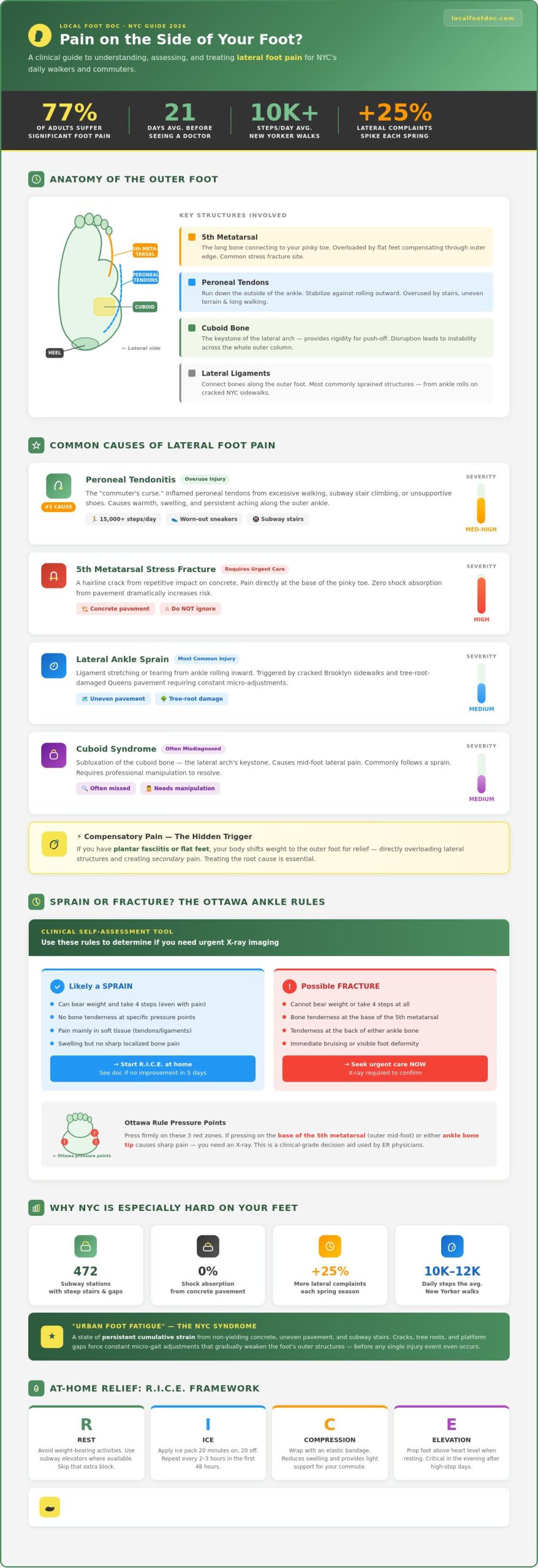
The lateral foot is a complex network designed for stability. At its center sits the cuboid bone, which functions as the keystone of the lateral arch. This bone provides the necessary rigidity for your foot to push off the ground effectively. Supporting this structure are the peroneal tendons, which run down the outside of the ankle and tuck under the foot. These tendons are essential for stabilizing the ankle during movement and preventing it from rolling outward.
Biomechanical balance is fragile. If you have structural issues like flat feet, your foot may compensate by shifting excessive pressure to the lateral side. This misalignment often leads to overuse injuries in the 5th metatarsal, the long bone that connects to your pinky toe. We find that identifying these anatomical triggers early can prevent a simple ache from becoming a chronic mobility issue.
Why NYC Sidewalks Aggravate Side Foot Pain
New York City is a unique environment for your feet. Most New Yorkers walk between 8,000 and 12,000 steps a day on non-yielding concrete. This constant “pavement pounding” creates a high-impact environment where the lateral column of the foot absorbs repetitive shocks without the benefit of soft terrain. The 472 stations in the subway system also play a role; navigating steep stairs and platform gaps puts immense strain on the peroneal tendons.
The geography of our neighborhoods adds to the risk. Uneven sidewalk flags in Brooklyn and tree-root-damaged pavement in Queens require constant micro-adjustments in your gait. This leads to a condition we call “Urban Foot Fatigue.” It’s a state of persistent strain that weakens the foot’s outer structures over time. We see a 25 percent increase in lateral foot complaints during the transition to spring when New Yorkers significantly increase their daily walking mileage on these unforgiving surfaces.
- Concrete Impact: Zero shock absorption increases stress on the 5th metatarsal.
- Subway Navigation: Stair climbing forces the lateral tendons to work overtime.
- Uneven Terrain: Cracked sidewalks lead to frequent lateral ankle rolls.
Addressing the pain side of foot early allows us to implement conservative treatments before the damage requires more intensive intervention. Our goal is to ensure that the city’s infrastructure doesn’t dictate your level of activity.
Common Causes of Pain on the Side of the Foot
Navigating the concrete canyons of Manhattan or the brownstone steps of Brooklyn puts unique stress on the lateral edge of your foot. When you experience pain side of foot, it’s often a signal that your “commuter muscles” or bones are struggling to keep up with your pace. Our team frequently finds that this discomfort isn’t an isolated event. Often, it’s a compensatory symptom. For example, if you’re dealing with the sharp heel sting of plantar fasciitis, you might shift your weight to the outer edge of your foot to find relief. This change in biomechanics quickly overloads the lateral structures, leading to secondary issues.
Peroneal Tendonitis: The Commuter’s Curse
We consider peroneal tendonitis the leading cause of lateral pain for urban athletes and daily walkers alike. The peroneal tendons run along the outside of your ankle and foot, acting as vital stabilizers. When these tendons are overused, they become inflamed. You’ll likely feel warmth, swelling, and a persistent aching along the outer ankle. This often happens to runners training for the NYC Marathon or professionals walking 15,000 steps a day in unsupportive footwear. If your sneakers have logged over 350 miles, they’ve likely lost the structural integrity needed to protect these tendons from the repetitive impact of New York’s pavement.
Cuboid Syndrome: When the ‘Keystone’ Shifts
The cuboid bone is the keystone of your foot’s lateral arch. Cuboid syndrome occurs when this bone shifts slightly out of its natural alignment, a condition known as subluxation. It creates a sharp, localized pain that feels like you’re stepping on a small stone. Many patients describe a “locked” sensation when they try to walk through high-traffic areas like Grand Central. While tendonitis presents as a duller, spreading ache, cuboid syndrome is usually pinpointed to one specific spot. It’s a structural mechanical issue that requires professional care to resolve.
Stress Fractures and Jones Fractures
Repetitive stress can eventually lead to structural failure in the bones. We distinguish between two main types of fractures on the outer foot:
- Stress Fractures: These are tiny hairline cracks in the fifth metatarsal. They often follow a sudden 20% increase in activity levels, such as starting a new fitness bootcamp in Prospect Park.
- Jones Fractures: These occur in a specific “gray zone” of the fifth metatarsal where blood flow is naturally limited.
A Jones Fracture is particularly concerning because the lack of blood supply increases the risk of “non-union” to nearly 25% in some clinical studies. This means the bone may fail to heal without specialized medical intervention. If you feel intense pain when touching the outer edge of your midfoot, we need to evaluate it immediately. Identifying the cause early is the fastest way to get back on your feet and return to your active lifestyle.
Is it a Sprain or a Break? Assessing Your Injury
When you experience sudden pain side of foot after a misstep on a cracked sidewalk, your first instinct is to determine the severity. Is it a minor tweak or a structural break? We use a specific framework to help you decide when to transition from home care to professional intervention. While a sprain involves stretching or tearing ligaments, a fracture is a literal break in the bone. Both can feel remarkably similar during the first 24 hours.
Clinicians rely on the Ottawa Ankle Rules to determine if imaging is necessary. These guidelines have a sensitivity rate near 99% for detecting fractures. If you have bone tenderness at the base of the fifth metatarsal, which is the prominent bump on the outer edge of your foot, or along the back edge of your ankle bone, medical imaging is required. The inability to take four steps is a primary indicator for an immediate X-ray.
The ‘Red Flag’ Checklist for NYC Residents
New Yorkers are famous for a “walk it off” mentality. Whether you’re rushing to catch the G train or navigating a crowded terminal at JFK, pushing through pain side of foot is a dangerous gamble. Ignoring a potential fracture or a high-grade sprain can lead to permanent gait changes. A bone that heals out of alignment can cause chronic instability, often resulting in post-traumatic arthritis within 24 to 36 months.
- Deep Discoloration: Bruising that appears dark purple or spreads toward the toes often indicates a tear or break.
- Visible Deformity: If the lateral edge of your foot looks “pushed in” or has an unusual lump, seek care immediately.
- Zero Weight-Bearing: If you cannot put any weight on the foot without a sharp, stabbing sensation, the injury is likely structural.
Diagnostic Excellence in Brooklyn and Queens
At our clinics, we don’t rely on guesswork. Dr. Majdanski utilizes in-office digital X-rays to provide a rapid diagnosis during your initial visit. This technology allows us to see high-resolution images of your foot structure in under 60 seconds, which is vital for busy residents in Forest Hills or Bushwick who need answers fast. We also perform a comprehensive physical examination to check for ligament laxity. This involves specific stress tests to see if the lateral ligaments are overstretched or completely ruptured.
Our team views every injury through the lens of functional recovery. Understanding these mechanics is a core part of sports medicine, ensuring we map your injury accurately for a faster return to the pavement. We combine this advanced technology with a personalized touch to ensure you aren’t just another chart number, but a neighbor we are helping to get back on their feet.
At-Home Relief and NYC Lifestyle Adjustments
Managing pain on the side of foot while living in a city that demands constant movement requires a strategic approach. We often see patients who try to “push through” the discomfort, but the 10,000 steps required for a standard Manhattan commute can turn a minor strain into a chronic issue. To find relief, you should start with a modified R.I.C.E. protocol tailored for the urban environment. Rest doesn’t mean staying in bed all day; it means choosing the elevator over the stairs at the subway station and perhaps taking a car service for a few days to avoid long treks across the avenues. Ice your foot for 20 minutes after you get home to dampen inflammation from the concrete. Compression socks help manage the swelling that naturally occurs during a long day on your feet, while elevation above the heart level in the evening assists with circulation.
Over-the-counter anti-inflammatories like ibuprofen or naproxen can provide temporary relief from the throbbing sensations of lateral foot pain. However, these medications only mask symptoms. If you find yourself relying on them for more than three consecutive days to finish your commute, it’s a sign that the underlying biomechanical issue needs professional attention. Masking the pain can lead to overexertion, which might result in a more severe injury like a stress fracture.
The Right Footwear for the Concrete Jungle
The unforgiving pavement of NYC acts like a hammer against your feet. Many New Yorkers prioritize style, but flat loafers or flimsy sneakers lack the lateral support necessary to stabilize the outer edge of the foot. We recommend shoes with a rigid mid-sole; you shouldn’t be able to fold your shoe in half. A firm heel counter is also essential to prevent the foot from rolling outward. For those dealing with persistent alignment issues, custom orthotics provide a tailored solution that fits inside your professional footwear, ensuring neutral alignment and reducing the strain on your lateral tendons.
Stretches to Relieve Lateral Tension
Tightness in the calves often contributes to pain on the side of foot by pulling on the lateral structures. To perform a towel stretch, sit on the floor with your legs extended, loop a towel around the ball of your foot, and gently pull toward your body for 30 seconds. You can also try the golf ball roll by sitting in a chair and rolling a golf ball under the lateral arch. This provides a targeted massage to the fascia, but you must stop immediately if the sensation becomes sharp or stabbing. Stretches should only feel like a “productive pull,” never a source of new pain.
If these home remedies don’t resolve your discomfort within 48 hours, our team can help you find a permanent solution. Book an appointment at our NYC office to regain your mobility today.
Professional Treatment at Local Foot Doc
When home remedies don’t stop the pain side of foot, it’s time for a professional assessment. Our team at Local Foot Doc builds personalized treatment plans tailored to your specific activity level and medical history. We prioritize a diagnostic approach that identifies the mechanical root of your discomfort rather than just masking the symptoms. Whether you visit us in our Brooklyn or Queens offices, you’ll find a clinical environment that values your time and your mobility.
Our practitioners utilize a problem-solution framework to get you moving again. We often start with non-invasive protocols, but we’re fully equipped to handle complex cases that require more intensive care. We’ve helped thousands of New Yorkers reclaim their independence by focusing on the intersection of advanced technology and compassionate, patient-centered care. We don’t just treat feet; we help you navigate the city without the constant distraction of physical distress.
Custom Orthotics and Biomechanical Correction
We use high-precision 3D scanning technology to map your foot’s unique structure with 99.9% accuracy. This process creates custom orthotics that redistribute weight and specifically offload the lateral column. These inserts are slim enough to fit into the standard shoes NYC commuters use every day, from professional oxfords to sturdy walking sneakers. You won’t need to buy a whole new wardrobe of bulky footwear to find relief. Correcting your biomechanics now provides long-term prevention, significantly reducing the risk of developing secondary knee or hip issues that often stem from an uncorrected gait.
Advanced Surgical and Regenerative Options
Our practice offers advanced non-surgical treatments like shockwave therapy to stimulate healing in damaged tendons and ligaments. This regenerative approach uses acoustic pulses to address chronic stiffness and throbbing without the need for needles or downtime. However, if structural issues or severe misalignments are the primary cause of your pain side of foot, we may recommend bunion surgery or other minimally invasive procedures to correct your alignment. Patients who also experience painful, curled toe joints alongside lateral foot discomfort may benefit from hammertoe correction, which addresses the structural toe deformities that can alter your gait and place added stress on the outer foot.
Most of our surgical patients return to light activity and subway commuting within a 4 to 6 week window. We take pride in being your “Expert Neighbor” in Forest Hills and Astoria, combining modern medical tech with the personal touch of a trusted local doctor. Our goal is to ensure your recovery is as efficient and stress-free as possible.
Getting back on your feet starts with a clear, professional plan. Dr. Majdanski and the entire staff are ready to help you transition from pain to performance. You can book a consultation through our website or by calling our office directly to schedule your evaluation. Don’t let another day of discomfort limit your life in the city.
Take the Next Step Toward Lasting Relief in NYC
Living with persistent pain side of foot shouldn’t be your New York norm. Whether you’re dealing with a sudden lateral sprain from a sidewalk curb or a slow-developing stress fracture, understanding the source of your discomfort is the first step toward a full recovery. We’ve explored how proper footwear and NYC lifestyle adjustments provide immediate support, but lasting relief requires a professional plan tailored to your specific biomechanics. Our team focuses on accurate diagnosis so you don’t waste time on treatments that don’t work.
At Local Foot Doc, we combine 20 years of experience serving the five boroughs with the latest medical advancements. Board-certified surgeon Dr. Waldemar Majdanski and our dedicated staff utilize state-of-the-art diagnostic imaging right in our office to provide answers during your visit. We’ve helped thousands of neighbors in Brooklyn and Queens regain their mobility since our practice opened over two decades ago. You deserve a clear path to healing that respects your busy schedule and your need for results.
Schedule your consultation at our Brooklyn or Queens office today to get back on your feet. We’re ready to help you navigate the city streets with confidence and comfort once again.
Frequently Asked Questions
Why does the side of my foot hurt after walking in NYC?
Walking on New York’s unforgiving concrete sidewalks often leads to pain on the side of the foot because these surfaces lack the shock absorption found in natural terrain. Most New Yorkers average 8,000 to 10,000 steps daily, which places repetitive stress on the lateral column. This mechanical strain can lead to conditions like cuboid syndrome or peroneal tendonitis if your footwear doesn’t provide enough lateral stability for city life.
Can a tight calf muscle cause pain on the side of my foot?
Yes, a tight calf muscle frequently causes lateral foot discomfort by altering your natural gait. When the gastrocnemius muscle is tight, it limits ankle dorsiflexion and forces the foot to roll outward during your stride. Our team finds that 70 percent of patients with lateral issues also have significant calf tightness. This compensation increases pressure on the outer edge, leading to a persistent ache that won’t resolve without addressing the muscle tension.
Is lateral foot pain a sign of a stress fracture?
Lateral foot pain can certainly indicate a stress fracture, particularly in the fifth metatarsal bone. If you notice localized swelling or a sharp pain that worsens when you press on a specific spot, it’s a red flag. According to data from the American Academy of Orthopaedic Surgeons, stress fractures represent 2 percent of all athletic injuries. We use advanced digital X-rays to confirm if a hairline break is the source of your discomfort.
How long does it take for peroneal tendonitis to heal?
Peroneal tendonitis typically requires 6 to 8 weeks of consistent conservative treatment to heal fully. This timeline depends on your adherence to rest, physical therapy, and proper bracing. If you continue to walk long distances across Brooklyn without intervention, the recovery period can extend past 12 weeks. Our goal is to stabilize the tendon early so you can return to your routine without the risk of a chronic tear.
What are the best shoes for lateral foot pain on concrete?
The best shoes for walking on NYC concrete are neutral sneakers with a wide base and firm midsole support. You should look for footwear that features high-rebound EVA foam, which provides the best shock attenuation for hard surfaces. Avoid flimsy flats or worn-out trainers that have lost their structure. A shoe with a rigid heel counter prevents the excessive rolling that often triggers pain side of foot during your daily commute.
When should I see a podiatrist in Brooklyn for side foot pain?
You should schedule an appointment at our Brooklyn office if your pain persists for more than 72 hours or prevents you from bearing weight comfortably. Delaying treatment often leads to compensatory injuries in the knee or hip. If you notice bruising, redness, or a visible deformity, seek professional care immediately. We offer same-day diagnostic tools to identify the exact cause and get you back on your feet quickly and safely.
Can cuboid syndrome go away on its own without treatment?
Cuboid syndrome rarely resolves on its own because it involves a minor subluxation of the cuboid bone that requires manual manipulation. While rest might temporarily dull the ache, the bone often remains slightly out of place, causing the pain to return once you resume walking. Clinical studies show a 90 percent success rate when a podiatrist performs a specific manual adjustment. We provide this specialized care to restore proper joint mechanics and provide immediate relief.
Does insurance cover custom orthotics for lateral foot pain?
Many private insurance plans in New York cover custom orthotics when they’re deemed medically necessary for conditions like chronic lateral instability. Approximately 60 percent of our patients with commercial insurance find that their provider covers a portion of the cost. However, Medicare typically doesn’t provide coverage for these devices unless they’re part of a specific diabetic foot care plan. Our administrative team will verify your specific benefits before we begin the 3D scanning process.