Imagine it’s a beautiful, sweltering summer day in Brooklyn, yet you’re the only one at the park wearing heavy sneakers instead of breathable sandals. If you’ve spent years hiding your feet at the beach or avoiding social gatherings because you’re embarrassed by a short toe, you aren’t alone. This condition, known as brachymetatarsia, often feels like a lonely burden that affects everything from your choice of footwear to your self-esteem. We recognize that for many of our neighbors in Queens and Brooklyn, a “short toe” isn’t just a cosmetic concern; it’s a source of real mechanical pain and social isolation.
In this article, we’ll help you understand the skeletal imbalance behind this condition and the modern surgical solutions available to restore your foot’s natural form. You’ll learn about the latest 2026 treatment protocols, including single-stage lengthening and distraction osteogenesis, which can help eliminate pain and restore your independence. We’ll also guide you through the process of establishing medical necessity for insurance coverage and explain how our dedicated team works with you to achieve the results you deserve. It’s time to stop hiding and start walking with confidence again.
Key Takeaways
- Understand why feeling embarrassed by short toe symptoms is a common experience and how this structural issue impacts your emotional well-being.
- Learn about the underlying cause of brachymetatarsia, a condition where the metatarsal growth plate closes prematurely, often affecting the fourth toe.
- Discover how conservative treatments like custom orthotics can help redistribute pressure and manage mechanical foot pain in your daily life.
- Explore the modern surgical techniques available in 2026 that can permanently lengthen the affected bone and restore the natural appearance of your foot.
- Find out how our specialized team in Brooklyn and Queens provides a compassionate path toward reclaiming your independence and wearing sandals with confidence.
The Hidden Burden: Why Being Embarrassed by a Short Toe is Common
Living in New York City means walking is a central part of your daily rhythm. Whether you are commuting through Brooklyn or strolling through a park in Queens, your feet carry you through every mile. When the humid NYC summer arrives, most people look forward to the relief of open-toed shoes. However, for those who are embarrassed by short toe issues, this seasonal shift brings a wave of “sandals anxiety.” We see many patients who spend their summers in heavy sneakers or boots, enduring the heat just to keep their feet hidden from view.
These feelings of self-consciousness often lead to specific, exhausting behaviors. You might find yourself strategically burying your feet in the sand at the beach or making excuses to avoid pool parties and locker rooms. It is common to feel that your foot is “deformed” or “ugly,” but it is vital to understand that this is a recognized medical condition, not a personal flaw. What is Brachymetatarsia? Simply put, it is a skeletal growth issue where one of the metatarsal bones stops growing prematurely. Shifting the perspective from a “beauty defect” to a “structural imbalance” is often the first step toward emotional and physical recovery.
When ‘Short Toe’ Becomes a Social Barrier
For many of our neighbors, the impact of brachymetatarsia extends far beyond shoe choices. It can dictate your participation in sports or gym activities where bare feet or specialized footwear are required. We often hear from young adults who feel significant anxiety regarding dating and intimate relationships, fearing the moment a partner might notice their foot. Because of the stigma, many people wait decades before seeking professional help. They suffer in silence, believing that their only option is to continue hiding. We want you to know that your quality of life matters, and the social isolation you feel is a valid reason to explore corrective options.
Beyond Aesthetics: The Physical Cost of Silence
While the psychological weight is heavy, the physical consequences of an untreated short toe are just as significant. The fourth toe plays a key role in balance and weight distribution. When that toe is elevated and doesn’t touch the ground properly, it can’t bear its share of your body weight. This forces the surrounding toes and the ball of your foot to work harder. Over time, this imbalance causes painful calluses to form on adjacent toes and may lead to metatarsalgia, a condition characterized by sharp or aching pain in the forefoot. In many cases, we use custom orthotics to help redistribute this pressure. Ignoring the problem doesn’t just mean staying embarrassed by short toe symptoms; it means risking long-term mechanical damage to your foot’s foundation.
What is Brachymetatarsia? The Science Behind the Short Toe
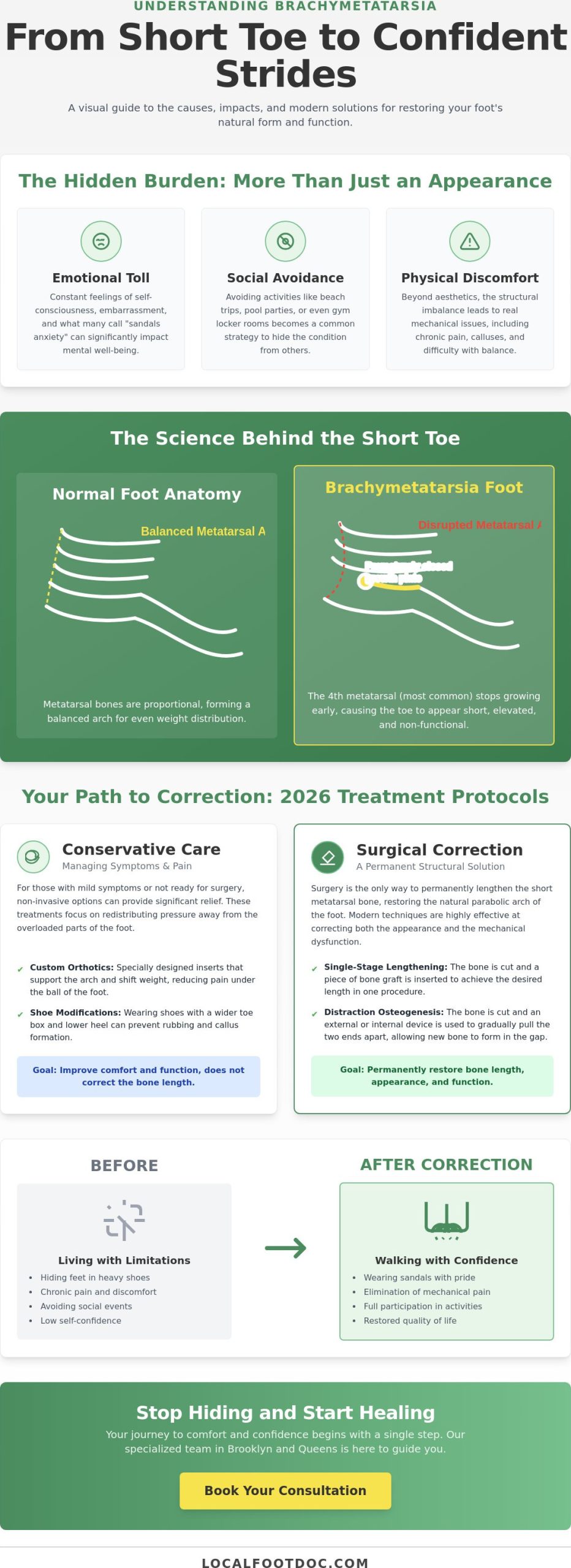
To understand why you feel embarrassed by short toe appearances, we must look closely at the underlying anatomy of the foot. Brachymetatarsia is a clinical condition defined by the premature closure of a metatarsal growth plate. While the rest of your foot continues to develop normally, one specific bone stops growing too soon. This creates the “floating toe” effect, where the affected toe appears to sit higher on the foot and doesn’t reach the ground. While this can happen to any of the five metatarsals, it most frequently involves the fourth toe, often leaving patients with a significant gap in their foot’s natural silhouette.
For many of our neighbors in Brooklyn and Queens, the science behind the short toe reveals that this isn’t just a cosmetic quirk but a structural deficiency. When the metatarsal bone is too short, the entire forefoot loses its ability to distribute weight evenly. This disruption of the “metatarsal arch” is the primary reason why a condition that starts as a visual concern often evolves into a source of chronic physical discomfort.
Genetic vs. Traumatic Origins
Our patients often wonder if their condition was preventable. In many cases, the origin is genetic. Congenital brachymetatarsia often appears in both feet and typically becomes most noticeable between the ages of 9 and 12, as the growth disparity widens during puberty. However, early childhood trauma can also play a role. A heavy object falling on the foot or a minor fracture near the growth plate can stunt bone development without causing immediate, severe pain. Whether inherited or caused by an old injury, the result is the same: a bone that is structurally incapable of supporting the foot’s complex mechanics.
How Brachymetatarsia Affects Foot Mechanics
The human foot functions like a carefully balanced bridge. When one support beam is shorter than the others, the rest of the structure must compensate. This leads to the “transfer lesion” effect, where the second and third toes take on excessive pressure that they aren’t designed to handle. Over time, this causes painful calluses and can even contribute to the development of other deformities. This shifting weight is a common reason why some patients eventually find they need bunion surgery Queens specialists provide, as the big toe begins to deviate due to the lack of lateral support. If you’ve noticed that your other toes are becoming painful or crowded, it’s likely a direct result of your short metatarsal. We recommend a professional evaluation to stop this mechanical breakdown before it affects your overall mobility.
Correction Options: Conservative Management vs. Surgery
When you first realize that your foot structure is causing discomfort, your immediate instinct might be to look for a quick fix at the pharmacy. We understand that the prospect of surgery can be daunting, so we often begin by exploring non-invasive ways to manage your symptoms. For many New Yorkers who are embarrassed by short toe conditions, the initial goal is often just to get through the day without sharp pain in the ball of the foot or irritation from their shoes.
Conservative management focuses primarily on accommodating the deformity rather than correcting it. This usually involves switching to shoes with a wide toe box to prevent the “floating” toe from rubbing against the top of the shoe. We also frequently prescribe custom orthotics to help redistribute the weight that the short metatarsal fails to carry. While these tools are excellent for reducing the transfer lesions and calluses we discussed earlier, they do not change the actual length of the bone. If you remain embarrassed by short toe aesthetics, these measures will likely feel like temporary fixes rather than a true resolution.
Non-Surgical ‘Band-Aids’
In the high-activity environment of NYC, small comforts matter. Silicone toe sleeves can provide a protective barrier to prevent painful blisters during long walks on concrete. Many patients also find success with specific athletic shoe brands that offer a wider, more natural foot shape, allowing them to avoid the look of traditional orthopedic footwear. However, these are ultimately band-aids. They don’t stop the underlying mechanical shift that can lead to worsening pain in the neighboring joints over time. They offer relief, but they cannot restore the foot’s natural silhouette.
Surgical Breakthroughs for 2026
When conservative options no longer provide relief, or when the emotional weight of hiding your feet becomes too much, modern surgery offers a permanent solution. There are two primary pathways we consider based on the degree of shortening:
- One-stage (Acute) Lengthening: This involves making a single cut in the bone and inserting a bone graft to bridge the gap. It is typically a faster process and is often ideal for shortenings of less than 1 cm.
- Gradual Lengthening (Distraction Osteogenesis): This method uses an external fixator to slowly stretch the bone over several weeks. This technique stimulates your body to grow its own new bone to fill the space.
In 2026, surgical protocols have become significantly more efficient. Many current protocols for gradual lengthening allow patients to walk on the surgical foot the very day of the surgery. This immediate weight-bearing is believed to promote faster and stronger bone healing, helping you return to your normal Brooklyn lifestyle sooner than was possible in years past. We work with you to determine which method offers the best path toward your goals of mobility and confidence.
The Surgical Journey: What to Expect from Your Correction
Deciding to move forward with correction is a significant step toward reclaiming your independence. We begin every journey with a specialized X-ray evaluation. This isn’t a standard scan; we use weight-bearing images to measure your metatarsal deficit down to the millimeter. This precision allows us to create a blueprint for your foot’s new structure, ensuring that the final result aligns with the natural arch of your other toes. If you have spent years feeling embarrassed by short toe issues, seeing this digital plan is often the first moment where the possibility of change feels real.
Most of our corrective procedures are performed on an outpatient basis. This means you can return home to Brooklyn or Queens the same day. We prioritize your comfort by offering various anesthesia options, typically combining local numbing with light sedation so you remain relaxed throughout the process. Depending on the technique we choose, your immediate post-operative phase may involve a period of non-weight bearing or limited mobility. Planning your life in a walk-up apartment or navigating the subway requires some foresight, and we help you coordinate these logistics well in advance of your surgery date.
Step-by-Step Recovery Timeline
Healing is a structured process. We guide you through each milestone to ensure your bone mends strongly and your skin heals beautifully.
- Weeks 1 to 4: Focus is on managing swelling and protecting the surgical site. You will likely wear a specialized boot and keep the foot elevated as much as possible.
- Weeks 6 to 10: This is the transition phase. As the bone consolidates, we move you from the surgical boot into supportive sneakers.
- Month 3 and beyond: You can begin returning to high-impact activities. Our sports medicine goals at this stage focus on strengthening the foot and restoring your full range of motion.
Managing Expectations and Scarring
We know that aesthetic results are just as important as functional ones. We use modern, minimally invasive incision techniques designed to hide or minimize visible scarring. While some “toe stiffness” is a normal part of the healing process, dedicated physical therapy helps your “new” toe learn how to grip and flex properly. The ultimate reward comes about three to four months after surgery. This is typically when the swelling has subsided enough for you to finally wear your first pair of open-toed sandals. If you are ready to stop feeling embarrassed by short toe symptoms and start your recovery, schedule a consultation with our surgical team today.
Why Choose Local Foot Doc for Your Toe Correction?
At Local Foot Doc, we have served the diverse neighborhoods of New York City for over two decades. Dr. Waldemar Majdanski brings more than 20 years of specialized surgical expertise to our practice, helping patients navigate both common ailments and complex reconstructive needs. We recognize that many individuals who are embarrassed by short toe appearances have spent years avoiding the very activities that make NYC summers enjoyable. Our offices in Forest Hills, Astoria, and Woodhaven provide a compassionate, judgment-free environment where your concerns are heard and validated. We provide comprehensive care for the entire foot, ensuring that while we address your primary concern, we also look for related issues, such as helping you understand what is plantar fasciitis and how it might be impacting your overall foot mechanics.
Expertise in Complex Deformities
Lengthening a metatarsal bone requires a high degree of precision to ensure the surrounding joints remain healthy and mobile. Experience matters here. Dr. Majdanski has dedicated his career to mastering these intricate procedures, focusing on the intersection of modern technical capabilities and individual attention. We don’t just provide a surgery; we offer a partnership in your recovery. This includes a commitment to patient education, where we explain every step of the bone-growth process. We also assist with the often-complex insurance authorization process. By documenting the functional limitations caused by your condition, we aim to secure the coverage you need for a medically necessary correction.
Schedule Your Consultation in Queens or Brooklyn
Your first visit to our Forest Hills podiatrist office is the beginning of your path toward regained independence. Our diagnostic process is thorough and community-focused, treating you like a neighbor rather than a chart number. To prepare, we suggest wearing shoes that you find particularly uncomfortable, as this helps us see where your foot faces the most mechanical stress. We’ll use our advanced imaging to create a roadmap for your treatment. The feeling of being embarrassed by short toe issues doesn’t have to be your permanent reality. It’s time to stop hiding your feet and start a professional path toward healing, mobility, and the resumption of the lifestyle you love.
Step Into a Future of Confidence and Comfort
Brachymetatarsia is a complex skeletal condition that affects both your physical health and your social well-being. By understanding the mechanical causes behind your foot structure, you can move past the belief that this is a personal flaw you must simply endure. We’ve explored how modern surgical techniques in 2026 provide predictable paths to lengthening the metatarsal and restoring the natural balance of your forefoot. Whether you choose conservative management with custom orthotics or a permanent surgical correction, the goal is always the same: to help you walk without pain and live without hiding.
You don’t need to feel embarrassed by short toe symptoms anymore. Our team provides board-certified surgical expertise and compassionate, judgment-free care across our multiple NYC locations in Queens and Brooklyn. We are here to guide you through every step of the healing process, from the initial X-ray blueprint to the day you wear your favorite sandals again. It’s time to prioritize your quality of life and reclaim the activities you love.
Schedule a judgment-free consultation with Dr. Majdanski today and take the first step toward reclaiming your independence. We look forward to helping you step forward with newfound confidence.
Frequently Asked Questions
Is brachymetatarsia surgery considered cosmetic or medically necessary?
Brachymetatarsia surgery is considered medically necessary when the condition causes persistent pain or functional limitations. Insurance providers in 2026 typically require documentation of a functional limitation, such as difficulty walking or chronic pain, and evidence that conservative treatments like custom orthotics have failed. While many patients are embarrassed by short toe aesthetics, the primary goal of our surgical intervention is to restore proper weight distribution and mechanical function to your foot.
How much length can actually be added to a short toe?
We can typically add between 10mm and 20mm of length depending on your specific anatomy and the surgical method chosen. Single-stage lengthening is often used for bone deficits under 1 cm. For more significant shortenings, gradual lengthening through distraction osteogenesis allows the bone and soft tissues to stretch further. This helps the toe reach the ground and align perfectly with its neighbors, restoring both the silhouette and the function of your forefoot.
Will I be able to walk normally after short toe surgery?
Yes, the ultimate goal of the procedure is to restore normal walking mechanics and balance. By lengthening the bone, we allow the affected toe to participate in weight-bearing, which reduces excessive pressure on the other toes. Many current surgical protocols for gradual lengthening even allow patients to walk on the surgical foot the day of the surgery to promote faster bone healing. Most patients find their gait becomes more stable once the structural imbalance is corrected.
Can brachymetatarsia affect both feet at the same time?
Brachymetatarsia frequently affects both feet, especially when the underlying cause is genetic or hereditary. If you have a short toe on both sides, we will evaluate the severity of each during your diagnostic consultation. We often recommend staging the surgeries a few months apart. This ensures you maintain mobility in one foot while the other heals, which is particularly important for navigating the active lifestyle found in Brooklyn and Queens.
What happens if I choose not to have surgery for my short toe?
If you choose not to have surgery, you will likely need to rely on conservative management to handle the resulting mechanical pain. Without correction, the structural imbalance often leads to “transfer lesions,” which are painful calluses on the second and third toes. You may also remain embarrassed by short toe symptoms that limit your social activities. The condition will not improve on its own and may cause increased joint discomfort as the foot compensates for the deformity.
Is the surgery painful, and how is the pain managed post-operatively?
You will be under anesthesia during the procedure, ensuring you feel no pain while we work. Afterward, we manage discomfort with a personalized plan that includes prescribed pain medication and anti-inflammatories. Most patients report that any sharp discomfort subsides within the first few days, especially when they follow our instructions for elevation and icing. Our team remains in close contact to ensure your recovery is as comfortable and smooth as possible.
How long do I need to take off work for toe lengthening surgery?
Most patients with office-based jobs return to work within one to two weeks, provided they can keep their foot elevated. However, if your job involves significant standing or walking, you may need six to ten weeks off to ensure proper bone consolidation. We will provide a specific timeline based on your surgical method and the physical demands of your daily routine. We work with you to plan your recovery around your professional obligations.
Will my other toes shift after one toe is lengthened?
Lengthening the short toe actually provides better stability for the rest of your foot and prevents shifting. By restoring the natural alignment, we provide lateral support that keeps the neighboring toes in their proper place. This structural correction often stops the progression of other deformities, such as hammertoes or bunions, which are frequently caused by the original gap. Your entire foot will function more harmoniously once the metatarsal arch is restored.