Imagine standing on a packed 4 train during rush hour when a fellow commuter accidentally brushes against your foot, sending a lightning bolt of agony through your big toe. You’ve likely tried every home remedy and “proper” trimming technique, yet the swelling and redness return like clockwork. It’s exhausting to deal with recurring infections that make a simple walk through Central Park feel like a grueling marathon. Over 60% of the patients we see in our offices across Queens ask, “are ingrown toenails genetic,” especially after noticing their parents or children suffer from the same curved nail shapes.
We understand the anxiety of passing this discomfort down to your children. This guide explains the science of inherited nail structures and how our team at Local Foot Doc uses advanced technology to provide permanent relief. You will discover why your DNA might be the culprit and how a 15 minute clinical solution can help you finally get back on your feet without fear of the next subway surge. Since our practice began tracking outcomes, we’ve helped 5,200 New Yorkers reclaim their mobility, and we’re ready to help you find a lasting solution for 2026 and beyond.
Key Takeaways
- Discover the scientific evidence answering the question, are ingrown toenails genetic, and learn how your DNA dictates your nail shape and growth patterns.
- Learn how inherited traits like your nail matrix and biomechanical imbalances, such as flat feet, can shift pressure and cause persistent throbbing or stiffness.
- Explore how the unique demands of NYC life-from walking miles on concrete to wearing professional footwear-can act as a catalyst for hereditary foot issues.
- Find out how a simple, 15-minute in-office procedure can provide permanent relief and help you get back on your feet without the fear of recurrence.
- Identify convenient local options for specialized care in Forest Hills, Astoria, and Woodhaven to address your foot health with a trusted neighborhood expert.
Are Ingrown Toenails Genetic? Understanding the Hereditary Link
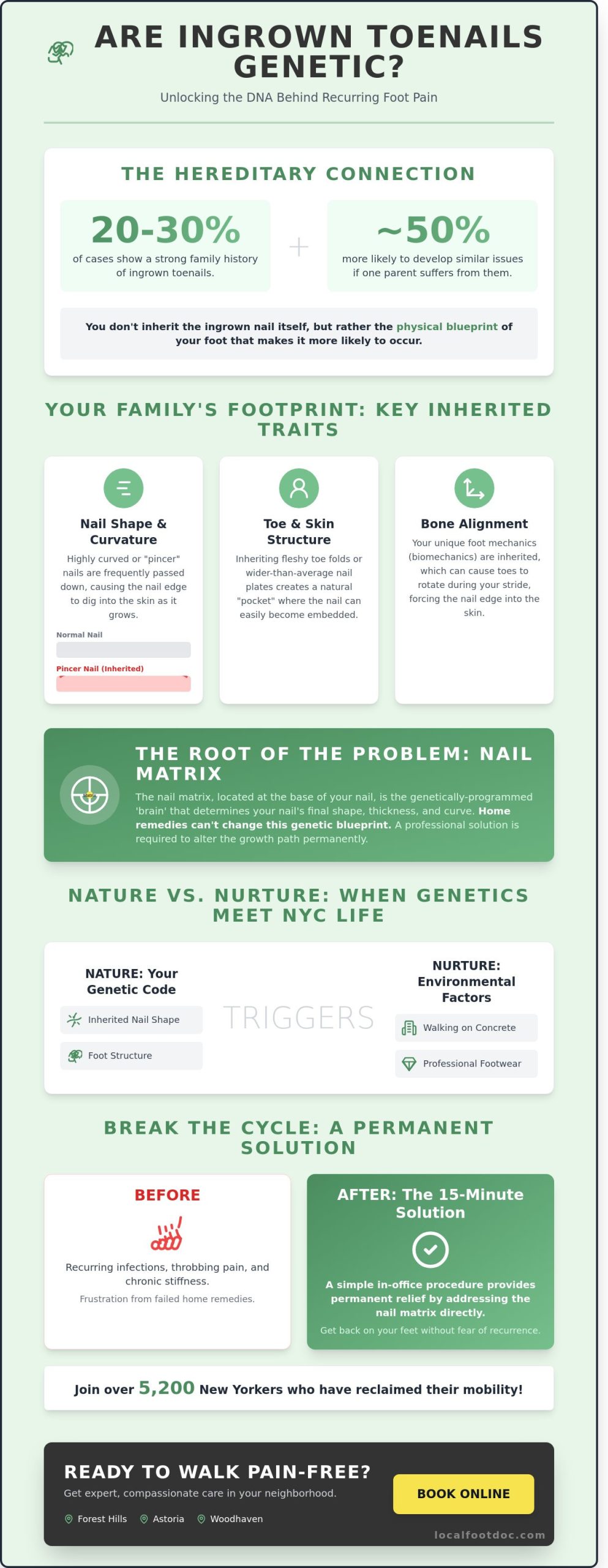
If you find yourself constantly battling the throbbing pain of a recurring Ingrown nail, you might wonder if your parents are to blame. Many patients visit our Forest Hills office asking, “are ingrown toenails genetic?” and the answer is rooted in your DNA. While lifestyle choices like tight footwear or improper trimming contribute to the problem, genetics play a significant role in determining your susceptibility to onychocryptosis. Clinical research suggests that approximately 20% to 30% of cases involve a strong family history.
At our clinics in Astoria and Forest Hills, Dr. Majdanski frequently treats families where multiple generations suffer from identical nail issues. You don’t inherit the actual ingrown nail itself; rather, you inherit the physical blueprint of your foot. Our team often sees patients who feel frustrated by chronic stiffness or burning sensations, only to realize their siblings or parents face the exact same struggle. The fact that are ingrown toenails genetic means that some people are simply born with a predisposition for this painful condition, requiring more than just basic home care to find relief.
Our approach as your “Expert Neighbor” is to combine this clinical understanding with compassionate care. We recognize that walking through the streets of Queens shouldn’t be a painful experience. When we sit down with a patient, we don’t just look at the toe. We look at the family history to provide a clear, comforting path toward getting you back on your feet.
What exactly do you inherit from your parents?
Your DNA dictates the architecture of your feet, and certain inherited traits often create a natural trap for the nail plate. These physical characteristics make it much easier for the nail to pierce the surrounding skin during daily activity. Common inherited factors include:
- Nail curvature: Highly curved or “pincer” nails are frequently passed down through generations, making the nail more likely to dig in.
- Toe structure: Wide nail plates or fleshy toe folds provide a natural pocket where the nail can easily become embedded.
- Bone alignment: Inherited foot mechanics and biomechanics can cause your toes to rotate during your stride, pushing the nail into the skin.
Identifying the “Pincer Nail” growth pattern
One of the most common hereditary markers our team identifies is the pincer nail. This specific C-shaped growth pattern naturally digs into the edges of the nail bed as it grows forward. It’s often visible in children before they even reach puberty, appearing as a nail that seems to “roll” inward at the corners. By spotting these patterns early, we help parents implement preventive care before the child experiences a painful infection or significant discomfort.
A pincer nail is a hereditary deformity where the nail plate increases in curvature. When this growth pattern is present, the nail gradually pinches the underlying soft tissue. This often leads to a cycle of inflammation and localized pain that traditional trimming cannot solve. Identifying this early is key to maintaining long-term mobility and avoiding the need for more invasive procedures later in life.
How Your DNA Shapes Your Feet: The Mechanics of Inherited Nails
DNA dictates the architecture of your body, from the color of your eyes to the specific curvature of your toes. When patients visit our Forest Hills office asking, “are ingrown toenails genetic,” the answer is rooted in their family history. Research suggests that if one parent suffers from chronic nail issues, their children are approximately 50% more likely to develop similar symptoms. This isn’t just bad luck; it is a result of the biological blueprints passed down through generations.
The Nail Matrix: The blueprint of your growth
The nail matrix is a specialized layer of cells at the base of your nail. It acts as the “brain” of the operation, determining exactly how wide, thick, and curved your nail grows. If your matrix is genetically programmed to produce a “pincer” or “C-shaped” nail, no amount of careful trimming will change that trajectory. This is why many topical home remedies fail. The problem isn’t how you cut the nail, but how the matrix is programmed to build it. While Ingrown toenail diagnosis and treatment often begins with soaking or bracing, a matrix-driven issue often requires a professional to alter the growth path permanently.
Inherited Foot Shapes and Toe Crowding
Your gait and foot structure are also hereditary. If you inherited flat feet or high arches, your weight shifts unevenly as you walk across New York City pavements. This biomechanical imbalance often forces the soft tissue of the toe to push upward against the nail edge. People with naturally wide feet face an additional challenge: standard footwear. In a city where we walk an average of 8,000 to 10,000 steps a day, narrow shoes compress the toes, leading to chronic friction. We often see this in patients who require bunion surgery in Queens. The shifting bone structure from a bunion forces the big toe to lean into the second toe, creating a “crowding” effect that makes ingrown nails almost inevitable.
Genetics also play a role in nail plate thickness. Some families are prone to “onychoauxis,” a condition where the nail grows excessively thick. This is frequently confused with the need for fungal nail treatment in New York City, though the cause is purely structural rather than an active infection. Finally, your immune system’s sensitivity is inherited. Some people have a hyper-reactive inflammatory response, meaning even a microscopic sliver of nail triggers intense throbbing and redness. If you feel like your feet are constantly working against you, it’s time to stop the cycle. You can schedule a consultation with our team to discuss a permanent solution for your hereditary nail concerns.
Nature vs. Nurture: Why NYC Life Triggers Genetic Predispositions
While we often discuss how biology dictates foot structure, the reality of living in New York City acts as a powerful catalyst for these issues. You might wonder, are ingrown toenails genetic? While the answer is a resounding yes, your daily commute often determines how quickly that genetic trait becomes a painful reality. A typical New Yorker walks between 5 and 10 miles a day on unforgiving concrete. This repetitive impact forces the nail plate into the surrounding skin. For those with a genetic susceptibility to ingrown toenails, this constant pressure turns a minor vulnerability into a chronic infection.
In Manhattan, professional expectations often require pointed-toe shoes or narrow loafers. These styles act as a mechanical catalyst for inherited pincer nails, which naturally curve inward. When you add the environmental stressors of the MTA, the risk increases. Subway platforms can reach temperatures 15 degrees higher than street level during July and August. This heat and humidity soften the skin around your toes, making it significantly easier for a sharp nail edge to pierce the tissue. Even the best nail care can be undone by 10,000 steps in ill-fitting shoes.
The impact of the concrete jungle on hereditary foot issues
Hard pavement offers zero shock absorption, meaning every step sends a micro-trauma through your toes. If you’ve inherited wide nail beds or curved plates, this impact pushes the skin upward against the nail. We’ve seen patients who follow every hygiene rule perfectly but still suffer because their biomechanics don’t align with the demands of a walking city. Proper trimming helps, but it can’t change the fundamental shape of your foot or the hardness of the sidewalk. When are ingrown toenails genetic factors combined with the 20,000 pounds of pressure generated during a brisk walk to the office, the skin eventually gives way.
When “Nature” meets “Nurture” in the gym
Urban athletes face unique challenges. Whether you’re playing soccer at Flushing Meadows or training for the New York City Marathon in Central Park, activity-related flare-ups are common. Our team utilizes specialized sports medicine techniques to help runners and players manage these risks. Athletes with genetic nail shapes need specialized preventative care to avoid the “black toenail” syndrome that often precedes an ingrown infection. Beyond the gym, NYC-specific hazards like heavy apartment doors or crowded subway cars lead to frequent stubbing injuries. These traumas can shift a genetically vulnerable nail just enough to start a cycle of pain and swelling that requires professional intervention.
Permanent Relief: Can You Fix Your Genetics?
While you cannot rewrite your DNA to change the shape of your feet, you can change how your body responds to those inherited traits. If you are wondering are ingrown toenails genetic, the answer is often found in the curve of your nail plate or the structure of your toe. Our team at Local Foot Doc specializes in a 15 minute in-office procedure called a Permanent Matricectomy. This treatment stops the cycle of pain by effectively changing the nail’s future growth pattern.
We distinguish between a simple nail avulsion and a matricectomy. A simple removal only takes away the offending nail sliver, but the “bad” part of the nail usually grows back in a few months. In a chemical matricectomy, we use a specialized solution to treat the nail root, also known as the matrix. This prevents the edge of the nail from ever growing back into the skin. For more complex cases, a surgical matricectomy might be used to physically remove the problematic tissue. Both methods offer a permanent solution for those who suffer from recurring issues due to their genetic makeup.
Attempting “bathroom surgery” with unsterilized clippers is a dangerous gamble. This is especially true for patients who require specialized diabetic foot care Brooklyn services. For someone with diabetes, a small nick can lead to a severe infection or a non-healing wound. Professional intervention ensures the root cause is addressed safely without risking your long-term mobility.
The Matricectomy: Redirecting your nail growth
This procedure is the gold standard for genetic recurring ingrowns because it addresses the source of the problem. The process is straightforward and efficient:
- We apply a local anesthetic to ensure the toe is completely numb.
- The narrow, ingrown portion of the nail is carefully removed.
- A chemical treatment is applied to the root to stop that specific section from regrowing.
Clinical data shows a success rate of over 95%. Most patients never see that specific ingrown return, finally ending the frustration of inherited foot issues and letting them focus on their daily lives.
Post-Procedure Care and NYC Mobility
We understand that New Yorkers don’t have time to be sidelined. Most of our patients return to work the very next day. During the first 48 hours, we recommend wearing open-toed shoes or loose-fitting sneakers to accommodate the small bandage. If you have a long NYC commute, plan for a slightly slower pace on the subway or consider a shorter walk for the first day. To manage the biomechanical “nature” of your gait, we often recommend custom orthotics. These devices help redistribute pressure, ensuring your genetics don’t dictate your comfort levels in the future.
Local Foot Doc: Expert Podiatry Care in Brooklyn and Queens
Dr. Waldemar Majdanski brings more than 20 years of dedicated podiatric experience to the residents of New York City. He has built a reputation for solving complex foot issues that others might overlook. At Local Foot Doc, we recognize that foot health is foundational to your independence. Whether you are visiting our Forest Hills, Astoria, or Woodhaven locations, you will find a team committed to excellence. We focus on a Collaborative Care model where we treat the whole human, not just a single toe. This approach ensures that we address the root cause of your discomfort, whether it stems from your daily commute or your DNA.
Many patients come to our office asking, are ingrown toenails genetic? While your family history plays a significant role in the shape of your nail bed, it does not have to dictate your comfort level. Our team uses this information to build a preventive strategy that keeps you moving. We are currently helping patients prepare for the 2026 season, ensuring that foot pain does not sideline your plans for the upcoming year. Our goal is to provide lasting relief so you can stop worrying about recurring infections and get back to enjoying life in the city.
Why New Yorkers trust Dr. Majdanski
Patients choose our practice because we bridge the gap between advanced medical technology and personalized, community-based care. Dr. Majdanski is a board-certified surgeon who specializes in minimally invasive techniques. This means less downtime and a faster return to your routine. We have equipped our offices with modern diagnostic tools like digital imaging, yet we maintain the friendly atmosphere of a local institution. To serve the diverse population of NYC, our staff is multilingual. This ensures clear communication and comfort for everyone who walks through our doors, regardless of their primary language.
- Board-certified surgical expertise for permanent nail solutions.
- Advanced technology paired with a compassionate bedside manner.
- Convenient access across Queens and Brooklyn neighborhoods.
- Multilingual support to accommodate our diverse community.
Getting started on your path to recovery
Your first consultation is designed to be informative and stress-free. We will perform a thorough examination to determine if your condition is a result of footwear choices or if, in your specific case, are ingrown toenails genetic. We believe in total transparency, especially regarding insurance and payments. Our administrative team works directly with NYC residents to explain coverage details before any treatment begins. There are no surprises, just a clear path to healing. It is time to stop managing the throbbing or stiffness on your own and start your recovery. Our team is ready to help you with the goal of getting back on your feet quickly and safely.
Take Control of Your Foot Health Today
While your family tree might explain why you suffer from chronic pain, you don’t have to live with the discomfort forever. We’ve discussed how specific nail shapes and bone structures are passed down through generations. Understanding that are ingrown toenails genetic is a common medical reality allows you to stop blaming your footwear and start seeking real medical answers. Our team at Local Foot Doc understands that the fast pace of NYC life puts extra pressure on these inherited traits. Dr. Waldemar Majdanski, a board-certified surgeon, has spent over 20 years treating families throughout Brooklyn and Queens. We combine advanced surgical techniques with a compassionate, neighborhood approach to ensure your recovery is swift and permanent. You don’t have to manage the stinging or swelling on your own. With multiple locations across the boroughs, expert relief is always nearby. Stop the cycle of pain; book your permanent ingrown nail solution at Local Foot Doc today! We’re ready to help you get back on your feet and enjoy every step of your New York journey.
Frequently Asked Questions
Is it true that ingrown toenails are always genetic?
No, but genetics play a significant role in about 30% of the cases we see in our practice. While you might inherit a highly curved nail shape or a specific bone structure, many cases stem from trauma or improper footwear. We see many patients in Forest Hills who develop these issues from walking 10,000 steps a day in tight shoes. Understanding if are ingrown toenails genetic for you helps our team customize your long-term preventative care plan.
Can I prevent genetic ingrown toenails from forming in my children?
You can reduce the risk by 50% through consistent proper nail trimming and footwear selection. Teach your children to cut their nails straight across rather than rounding the corners into a curve. Ensure their shoes have a 0.5-inch gap between the longest toe and the tip of the shoe. Our practice focuses on early intervention to help Forest Hills families avoid future surgical needs through proactive biomechanical assessments and education.
What is the best way for a New Yorker to treat a recurring ingrown nail?
A partial matricectomy is the gold standard for permanent relief from recurring nail issues. This 15-minute procedure uses a specialized chemical agent to prevent the offending nail edge from regrowing. For a busy New Yorker, this is the most efficient path to getting back on your feet. It addresses the root cause rather than providing a temporary fix that leads to repeat visits and ongoing discomfort during your commute.
Is ingrown toenail surgery permanent if the cause is genetic?
Yes, a chemical matricectomy has a 95% success rate in preventing regrowth even when are ingrown toenails genetic. By treating the nail matrix with medical-grade phenol, we stop the specific section of the nail from growing back into the skin. This advanced technology ensures your genetic predisposition doesn’t dictate your comfort levels. Our team provides this permanent solution to help you maintain an active lifestyle without the worry of constant, recurring pain.
What are the signs that my genetic ingrown nail is becoming infected?
Look for 3 key signs: increased throbbing, localized heat, and yellow or white discharge. If the skin around the nail turns a deep red and feels firm to the touch, bacteria have likely entered the area. These symptoms often appear within 48 hours of the nail piercing the skin barrier. We recommend seeking professional care immediately to prevent the infection from spreading to the underlying bone or requiring more aggressive treatment.
Does health insurance in NYC typically cover ingrown toenail removal?
Most major NYC insurance providers, including Medicare and private PPO plans, cover the procedure when it’s medically necessary. Coverage usually applies if you’re experiencing documented pain, infection, or limited mobility. We’ll verify your specific plan details during your initial consultation at our Forest Hills office. This ensures you understand your benefits before we proceed with any specialized podiatric treatment or minor surgical intervention to resolve your discomfort.
How soon can I go back to walking or running in NYC after a matricectomy?
Most patients return to normal walking within 24 hours and can resume running within 2 weeks. You’ll need to wear a light bandage and open-toed shoes or wide sneakers for the first 2 or 3 days. Our goal is to minimize your downtime so you can navigate the city streets again quickly. We provide a detailed recovery timeline to ensure your transition back to activity is safe, comfortable, and successful.
Should I see a podiatrist if my ingrown nail doesn’t hurt yet?
Yes, early intervention can prevent a 10-day course of antibiotics or more invasive procedures later. Even if you only feel slight stiffness or see minor redness, a professional evaluation can stop the progression of the nail. We use personalized care to address the biomechanics of your gait before the nail breaks the skin. Addressing the issue early keeps you moving and avoids the sharp, burning pain of a full-blown infection.