Imagine stepping off an uneven curb in Brooklyn or rushing for the L train only to feel that sickening pop in your ankle. In a city where your feet are your primary vehicle, ankle sprains are more than a minor inconvenience; they’re a direct threat to your daily independence. We know the anxiety of sitting on a subway bench while others rush past, wondering if that sharp throbbing is a simple tweak or a fracture that requires professional intervention. It’s natural to fear long-term instability when your lifestyle demands miles of walking every single day.
We understand the urgency of the New York pace, especially since sports and recreational injuries saw a 17% rise in 2024. Our team at Local Foot Doc is here to provide the clinical expertise and compassionate care you need to navigate this recovery. You’ll learn how to identify the severity of your injury, apply effective pain relief methods, and follow a structured plan for a quick return to the pavement. This guide covers everything from diagnostic differences between sprains and fractures to the specialized rehabilitation steps needed for the concrete jungle so you can get back on your feet with total confidence.
Key Takeaways
- Identify the specific mechanics of “rolling” your foot on uneven urban surfaces and how it impacts your lateral ligaments.
- Differentiate between the three clinical grades of ankle sprains to understand the true extent of your injury beyond just the initial swelling.
- Learn how podiatrists use the Ottawa Ankle Rules to determine if your symptoms require an X-ray to check for a fracture.
- Apply the modern P.O.L.I.C.E. protocol to manage throbbing and stiffness while safely reintroducing the movement required for your daily commute.
- Discover how personalized sports medicine plans in Brooklyn and Queens provide a clear path to recovery and long-term stability.
What is an Ankle Sprain? Understanding the Urban Injury
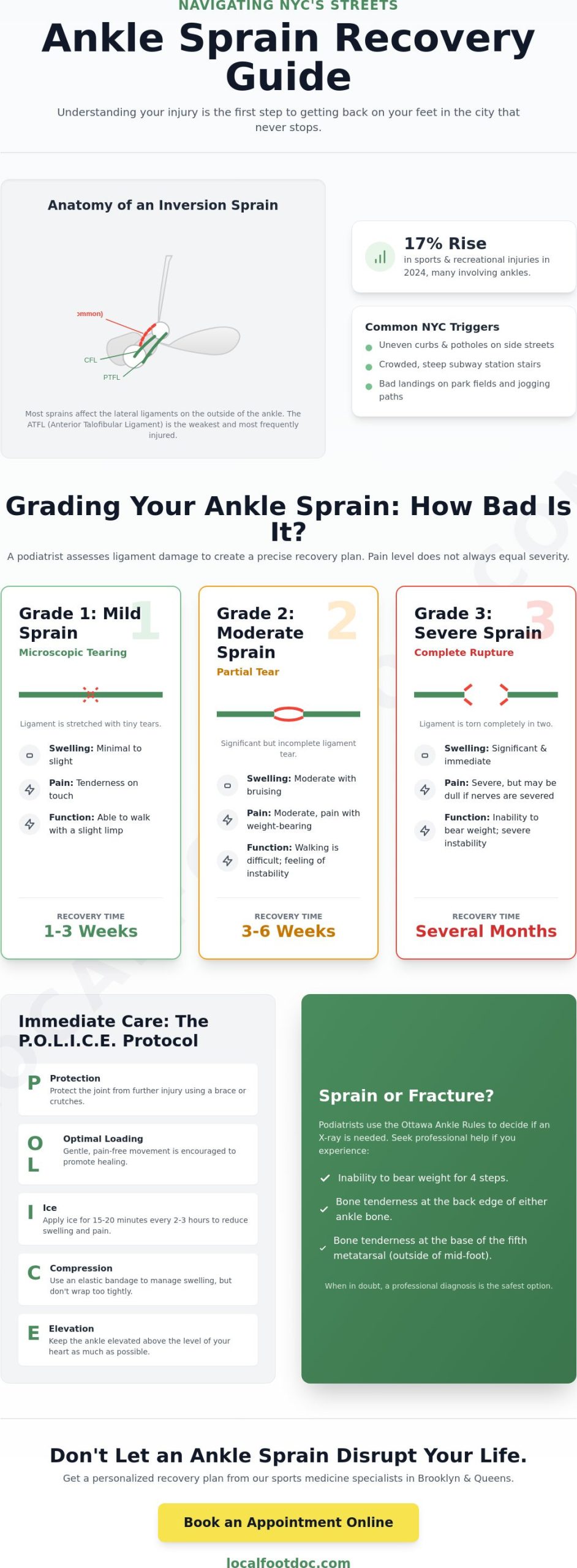
To provide a clear answer to the question What is an Ankle Sprain?, we look at the tough, fibrous bands of tissue called ligaments that connect your bones and provide joint stability. An ankle sprain happens when these ligaments are stretched or torn beyond their natural range of motion. In our fast-paced city, these injuries are rarely just a minor twist; they’re a direct disruption to your mobility. Because New Yorkers often clock over 10,000 steps a day just navigating their commute, the repetitive stress on these tissues is constant. This high-activity lifestyle means your lateral ligaments are frequently working overtime to keep you balanced on shifting terrain.
Most ankle sprains affect the outer side of the joint, involving the lateral ligament complex. This complex consists of three main structures: the Anterior Talofibular Ligament (ATFL), the Calcaneofibular Ligament (CFL), and the Posterior Talofibular Ligament (PTFL). The ATFL is the most vulnerable and is typically the first to suffer damage during a roll. When these tissues are overextended, they can fray or tear completely. This damage triggers the immediate inflammation, throbbing, and bruising that many patients experience before they even make it home from the subway.
Common NYC Triggers for Ankle Injuries
Living in the city means navigating a topographical obstacle course every day. We often treat patients who’ve lost their footing on the steep, crowded stairs of the Atlantic Avenue-Barclays Center station or tripped over a hidden pothole in a Brooklyn side street. Even our public parks contribute to the caseload. Weekend athletes at Astoria Park or Flushing Meadows frequently arrive at our clinics after a bad landing during a soccer match or a jog on uneven turf. These specific urban hazards make the risk of injury much higher than in a more predictable suburban environment.
The Anatomy of a Roll
Understanding how the injury occurs helps us determine the best path to recovery. Most urban incidents are inversion sprains, which happen when the foot turns inward and puts extreme tension on the outer ligaments. Eversion sprains involve the foot turning outward; while these are less frequent, they often involve more complex damage. Many of our patients report a distinct popping sensation at the moment of injury, which usually signals a significant stretching of the ligament fibers. It’s vital to remember that a sprain is an injury to the ligaments and not a break in the bone.
Grading Your Ankle Sprain: How Bad is it?
After the initial shock of a roll, your first priority is likely figuring out how long you’ll be off your feet. Not all ankle sprains are the same. We use a clinical grading system to assess how much damage the ligament fibers have sustained. This classification helps our team predict your recovery timeline and determine if you can safely navigate the several blocks to your nearest subway entrance. To determine the most effective treatment plan, we follow established protocols for Grading Your Ankle Sprain, which allows us to categorize the damage based on ligament integrity and joint stability.
Interestingly, the level of pain you feel doesn’t always match the severity of the injury. Some minor Grade 1 injuries cause sharp, stinging pain, while a complete Grade 3 rupture might feel surprisingly dull because the nerve endings in the ligament were also severed. This is why a professional assessment is vital. We focus on identifying “functional instability,” which is the feeling that your ankle might give way while you’re walking. For a New Yorker, this instability is a significant safety risk on crowded platforms or busy intersections. When we evaluate ankle sprains in our Brooklyn and Queens offices, we look for these subtle signs of weakness that could lead to future falls.
Grade 1: The Mild Stretch
A Grade 1 injury involves microscopic tearing of the ligament fibers. You’ll likely notice slight swelling and some tenderness when you touch the area. Most people can still walk, though you might find yourself limping slightly by the end of a long day. Full recovery usually takes between 1 to 3 weeks. If you feel a slight twinge but can still bear weight, our sports medicine specialists can help ensure you don’t turn a minor stretch into a chronic issue.
Grade 2 & 3: Moderate to Severe Tears
Grade 2 involves a partial tear of the ligament. You’ll see significant bruising and feel moderate pain that makes walking difficult. Grade 3 is the most serious, representing a full rupture of the ligament. In these cases, the ankle often feels completely unstable and you won’t be able to bear any weight. Because Grade 3 injuries can mimic the symptoms of a fracture, they require immediate professional evaluation to prevent permanent joint laxity. In 2024, clinical data showed that early intervention for severe tears significantly reduces the risk of long-term “giving way” episodes, helping you return to your normal routine faster.
The Big Question: Is My Ankle Sprained or Broken?
Most patients we see in Brooklyn and Queens arrive with one major concern: “Do I need an X-ray?” It’s a valid question when you’re dealing with a painful injury that makes it impossible to reach the nearest subway entrance. Understanding the Symptoms and causes of sprained ankles is the first step toward effective relief. While ankle sprains involve ligament damage, a fracture involves a break in the bone itself. The sensations can overlap significantly, but the clinical path to recovery is very different for each.
Our team utilizes a specific set of clinical guidelines known as the Ottawa Ankle Rules to determine if diagnostic imaging is actually necessary. This evidence-based approach helps us avoid unnecessary radiation and costs for our patients. If you can’t bear weight for at least four steps or if you experience pinpoint pain on the medial or lateral malleolus, those bony bumps on the sides of your ankle, we’ll likely order an X-ray. Pain from a sprain typically feels like a broad, dull throb or a hot, stinging sensation. In contrast, a fracture often produces a sharp, localized pain that feels like it’s coming from deep within the joint. If you’re unsure about your symptoms, you can read more about how to tell if your foot is broken or sprained.
Red Flags That Require Immediate Care
We advise all our patients to look for specific “red flags” that signal a potential fracture rather than a standard sprain. If you cannot take four steps immediately after the injury, even with a limp, it’s a strong indicator of bone involvement. Extreme tenderness specifically on the posterior edge or tip of the bony protrusions on your ankle is another warning sign. Finally, if you notice any visible deformity or misalignment of the foot, seek professional help immediately. These symptoms suggest more than just stretched ligaments and require a formal evaluation to ensure you don’t face long-term mobility issues or chronic instability.
The Role of Diagnostic Imaging
Imaging plays a vital role in our diagnostic process, especially since the incidence of ankle sprains presenting to U.S. emergency departments is 1.53 per 1,000 person-years as of May 2026. X-rays are the gold standard for identifying bone chips, cracks, or full fractures that might be hidden by swelling. While X-rays are efficient, they cannot visualize the soft tissue damage inherent in ankle sprains. When we suspect a complex injury, such as a high ankle sprain or a Grade 3 rupture, we may recommend an MRI to assess the ligaments and tendons. This level of detail is essential for creating a personalized recovery plan. An accurate diagnosis prevents the development of chronic joint laxity, ensuring you can return to the pavement without the fear of your ankle “giving way” during your morning commute.
Recovery and Rehabilitation for Active New Yorkers
Recovering from ankle sprains in a city that never stops requires a strategy more robust than just staying on the couch. While traditional advice often focuses on total rest, we utilize the modern P.O.L.I.C.E. protocol: Protection, Optimal Loading, Ice, Compression, and Elevation. The most critical shift for New Yorkers is “Optimal Loading.” This means we encourage controlled, pain-free movement as early as possible. Research presented in March 2026 confirms that early, graduated weight-bearing prevents the debilitating stiffness that often follows a period of total immobilization. By protecting the joint with a brace and introducing light activity, we help you maintain the mobility needed to get back on your feet and back to your commute.
Navigating the concrete jungle while injured involves practical adjustments to your daily routine. We recommend switching to high-top supportive sneakers or utilizing a lace-up ankle stabilizer that fits inside your work shoes. Our approach to sports medicine applies professional-grade recovery techniques to the everyday urban athlete, ensuring your ligaments heal with maximum strength and flexibility. If you’re struggling with persistent pain, you can schedule a consultation with our recovery experts to get a personalized rehabilitation plan.
The First 48 Hours: Managing Swelling
The initial two days are vital for controlling the inflammatory response. We suggest icing the area for 15 to 20 minutes every few hours to manage the throbbing sensation. When applying compression wraps, ensure they’re snug but not tight enough to cause tingling or numbness in your toes. Elevation is equally important; try to keep your ankle above the level of your heart whenever you’re at your desk or home. Even in a small apartment or a busy office, find a way to prop your leg up to encourage fluid drainage and reduce localized pressure.
Physical Therapy and Long-Term Stability
Once the initial swelling subsides, we focus on proprioception, which is your brain’s ability to sense the position of your joint. This is your body’s internal GPS. Exercises like standing on one leg while brushing your teeth help retrain these neurological pathways. We also emphasize strengthening the peroneal muscles on the outside of the lower leg. These act as your primary defense against future ankle sprains by pulling the foot back into a neutral position if it starts to roll. You should only transition from a protective brace back to normal footwear once you can perform these stability exercises without pain or a sense of “giving way.”
Expert Ankle Care at Local Foot Doc in Brooklyn & Queens
At Local Foot Doc, we recognize that a cookie-cutter approach doesn’t work for a New Yorker’s high-mileage lifestyle. Dr. Waldemar Majdanski brings specialized expertise in ankle trauma and sports medicine to every consultation, ensuring that ankle sprains are treated with the precision they deserve. We don’t just focus on the immediate pain; our team analyzes your specific biomechanics to understand how your injury occurred and how to prevent it from happening again. Whether you’re navigating the crowded streets of Astoria or the residential blocks of Forest Hills, our goal is to provide a clear, comforting path toward regained independence.
Our practice functions as a trusted local institution, combining advanced technology with the personal touch of a neighborhood doctor. We develop personalized treatment plans that account for your unique daily step count and activity level. By partnering with you in the healing process, we ensure you have the tools and confidence needed for getting back on your feet safely and permanently. We invite you to visit one of our convenient locations in Forest Hills, Astoria, or Woodhaven for a comprehensive evaluation of your injury.
Advanced Diagnostics in Our NYC Offices
We provide fast, accurate answers by utilizing in-office diagnostic imaging, which allows you to skip the long waits and high costs of a typical city emergency room. Our expert evaluation goes beyond a simple physical exam to assess ligament integrity and joint stability with clinical precision. Because we understand the demands of your job and lifestyle, we provide customized recovery timelines instead of vague estimates. This data-driven approach ensures your treatment plan is as efficient as the city you live in.
Why See a Podiatrist Instead of an Urgent Care?
While an urgent care center might provide a basic wrap, our specialists focus on the long-term biomechanics of the foot and ankle. We prioritize preventing chronic ankle instability, a condition that often stems from improperly treated ankle sprains. Our care plans include targeted rehabilitation to strengthen your joint against the uneven pavement of the five boroughs. If conservative treatments aren’t enough, you have direct access to a board-certified surgeon. It’s helpful to know that ankle ligament surgery has a high success rate, ranging from 85% to 95% according to 2026 clinical data, ensuring you have a reliable solution for even the most severe injuries.
Take Control of Your Urban Recovery Today
Navigating the city with a painful injury is a challenge no New Yorker should face alone. By understanding the clinical grade of your injury and following a structured rehabilitation plan, you can protect your long-term mobility. We’ve highlighted the importance of early, optimal loading and the specific red flags that distinguish ankle sprains from more serious fractures. Professional intervention is the most reliable way to prevent chronic joint weakness and ensure you’re ready for the miles of pavement ahead.
Dr. Waldemar Majdanski, a board-certified surgeon with over 20 years of NYC clinical experience, provides the specialized care required for complex foot and ankle trauma. Our team offers advanced diagnostics and personalized treatment plans at our convenient locations in Forest Hills, Astoria, and Woodhaven. Don’t let a temporary setback turn into a permanent limitation. Schedule your ankle evaluation at our Brooklyn or Queens office today to receive the expert guidance you need. We look forward to helping you regain your independence and getting you back on your feet with total confidence.
Frequently Asked Questions
How long does a sprained ankle take to heal?
Recovery timelines depend on the severity of the ligament damage. According to 2026 clinical standards, a Grade 1 injury typically heals within 1 to 3 weeks, while a Grade 2 partial tear may require 4 to 6 weeks. Severe Grade 3 ruptures often take 3 to 6 months of dedicated rehabilitation before you can return to high-impact activities. We focus on a structured plan to ensure your ligaments regain full strength for the NYC pavement.
Can I walk on a sprained ankle if it doesn’t hurt too much?
You can walk if your pain level is low, but you should use a supportive brace to protect the joint from another roll. Early, controlled weight-bearing is a key part of the modern P.O.L.I.C.E. protocol because it prevents joint stiffness. If you notice increased throbbing or new swelling after your commute, it’s a sign you’re overexerting the tissue and need to scale back your activity immediately.
What is the fastest way to get rid of swelling in my ankle?
The most efficient way to reduce swelling is combining active compression with elevation above the level of your heart. Apply ice for 15 to 20 minutes every 2 to 3 hours during the first 48 hours to constrict blood vessels and limit fluid buildup. Using a medical-grade compression wrap prevents fluid from pooling in the joint, which is a common problem for New Yorkers who spend long hours standing on the subway.
Should I go to the ER or a podiatrist for a sprained ankle in NYC?
A podiatrist is the preferred choice for specialized care and shorter wait times compared to a city emergency room. We provide in-office imaging and a deeper analysis of your foot biomechanics that general urgent care centers might overlook. You should only choose the ER if you see a visible bone deformity, have an open wound, or experienced high-energy trauma that suggests a complex, multi-level fracture.
Why does my ankle feel “loose” months after a sprain?
That “loose” sensation is often a sign of chronic ankle instability, which occurs in approximately 20% of cases where ankle sprains weren’t fully rehabilitated. This happens when the ligaments remain stretched or your proprioception, your body’s “position sense,” hasn’t recovered. We use targeted peroneal strengthening and balance exercises to retrain your nervous system and restore the natural stability of your joint, ensuring you feel secure on uneven sidewalks.
Can an old ankle sprain cause problems later in life?
Yes, an improperly healed injury can lead to post-traumatic osteoarthritis as you age. A 2024 study indicated that patients with a history of multiple ankle sprains have a significantly higher risk of cartilage wear by age 50. When the joint is unstable, it moves in ways that accelerate joint degeneration. Addressing these issues now with custom orthotics or physical therapy is essential for maintaining your mobility and independence in the future.
Is heat or ice better for an ankle sprain after the first day?
Ice remains the best choice for the first 72 hours to manage inflammation and numb sharp pain. After the initial swelling has stabilized, you can introduce heat to improve local blood circulation and reduce stiffness. Many of our patients find that applying a warm pack for 10 minutes before leaving for work helps the ankle feel more flexible and responsive during their morning walk to the train station.
How do I prevent rolling my ankle again on NYC sidewalks?
Prevention starts with strengthening the peroneal muscles on the outside of your leg and wearing shoes with a wide, stable base. Avoid walking while looking at your phone, especially near Brooklyn construction zones or uneven subway grates. We recommend simple balance drills, like standing on one foot for 30 seconds while brushing your teeth, which 2026 sports medicine guidelines suggest can reduce re-injury risk by up to 35%.