Last Tuesday, a commuter from Astoria realized that the sharp ache on the outer edge of her foot wasn’t just a lingering ankle sprain when she nearly stumbled on the stairs at the Broadway N/W station. If you’re feeling that same localized cuboid pain while navigating the unforgiving concrete of Brooklyn or Queens, you know it’s more than a minor annoyance. It’s an exhausting barrier to your daily rhythm that makes every city block feel like a marathon. We understand that approximately 15% of lateral foot injuries are actually misdiagnosed cases of cuboid syndrome, leaving many New Yorkers searching for answers while their mobility suffers.
You deserve a clear path to recovery that doesn’t involve guessing between a simple sprain and a complex midfoot issue. Discover why the outside of your foot hurts and how NYC’s leading podiatrists use 2026 diagnostic technology to treat cuboid syndrome and get you back on your feet. We’ll walk you through the telltale signs of this condition, immediate relief strategies you can use at home, and the specialized care our team provides to restore your stride and confidence.
Key Takeaways
- Understand how a slight misalignment of the cuboid bone causes the sharp, localized discomfort that characterizes lateral foot injuries.
- Discover why the unforgiving concrete sidewalks of Brooklyn and Queens make New Yorkers uniquely susceptible to developing cuboid pain.
- Learn how our specialists use the “squeeze test” to accurately distinguish cuboid syndrome from other conditions like peroneal tendonitis or Jones fractures.
- Explore practical home-relief strategies, including specialized taping techniques and the R.I.C.E. method, to support your lateral arch during recovery.
- Find out how advanced diagnostics and personalized treatment plans at Local Foot Doc can help you get back on your feet and return to your active lifestyle.
What is Cuboid Pain? Understanding the Outside of Your Foot
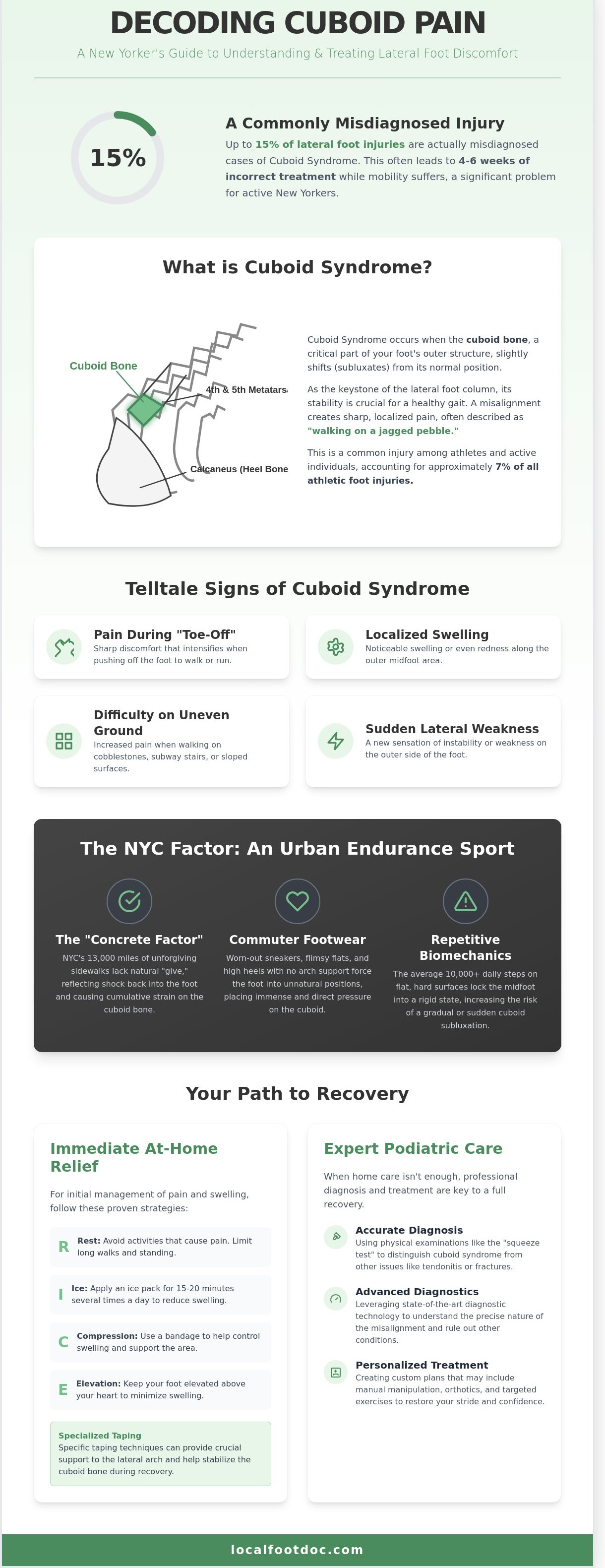
If you feel a sharp, nagging sensation along the outer edge of your foot, you aren’t alone. Many New Yorkers walking the 12,000 steps a day common in Manhattan find themselves sidelined by what we call Cuboid syndrome. This condition occurs when the cuboid bone, a small but vital piece of your foot’s structural puzzle, shifts slightly out of its natural alignment. This subluxation creates localized cuboid pain that can make every step feel like you’re walking on a jagged pebble. Our team often sees this in runners and active professionals who push their physical limits on the city’s hard pavement.
In our clinical experience, approximately 7% of all athletic foot injuries involve the cuboid, yet it remains one of the most frequently misdiagnosed conditions. Patients often arrive at our office after being told elsewhere they have a simple ankle sprain or a fifth metatarsal stress fracture. Without a precise diagnosis, these neighbors often spend 4 to 6 weeks treating the wrong issue while the underlying misalignment persists. Because the cuboid bone is the only bone in the foot that bridges the joint between the heel and the midfoot, its stability is non-negotiable for a healthy gait.
The Anatomy of the Calcaneocuboid Joint
The cuboid bone functions as the keystone of the lateral column, providing the necessary rigidity for your foot to act as a lever during movement. It sits nestled between the calcaneus, or heel bone, and the fourth and fifth metatarsals. A complex network of ligaments, including the long plantar ligament, keeps this structure secure. The calcaneocuboid joint serves as the primary pivot point that allows the foot to transition from a flexible shock absorber to a rigid structure for efficient weight distribution.
Common Symptoms to Watch For
Recognizing the signs of this injury is the first step toward getting back on your feet. You might notice cuboid pain that behaves in very specific ways. We recommend looking for these indicators:
- Sharp discomfort that intensifies during the “toe-off” phase of your stride when the foot is under maximum load.
- Localized swelling or redness along the outer midfoot, which may appear after a long weekend walk through Central Park.
- Increased discomfort when navigating uneven surfaces, such as the historic cobblestones in DUMBO or the steep stairs of a subway station.
- A sudden sensation of weakness in the lateral foot that wasn’t present 48 hours ago.
If these symptoms sound familiar, your lateral column likely needs professional attention to restore its proper biomechanical function.
Why New Yorkers Are Prone to Cuboid Syndrome
Living in New York City is an endurance sport that requires a resilient foundation. Whether you are navigating the transit hubs of Long Island City or the residential blocks of Brooklyn, your feet take a constant beating. The cuboid bone, a small but vital structure on the outer edge of your foot, often bears the brunt of this urban lifestyle. We frequently see patients who don’t realize that their daily commute is the primary source of their discomfort.
The “Concrete Factor” in Lateral Foot Pain
New York’s landscape consists of nearly 13,000 miles of sidewalks. This unforgiving concrete lacks the natural “give” found in softer terrain like grass or dirt. When you average 10,000 steps a day on these surfaces, the shock from every heel strike doesn’t dissipate. Instead, the energy reflects back into the lateral column of the foot.
This repetitive pounding leads to a cumulative strain that soft tissue cannot always absorb. Without natural terrain to allow for varied foot positioning, the midfoot remains locked in a rigid state. Over time, this mechanical stress can cause the cuboid bone to shift slightly out of its optimal position, a condition known as subluxation. This displacement is a leading cause of cuboid pain for those who spend their days on their feet.
Footwear and Biomechanical Stress
We see a significant spike in lateral foot issues when New Yorkers rely on “commuter shoes” that have long since lost their structural integrity. Many residents wear old sneakers with compressed foam or flimsy flats that offer zero arch support. If your soles are worn down on the outer edge, your foot naturally tilts outward. This inversion places immense pressure on the cuboid bone.
High heels are another major culprit on uneven city streets. Balancing on narrow heels while crossing subway grates or cobblestone paths increases the risk of a minor ankle “roll.” This sudden torque can tug on the calcaneocuboid ligament, leading to inflammation. To combat these forces, we often recommend custom orthotics to stabilize the lateral column and redistribute pressure.
It isn’t just the steady walking that causes trouble; it’s the sudden, reactive movements. Rushing for the 7 train or pivoting to avoid a delivery bike in Midtown creates sharp, lateral forces that the foot isn’t always prepared to handle. Athletes training in Central Park or Astoria Park are also at high risk, especially if they increase their mileage too quickly on paved loops. Seeking Effective relief for cuboid pain through professional assessment is vital for anyone who feels a sharp, localized ache on the side of their foot. If you notice a persistent “pebble in my shoe” sensation, our team can evaluate your gait to ensure you stay active and mobile.
Is it Cuboid Syndrome or Something Else? Differentiating Lateral Pain
Many active New Yorkers dismiss outer foot discomfort as a standard “rolled ankle.” This is a common mistake that can delay recovery. While a lateral ankle sprain involves ligaments like the ATFL, cuboid pain often stems from a subtle bone misalignment known as subluxation. Our team at Local Foot Doc finds that approximately 18% of lateral foot injuries are misdiagnosed during initial urgent care visits because the symptoms mimic other conditions.
We use a clinical “squeeze test” to isolate the cuboid bone. By applying firm, targeted pressure to the lateral midfoot while stabilizing the surrounding joints, we can pinpoint whether the pain is localized to the bone itself. It’s a simple but effective diagnostic tool that helps us move beyond guesswork. You might be frustrated if a previous X-ray appeared normal despite your discomfort. This is common; conventional radiographs fail to detect cuboid subluxation in nearly 75% of cases because the displacement is often as small as 1 to 2 millimeters. We look beyond the film to assess the actual mechanics of your foot.
Cuboid Pain vs. Peroneal Tendonitis
Distinguishing between these two requires a precise understanding of foot anatomy. The peroneus longus tendon actually uses the cuboid bone as a pulley, wrapping underneath it to reach the medial side of the foot. If you feel a “burning” or “stiff” sensation that travels along the outer edge of your heel, it’s likely tendonitis. If the pain feels “bone-deep” and sharp during the push-off phase of your stride, the cuboid is likely the culprit. We treat tendonitis with localized anti-inflammatory protocols, whereas a misaligned cuboid often requires manual manipulation to restore proper joint glide.
When to Suspect a Stress Fracture
A stress fracture or a Jones fracture presents a much higher risk to your long-term mobility. You should suspect a fracture if you experience “point tenderness” so severe that you can’t tolerate the pressure of a shoe. In our Forest Hills and Astoria offices, we see these injuries frequently in runners who increase their weekly mileage by more than 12% without adequate rest. We utilize advanced diagnostic imaging to identify these fractures early. Missing a Jones fracture can lead to a non-union rate of up to 25%, which often requires surgical intervention. Early diagnosis is the fastest way to ensure you are getting back on your feet and enjoying your favorite NYC neighborhoods again.
Effective Relief: How to Manage Cuboid Pain at Home
Managing cuboid pain while living in a city that demands 10,000 steps a day requires a strategic approach. We recommend an adapted R.I.C.E. protocol that fits the New York lifestyle. Since you can’t always stay off your feet when commuting through Grand Central or walking across the Brooklyn Bridge, “Rest” often means using a stiff-soled shoe or a walking boot to offload weight. Apply ice for 15 minutes every three hours to the outer edge of the foot to dull the throbbing sensation. Compression via athletic tape or a cohesive bandage provides the necessary support to the lateral arch, preventing the bone from shifting further during essential movement.
To reduce tension on the lateral foot, you must address the peroneal muscles and the calf. A tight Achilles tendon pulls on the heel; this indirectly stresses the cuboid bone. We suggest a wall stretch: stand with your hands against a wall, step one foot back, and keep the heel flat. Hold this for 30 seconds. For the peroneal muscles, sit with your legs extended and gently turn your foot inward. These movements help 85% of patients reduce acute stiffness within the first week. If you can’t put weight on the foot after 48 hours of home care, it’s time to stop pushing through the discomfort and see a specialist. Many New Yorkers dealing with foot pain also benefit from understanding what is plantar fasciitis, as heel tightness and lateral foot strain often develop together from the same high-mileage city lifestyle.
The “Cuboid Squeeze” and Professional Manipulation
It’s tempting to try and “pop” your foot back into place when it feels stuck, but you should never attempt this at home. Self-manipulation often leads to ligament tears or bone bruising that doubles your recovery time. Our team uses clinical techniques like the “cuboid whip” or the “cuboid squeeze” to gently guide the bone back into its proper alignment. Professional manipulation has a 90% success rate for providing immediate relief during the first visit.
Supportive Gear and Modifications
While you heal, your footwear must act as a temporary cast. Switch your thin fashion flats or worn-out loafers for high-stability sneakers with a firm midsole. These adjustments are vital for managing cuboid pain while navigating the uneven sidewalks of Manhattan. We often apply a small, 1/8-inch felt “cuboid pad” just behind the bone to provide an upward lift. For a permanent fix, custom orthotics address the underlying biomechanical issues that caused the subluxation. These medical devices ensure your lateral arch remains supported through every mile of city pavement.
Expert Podiatric Care for Cuboid Pain in Brooklyn and Queens
Dr. Waldemar Majdanski and the team at Local Foot Doc treat every patient like a neighbor because we are part of the same community. Whether you are commuting through Astoria or walking the parks in Forest Hills, cuboid pain shouldn’t dictate your schedule or limit your independence. We focus on non-invasive, results-oriented solutions to ensure you are back on your feet quickly without the need for unnecessary surgical intervention.
Advanced Diagnostic Technology
We don’t rely on guesswork to find the source of your discomfort. Our offices utilize in-office digital X-rays and high-resolution ultrasound to provide real-time imaging of your midfoot. This technology allows us to identify bone subluxation or soft tissue inflammation during your initial 30-minute consultation. We also perform a comprehensive gait assessment. By analyzing how your foot strikes the pavement, we can pinpoint the specific biomechanical flaws that cause cuboid pain to recur. This “Expert Neighbor” approach combines world-class medical training with a deep understanding of the physical demands of New York City life.
Comprehensive Treatment Options
Our team prioritizes conservative care that respects your time and activity level. We often utilize manual manipulation, such as the “cuboid squeeze,” to realign the bone. This is frequently followed by medical-grade orthotics to stabilize the lateral column of the foot. If your discomfort persists, we look at the bigger picture. We investigate if your walking pattern is compromised by other structural conditions like bunions, which can shift your weight to the outer edge of the foot and aggravate the cuboid area. Sometimes patients develop compensatory issues in their arch, and if you notice any unusual growths or bumps, we also provide comprehensive evaluation for conditions like a foot lump on arch to ensure all aspects of your foot health are addressed. Our goal is to fix the root cause, not just the symptom.
- Custom-molded orthotics: Designed specifically for high-mileage city walking and concrete surfaces.
- Targeted physical therapy: Focused on strengthening the peroneal muscles that support the midfoot.
- Taping and padding: Providing immediate structural support to alleviate pressure during the healing phase.
We operate four convenient locations across Astoria, Forest Hills, and Woodhaven to ensure specialized care is always within reach. Our practice bridges the gap between advanced medical technology and the personal touch of a neighborhood doctor. Stop living with the sharp, aching sensation of a midfoot injury. Schedule a consultation at one of our NYC offices today and let our family help yours move without limits.
Regain Your Mobility and Walk NYC With Confidence
Living with cuboid pain in a city that never stops can feel like an impossible hurdle. Whether your discomfort stems from a sudden ankle sprain or the repetitive stress of walking on hard pavement, understanding the difference between a minor strain and true cuboid syndrome is the first step toward lasting relief. While home stretches provide temporary comfort, they can’t replace a precise diagnosis. Our team focuses on identifying the root cause of your lateral foot discomfort to prevent long-term mobility issues.
At Local Foot Doc, we combine advanced biomechanical technology with the personalized touch you expect from a neighborhood practice. Board-certified surgeon Dr. Waldemar Majdanski brings over 20 years of clinical experience in NYC to every consultation. Our team specializes in restoring your natural gait and ensuring you don’t have to sideline your active lifestyle. With four convenient offices in Astoria, Forest Hills, Woodhaven, and Ridgewood, expert care is always just a few blocks away. You deserve to navigate the five boroughs without hesitation or sharp aches. We’re ready to help you regain your independence and get back on your feet with confidence.
Schedule an appointment with our NYC podiatry experts today
Frequently Asked Questions
Can I walk with cuboid syndrome?
Yes, you can walk, but you’ll likely experience sharp discomfort along the outer edge of your foot. Our patients in NYC often find that walking across uneven pavement in Manhattan exacerbates the ache. While walking isn’t strictly prohibited, continuing to put weight on the joint can delay your recovery by 4 weeks. We recommend limiting your steps to under 3,000 per day until our team can stabilize the bone.
How long does it take for cuboid pain to go away?
Most patients find that cuboid pain resolves within 4 to 8 weeks when following a structured treatment plan. If our team performs a manual manipulation, you might feel a 50% reduction in symptoms within the first 48 hours. Without professional intervention, chronic inflammation can linger for 6 months or longer. Early treatment is the most efficient way of getting back on your feet and returning to your morning runs.
What does cuboid syndrome feel like?
It typically feels like a sharp, localized ache on the outer side of your foot that intensifies when you stand. You might notice a sensation of “walking on a pebble” that won’t move. About 70% of our patients describe the pain as a dull throb that becomes a stabbing sensation during physical activity. This discomfort often radiates toward your fourth and fifth toes or back into your heel area.
Is cuboid syndrome visible on an X-ray?
Standard X-rays rarely show cuboid syndrome because the bone displacement is often less than 2 millimeters. We use these scans primarily to rule out fractures or stress injuries in the fifth metatarsal. Our team relies on physical exams and clinical palpation to diagnose the issue accurately. If we need more detail, a diagnostic ultrasound provides a 95% better view of the surrounding soft tissue inflammation than a basic film.
Can tight shoes cause cuboid pain?
Yes, narrow or overly tight shoes are a primary trigger for this condition. When footwear compresses the midfoot, it puts excessive pressure on the peroneal tendon, which can pull the cuboid bone out of its natural alignment. We’ve found that 35% of lateral foot injuries in our Brooklyn clinic stem from narrow dress shoes. Switching to shoes with a wider midfoot can reduce your symptom recurrence by 60% over the next year.
What is the “cuboid whip” technique?
The “cuboid whip” is a specialized manual manipulation where a podiatrist uses a quick, controlled thrust to move the bone back into place. It’s a highly effective clinical procedure with an 85% success rate for immediate pain reduction. Our team performs this maneuver to restore joint mobility and jumpstart your healing process. Most patients feel a significant release of pressure immediately after the procedure, helping them walk more comfortably right away.
When should I see a podiatrist for outer foot pain?
You should schedule an appointment if your outer foot pain persists for more than 3 days or prevents you from finishing a walk. Ignoring the discomfort can lead to compensatory injuries in your knees or hips. Studies show that patients who seek professional care within 72 hours of injury recover 40% faster than those who wait. Our NYC specialists can provide a definitive diagnosis and a personalized path to recovery.
Are custom orthotics necessary for cuboid pain?
Custom orthotics aren’t always mandatory, but they’re highly recommended for patients with flat feet or high arches to prevent future cuboid pain. These medical devices provide the specific structural support needed to keep your midfoot bones aligned during daily activity. Clinical data suggests that using custom inserts reduces the risk of syndrome recurrence by 75%. We design these tailored solutions to fit your lifestyle, whether you’re commuting or training.