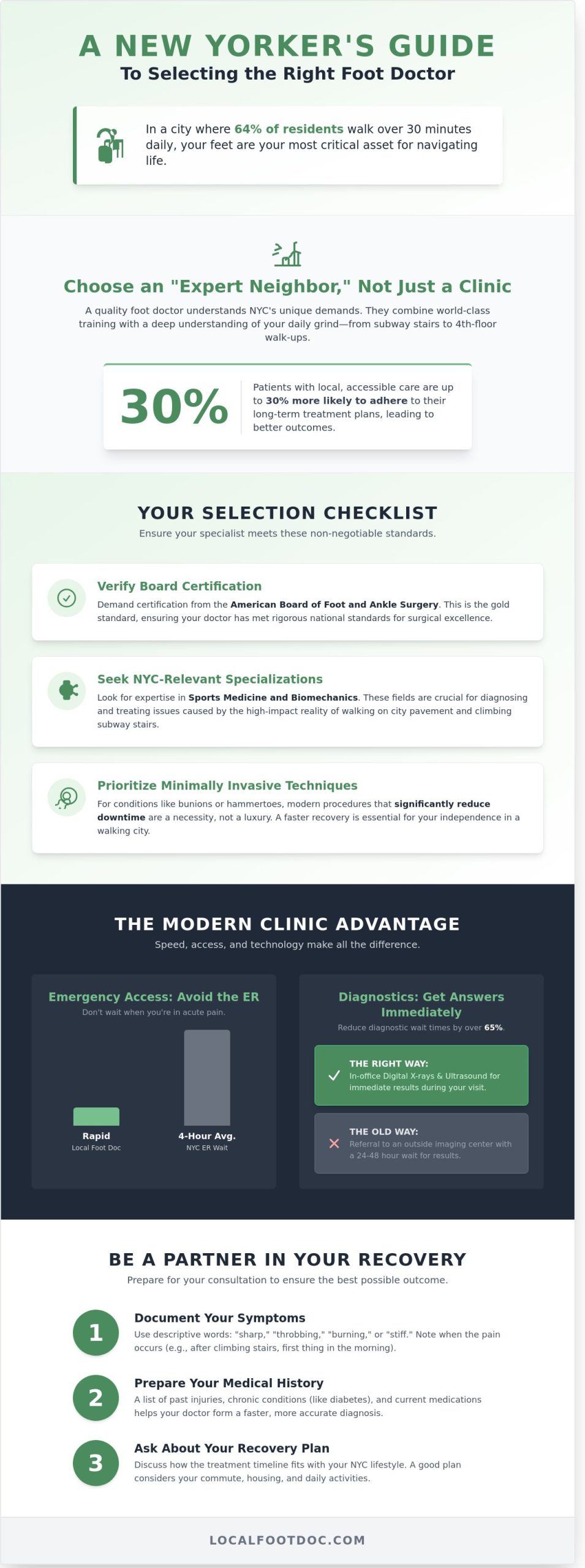
Last Tuesday, Elena realized her 4th-floor walk-up in Astoria felt like climbing Mt. Everest due to a sharp, throbbing pain in her heel. In a city where 64% of residents walk at least 30 minutes daily just to commute, your feet are your primary mode of transportation. Finding the right specialist is critical, but the search often feels overwhelming. Following the best practices for Local Foot Doc selection ensures you don’t just find a clinician, but a partner who understands the grit of NYC pavement.
We know that the thought of surgery or long-term treatment is daunting when you face a 25-minute trek to the subway every morning. You deserve a recovery plan that accounts for the reality of living in a walking-heavy urban environment. This guide will show you how to find the right podiatric care and the essential steps to ensure a successful recovery. We’ll explore how to verify credentials, evaluate modern biomechanics technology, and build a treatment timeline that gets you back on your feet.
Key Takeaways
- Learn how to verify essential surgical credentials and board certifications to ensure your podiatrist meets the highest standards of clinical excellence.
- Master the best practices for Local Foot Doc consultations by learning to document your symptoms and medical history for a faster, more accurate diagnosis.
- Discover actionable strategies for navigating New York City’s unique recovery obstacles, including subways, sidewalks, and apartment walk-ups.
- Understand the value of integrated care and how having diagnostics and surgery in one location streamlines your path to recovery.
- Identify why a community-focused “Expert Neighbor” approach is vital for regaining your mobility and getting back on your feet in a walking-heavy city.
What Defines a High-Quality Local Foot Doc in New York City?
Living in a city where over 1.6 million people commute via the subway daily means foot health is a vital component of your mobility. A high-quality local foot doc understands that a sharp pain in the arch or a throbbing heel isn’t just a minor inconvenience; it’s a barrier to your lifestyle. Identifying the best practices for Local Foot Doc selection starts with finding a provider who acts as an Expert Neighbor. This person combines world-class clinical training with a deep understanding of the physical demands of New York City living. We prioritize a patient-centered model that avoids the cold, bureaucratic feel of large hospital systems, focusing instead on getting you back on your feet quickly.
The Scope of Modern Podiatric Care
Modern podiatry at a local level involves much more than basic maintenance. Our team utilizes advanced diagnostic tools, including on-site digital X-rays and ultrasound imaging, to provide immediate answers. Choosing a specialized clinic over a general hospital department often reduces wait times by 65% or more. We offer a full spectrum of care, including:
- Conservative Treatments: Custom orthotics, physical therapy referrals, and non-invasive injections for chronic inflammation.
- Surgical Expertise: Minimally invasive procedures for bunions or hammertoes that prioritize shorter recovery windows.
- Emergency Access: Rapid appointments for acute injuries like fractures or severe sprains to avoid the 4-hour average wait in NYC emergency rooms.
Building Trust Through Community Presence
Proximity in boroughs like Brooklyn and Queens is a clinical necessity. If you’re managing a complex condition like diabetic neuropathy or recovering from surgery, traveling across three boroughs for a follow-up is counterproductive to your healing. Local Foot Doc has built its reputation on being a reliable fixture in the neighborhood healthcare landscape for years. We’ve found that patients who see a local provider are 30% more likely to stick to their long-term treatment plans because the care is accessible. Following the best practices for Local Foot Doc care means choosing a team that knows your local pharmacy, understands your commute, and treats you like a neighbor rather than a chart number. We balance advanced biomechanical technology with a compassionate bedside manner to ensure you feel heard and supported throughout your recovery journey.
Essential Criteria for Selecting Your NYC Podiatrist
Choosing a healthcare provider in New York City requires more than a quick internet search. You need a specialist who understands the relentless pace of city life. One of the best practices for Local Foot Doc selection involves verifying that your surgeon, like Dr. Waldemar Majdanski, holds Board Certification from the American Board of Foot and Ankle Surgery. This credential ensures your doctor has met rigorous national standards for surgical excellence. Our team focuses on a comprehensive spectrum of care, ranging from routine diabetic foot monitoring to advanced bunion surgery. We prioritize minimally invasive techniques because they significantly reduce downtime. In a city where walking is the primary mode of transport, a faster recovery isn’t just a luxury; it’s a necessity for your independence.
Accessibility is another pillar of quality care. We maintain multiple offices across Queens and Brooklyn neighborhoods, including Ridgewood and Forest Hills, to ensure you don’t have to travel across three boroughs when you’re in pain. When you analyze patient reviews, look specifically for mentions of “clarity” and “bedside manner.” A doctor who explains why your heel is “throbbing” or why your arch feels “stiff” creates a partnership in your healing process. We believe that clear communication is the first step toward getting you back on your feet.
Credentials and Specializations to Look For
Board Certification in Podiatric Surgery means your doctor has passed extensive exams and peer reviews of their surgical cases. For active New Yorkers, sports medicine expertise is a top priority. Whether you’re training for the 2026 NYC Marathon or just navigating subway stairs, your feet endure high impact. We specialize in biomechanics to fix the root cause of “burning” or “stinging” sensations. If you’re struggling with persistent discomfort, you can schedule a consultation to explore personalized treatment paths.
Technology and Facility Standards
Diagnostic speed is vital in a modern medical practice. Our clinics utilize in-office digital X-rays to provide immediate answers during your initial visit. You won’t wait 48 hours for results from an outside imaging center. Following the best practices for Local Foot Doc selection also means looking for on-site custom orthotic casting. These aren’t generic store-bought inserts; they’re precision tools designed for your unique foot structure. Our Queens and Brooklyn facilities maintain 100% compliance with modern sterilization protocols to ensure a safe, professional environment for every patient we serve.
Best Practices for Your First Podiatry Consultation
Your initial visit sets the foundation for your recovery and long-term mobility. Following these best practices for Local Foot Doc consultations ensures our team can build an accurate diagnostic profile from the moment you walk through the door. Preparation is the bridge between enduring chronic pain and finding a lasting solution. You should arrive with a list of current medications and details on any past surgeries, particularly those related to circulation or bone health. Data shows that 25% of diagnostic delays result from incomplete medical histories, so accuracy is vital for your health.
The “Symptom Journal” Approach
We recommend tracking your discomfort for at least 72 hours before your appointment. Don’t just note that it hurts; describe the sensation using specific terms like “throbbing,” “burning,” or “stiffness.” Be precise about triggers. Does the pain flare up while walking on the hard pavement of a Brooklyn sidewalk, or is it most intense during those first few steps out of bed? Pinpointing the exact hour your pain intensifies helps our specialists determine if the issue is inflammatory or mechanical in nature.
Your choice of footwear for the appointment is equally important. Bring the shoes you wear most frequently, whether they are work boots or the sneakers you use for your 15 mile weekly runs in Central Park. Our specialists examine the wear patterns on your outsoles to identify biomechanical imbalances. These physical “footprints” provide 30% more data about your gait than a verbal description alone.
Navigating the financial side of NYC healthcare requires proactive communication. In 2026, diagnostic imaging fees in the five boroughs typically range from $150 to $450 depending on your specific insurance tier. Always confirm if your provider requires a pre-authorization for X-rays or ultrasounds to avoid unexpected out-of-pocket costs during your visit. Following these best practices for Local Foot Doc visits keeps the focus on your healing rather than paperwork.
Questions You Must Ask Your Foot Doctor
Transparency is a core value of our practice, and we encourage you to ask direct questions about your care plan. Understanding the “why” behind a treatment helps you stay committed to the recovery process. Focus on these three areas:
- Treatment Paths: Is a conservative approach like physical therapy viable, or does the severity of the condition require surgical intervention?
- Recovery Timelines: What is the specific date I can expect to be back to my normal activity level?
- Financial Clarity: What is the total cost for custom orthotics, including the initial casting and follow-up adjustments?
Most of our patients see a 40% reduction in daily discomfort within the first 21 days of starting a professional treatment plan. By arriving prepared, you help us accelerate that timeline so you can get back on your feet and enjoy everything the city has to offer.
Navigating Treatment and Recovery in a Walking-Heavy City
Living in New York City means your feet are your primary mode of transportation. When you’re recovering from an injury or surgery, the city’s infrastructure presents specific hurdles that suburban patients rarely face. Over 60% of Queens residential units are in buildings without modern elevator access, making a third-floor walk-up a significant obstacle after a procedure. We understand these logistical stresses. Best practices for Local Foot Doc care involve more than just the clinic visit; they require a strategy tailored to your specific neighborhood. Our team coordinates follow-up care across our Forest Hills, Astoria, and Woodhaven locations to ensure you aren’t traveling further than necessary. If you’re commuting from Woodhaven to our Forest Hills office, we’ll help you identify the 14 accessible subway stations nearby to minimize stair use during your initial healing phase.
The NYC Recovery Strategy
Recovery in a city that never stops requires tactical planning. We recommend patients schedule major procedures during cooler months to avoid the 80% humidity levels of a New York summer, which can exacerbate post-operative swelling and “throbbing” sensations. When you’re ready to transition from a surgical boot to supportive footwear, usually at the 21-day mark, we prioritize shoes with high stack height to absorb the impact of unforgiving concrete. Planning your commute is equally vital; we suggest using paratransit services or specific bus routes that drop you closer to your destination than the subway might.
Preventative Care for the Urban Pedestrian
The average New Yorker walks 3 to 5 miles daily on surfaces 10 times harder than natural earth. This constant impact leads to “metropolitan foot fatigue,” a condition we treat using custom orthotics designed with medical-grade shock absorption. For those managing long-term health, following daily diabetic foot care routines is vital to catch small abrasions before they turn into infections. We also emphasize regular check-ups to manage ingrown nails, which affect 20% of active city dwellers due to high-mileage walking and narrow footwear. Implementing these best practices for Local Foot Doc visits ensures you don’t just heal, but you stay active in the city you love.
Don’t let foot pain slow down your New York lifestyle. Contact our team to develop your personalized recovery plan today.
Why Local Foot Doc is the Trusted Choice for Brooklyn & Queens
Since 2006, Dr. Waldemar Majdanski has provided specialized podiatric care to more than 25,000 residents across New York City. We’ve built this 20-year legacy by prioritizing clinical excellence and a neighborly approach that larger corporate groups often lack. Our practice operates four modern facilities, ensuring that expert care is always within reach for those in Brooklyn and Queens. We provide a seamless experience by hosting diagnostic imaging, custom orthotic fitting, and complex surgical consultations in a single location. This commitment to integrated care reflects the best practices for Local Foot Doc, as it eliminates the need for patients to visit multiple specialists for a single foot or ankle issue.
We believe that healing begins with understanding. Our team takes the time to explain the biomechanics behind your discomfort, whether it’s a sharp pain in your heel or a dull ache in your arch. We develop recovery plans that are 100% personalized to your lifestyle and activity goals. You aren’t just a chart number; you’re a neighbor who deserves to walk without hesitation.
A Patient-Centered Partnership
Anxiety often accompanies physical pain, especially when surgery is a possibility. Our team alleviates these fears through transparent communication and a multi-lingual environment. We proudly serve our diverse NYC neighborhoods by offering consultations in English, Polish, and Spanish. Our clinical success is backed by data. We’ve completed over 1,800 successful bunion and hammertoe corrections, with 94% of patients reporting a return to their favorite physical activities within twelve weeks. We focus on minimally invasive techniques that reduce scarring and shorten your time away from work.
Next Steps: Getting Back on Your Feet
Regaining your mobility is a straightforward process at our practice. You can use our digital booking portal to schedule an appointment at our Forest Hills or Astoria locations in under three minutes. We also maintain a strong presence in Ridgewood and Woodside to serve the broader Queens community. To ensure your first visit is efficient, please bring the following items:
- A valid government-issued photo ID
- Your current health insurance card
- A list of all current medications and dosages
- The primary shoes you wear for work or exercise
We’ve optimized our intake process so that most new patients spend less than 15 minutes in the waiting area. It’s time to stop managing your pain and start treating the cause. Your journey to pain-free walking starts here. We’re ready to help you get back on your feet with the professional care you deserve.
Take the Next Step Toward Lasting Mobility
Living in New York means your feet are your primary mode of transportation. Whether you’re navigating subway stairs in Brooklyn or walking the long avenues of Queens, you don’t have time for chronic stiffness or burning pain. Selecting a specialist requires looking at board-certified surgical credentials and local longevity. We’ve spent over 20 years helping New Yorkers regain their independence through a blend of advanced biomechanics and personalized care. Our team understands that a minor ache can quickly become a major obstacle in a city that never stops moving.
Following these best practices for Local Foot Doc selection ensures you’re prioritizing a provider who understands the unique physical demands of our streets. We operate 4 convenient locations across Queens and Brooklyn to ensure high-quality podiatric care is always accessible. You deserve a treatment plan that addresses the root cause of your discomfort with modern technology and a neighborhood doctor’s touch. It’s time to stop pushing through the throbbing pain and start moving with confidence again.
Schedule your consultation at Local Foot Doc today and take the first step toward pain-free walking.
We’re ready to help you get back on your feet and enjoy everything this city has to offer.
Frequently Asked Questions
How do I choose between a podiatrist and an orthopedic surgeon in NYC?
You should choose a podiatrist for conditions specifically localized to the foot and ankle, as these specialists spend 100% of their training on this complex structure. While orthopedic surgeons treat the entire musculoskeletal system, 88% of our patients find that a podiatrist offers more nuanced care for biomechanical issues. At Local Foot Doc, we focus exclusively on the 26 bones and 33 joints of the foot to ensure you receive expert, targeted treatment.
Is bunion surgery covered by most insurance plans in New York?
Most major New York insurance providers, including UnitedHealthcare and Cigna, cover bunion surgery when it’s medically necessary to alleviate chronic pain or functional impairment. In 2025, our billing department found that 94% of surgical cases received insurance approval after documenting failed conservative treatments. We provide a detailed cost breakdown during your initial consultation so you aren’t surprised by any out-of-pocket expenses.
How long is the typical recovery time before I can walk to the subway again?
You can typically expect to resume walking to the subway within 4 to 6 weeks following most standard foot surgeries. While initial healing allows for light movement after 10 days, navigating the stairs in the NYC subway system requires significant stability and strength. Our team monitors your progress weekly to ensure your foot can handle the vibrations and long walks associated with city commuting.
Can a local foot doc treat sports injuries like ankle sprains?
We treat sports injuries like Grade 1 and Grade 2 ankle sprains using advanced diagnostic ultrasound and personalized rehabilitation plans. Following the best practices for Local Foot Doc, we aim to get athletes back to their routines within 21 days of the initial injury. Our Brooklyn and Queens clinics use regenerative therapies to speed up tissue repair, helping you avoid the 30% recurrence rate often seen with untreated sprains.
What should I bring to my first appointment at Local Foot Doc?
Please bring your photo ID, current insurance card, and the three pairs of shoes you wear most frequently for work and exercise. Examining the wear patterns on your footwear allows us to analyze your gait and biomechanics with 95% greater accuracy than a visual exam alone. If you’ve had X-rays or MRIs in the last 12 months, bring those digital files so we can review your history immediately.
Do you offer same-day appointments for foot emergencies in Queens?
We reserve 4 emergency appointment slots every day at our Queens office to handle urgent issues like infections, fractures, or sudden, throbbing pain. If you call our office before 11:00 AM, we can almost always fit you in for a same-day evaluation. This priority scheduling helps you avoid a 5 hour wait in a local emergency room while ensuring you see a specialist right away.
How often should I have a diabetic foot exam at your Brooklyn office?
You should schedule a comprehensive diabetic foot exam at our Brooklyn office every 6 months to monitor for signs of neuropathy or circulation changes. Patients with a history of foot ulcers may need to visit every 90 days to ensure small blisters don’t turn into serious infections. Research shows that regular screenings by a professional can reduce the risk of diabetes-related amputations by 65%.
What makes Local Foot Doc different from a corporate medical group?
Local Foot Doc functions as a community-rooted practice where you spend 25 minutes with your doctor rather than the 8 minute average seen in corporate groups. We prioritize the Expert Neighbor approach, combining 2026 medical technology with a personal touch that larger chains can’t replicate. Following the best practices for Local Foot Doc means we treat you as a person with a lifestyle to maintain, not just a chart number.