Last Tuesday, Sarah found herself gripping the subway pole on the L train, her big toe joint throbbing before she even reached Union Square. Like many of the 3.9 million daily subway riders navigating New York City, she’s realizing that our concrete landscape is unforgiving on the feet. If you’ve started noticing that familiar burning sensation or a visible shift in your toe’s alignment, you’re likely searching for how to prevent bunions from getting worse without sacrificing your career or your morning commute.
We understand the anxiety of watching a bunion progress and the fear that a long surgical recovery might sideline you from the city you love. You deserve to walk through Chelsea or Midtown without calculating every step for pain. In this 2026 guide, our team outlines the precise clinical adjustments and lifestyle shifts that halt deformity and provide immediate relief. We’ll explore everything from advanced biomechanical supports to the exact moment professional intervention becomes mandatory, ensuring you stay mobile and confident as you get back on your feet.
Key Takeaways
- Master the “Commuter Swap” strategy to protect your MTP joint from the daily physical demands of NYC transit and office life.
- Discover clinical strategies for how to prevent bunions from getting worse by breaking the structural “vicious cycle” of Hallux Valgus.
- Implement a daily “Foot Reset” routine designed to alleviate the throbbing and stiffness caused by standing all day on city pavement.
- Learn how to identify the critical signs that home care is no longer enough and why waiting too long can lead to permanent joint issues.
- Explore how personalized podiatric care at our Astoria, Forest Hills, and Woodhaven clinics can help you get back on your feet and stay active.
Understanding Hallux Valgus: Why Bunions Progress Over Time
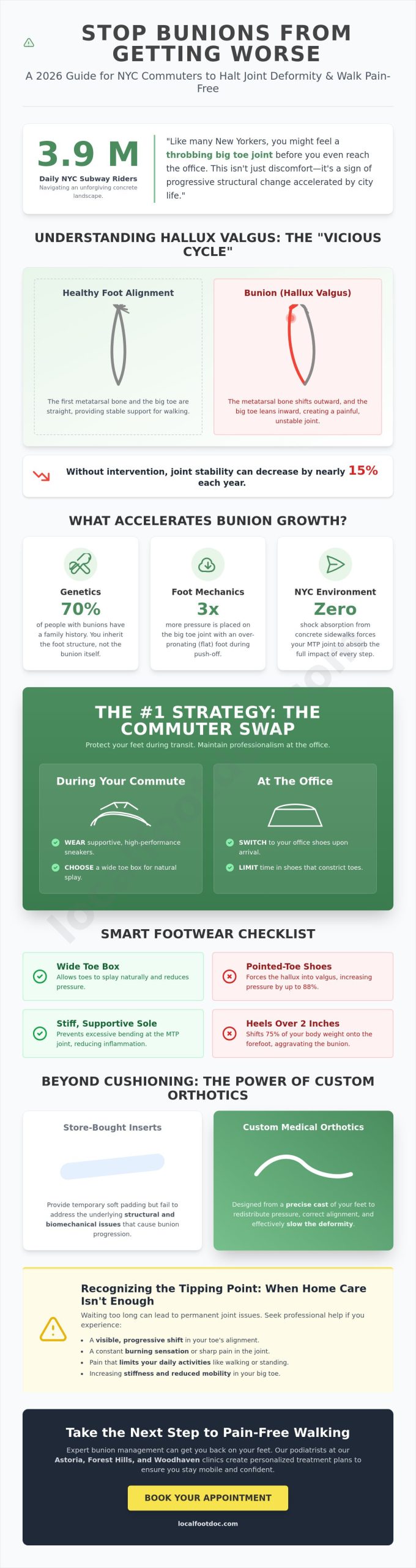
Many people mistake a bunion for a simple skin growth or a localized swelling, but it’s actually a complex structural shift in the foot’s framework. A bunion is a progressive misalignment of the first metatarsal bone. This condition, clinically known as Hallux Valgus, occurs when the long bone in the forefoot shifts outward while the big toe leans inward toward the other toes. This creates a “vicious cycle” where the more the toe tilts, the more the mechanical forces of your gait pull the joint further out of place. Our team at Local Foot Doc frequently observes that once this shift begins, the joint’s stability decreases by nearly 15% each year without intervention.
Genetics play a primary role in how quickly this deformity advances. Research suggests that approximately 70% of people with bunions have a family history of the condition. You don’t necessarily inherit the bunion itself, but you do inherit a specific foot structure, such as low arches or hypermobile joints, that makes you more prone to progression. Identifying these hereditary traits early is a crucial part of learning how to prevent bunions from getting worse before they limit your daily activities.
The Anatomy of a Growing Bunion
As the joint moves further out of alignment, the tendons and ligaments that are supposed to keep the toe straight begin to pull at abnormal angles, which worsens the deformity. This mechanical failure often leads to the inflammation of the bursa, the fluid-filled sac that cushions the joint. This inflammation is what causes the sharp, burning sensation that many New Yorkers feel after a long day of walking. This progression is often accelerated by an over pronation foot, which places 3 times more pressure on the big toe joint during the “push-off” phase of every step.
Why NYC Commutes Accelerate Bunion Growth
Living in the five boroughs puts unique, repetitive stress on your feet that residents of other cities may not face. The hard concrete sidewalks of Brooklyn and Queens provide zero shock absorption, forcing the first MTP joint to absorb the full force of your body weight with every block you walk. “Subway surfing,” the act of balancing on a moving train without holding a rail, requires constant micro-adjustments in the forefoot that strain the joint. Seasonal changes in New York also play a role. Swapping supportive winter boots for thin, unpadded flats in the summer can cause a 20% increase in reported foot pain. Understanding these local environmental triggers is essential when figuring out how to prevent bunions from getting worse in a city that demands constant movement.
Strategic Footwear and Custom Orthotics for the NYC Commuter
Walking is the lifeblood of New York City, but the 12,000 steps a typical commuter takes daily can accelerate joint deformity if your footwear is poor. We frequently recommend the “Commuter Swap” as a foundational strategy for our patients. This involves wearing supportive, high-performance sneakers during transit and switching to office shoes only after you arrive at your desk. This simple habit is one of the most effective ways to understand how to prevent bunions from getting worse while maintaining a professional appearance.
The mechanics of your shoe are vital. Pointed-toe fashion is a primary driver of pain because it forces the hallux into a valgus position, increasing pressure on the medial joint by up to 88%. You should prioritize a wide toe box that allows your toes to splay naturally. Additionally, keep heel heights under two inches. Anything higher shifts nearly 75% of your body weight onto the forefoot, which aggravates the bunion. We also look for sole rigidity; a stiff sole prevents the metatarsophalangeal (MTP) joint from excessive bending, which reduces inflammation during the “toe-off” phase of your gait.
The Role of Custom Orthotics in Preventing Progression
Store-bought “cushion” inserts often fail because they provide soft padding without structural correction. Our custom orthotics are medical-grade devices designed to redistribute pressure away from the bunion and back toward the midfoot. For Expert Bunion Management, we use a precise casting process at our Forest Hills and Astoria locations. This ensures a fit that addresses your specific biomechanical imbalances, effectively slowing the progression of the deformity by stabilizing the foundation of your foot.
Choosing the Right Shoes for a Walking City
In 2026, New York professionals have better options than ever. Look for brands like Hoka, Brooks, or Altra, which offer professional-looking models with wide toe boxes and shock-absorbing midsoles. When you go shopping, always go in the late afternoon. Your feet typically swell by 5% to 8% after a day of walking, so a shoe that fits at 4:00 PM won’t pinch during your evening commute. Look for these specific features:
- Wide Toe Box: Ensures no lateral pressure on the big toe.
- Arch Support: Prevents the foot from collapsing inward (overpronation).
- Rocker Bottom Soles: Reduces the force required to push off the ground.
If you’ve noticed your shoes are wearing unevenly or your bunion is throbbing after a trip on the 7 train, it’s time to evaluate your alignment. You can schedule a biomechanical assessment with our team to find the perfect fit for your lifestyle.
Effective Home Remedies and Exercises to Slow Bunion Growth
Living in New York means your feet endure thousands of steps on concrete daily. Our team recommends a “Foot Reset” routine every evening to mitigate the strain of a long day in the city. While these Effective Home Remedies won’t reverse the bone’s position, they are vital tools for anyone wondering how to prevent bunions from getting worse. It’s essential to understand that home care manages the inflammation and muscle fatigue rather than fixing the underlying hallux valgus deformity itself.
After a long commute from Brooklyn to Midtown, your bunion joint might feel like it’s throbbing or burning. We suggest the RICE method: Rest, Ice for 15 minutes, Compression with a light wrap, and Elevation above your heart level. This simple protocol reduces the localized swelling that often accelerates joint degradation. Remember, these steps are management tools. They help you stay active, but they don’t replace a professional evaluation of your foot’s biomechanics.
Strengthening the Intrinsic Foot Muscles
Building the small muscles inside your foot helps stabilize the big toe and provides better support for your arch. When your arch is strong, it reduces the medial load on the bunion joint. We suggest incorporating these two exercises into your daily routine:
- Towel Curls: Sit with your feet flat on the floor. Place a small hand towel under your toes and use them to scrunch the fabric toward your heel. Perform 3 sets of 10 repetitions to improve arch strength.
- Toe Splaying: Try to spread your toes apart as wide as possible without lifting them off the ground. This targets the abductor hallucis muscle, which helps keep the big toe straight. Hold the splay for 5 seconds and repeat 15 times.
Night Splints and Padding: What Actually Works?
Our patients often ask about the latest “correctors” advertised online. We must be clear: no device can realign a bunion overnight without surgery. However, certain products have a place in your care plan. Bunion sleeves, for example, are excellent for reducing friction against your shoes during a 20 minute walk to the subway. They don’t move the bone, but they protect the skin from painful calluses and bursitis.
Night splints can also be helpful for some New Yorkers. These devices provide a prolonged stretch to the adductor muscles, which often get tight and pull the toe further out of alignment. While they won’t cure the deformity, they can alleviate the stiffness you feel when you wake up. Avoid any product that claims to be a permanent “cure.” We want you to focus on realistic management that keeps you moving through your neighborhood comfortably.
Recognizing the Tipping Point: When Prevention Is Not Enough
Most New Yorkers we see in our clinics express the same goal: they want to avoid the operating room at all costs. We understand that hesitation. While our primary focus is teaching you how to prevent bunions from getting worse, there is a physiological threshold where conservative measures lose their effectiveness. Delaying treatment past this point often transforms a straightforward correction into a complex reconstruction. Bunions affect approximately 23% of adults aged 18 to 65; for many, the condition eventually outpaces the benefits of wider shoes and toe spacers.
When the big toe joint remains misaligned for years, the protective cartilage begins to wear down. This leads to hallux rigidus, or “stiff big toe” arthritis, which is significantly more difficult to treat than a standard bunion. The shift in pressure often forces the second toe to cross over, creating painful hammertoes that require their own surgical fixes. A proactive evaluation by a foot doctor in Brooklyn can determine if you are nearing this critical juncture. Our team uses these consultations to help you stay ahead of the pain before permanent joint damage occurs.
3 Red Flags That Your Bunion Needs Professional Intervention
- Persistent pain in supportive footwear: If you’ve switched to wide-toe-box shoes and still experience a burning or throbbing sensation after a walk through Prospect Park, the joint inflammation is likely chronic.
- Loss of range of motion: Inability to move the big toe upward or downward indicates the joint is “jamming.” This mechanical failure accelerates cartilage erosion and makes 2026 mobility goals harder to reach.
- Secondary complications: This includes severe, painful calluses on the ball of the foot or issues requiring specialized diabetic foot care. For patients with diabetes, a bunion is a high-risk area for skin breakdown and infection that requires immediate medical attention.
The Myth of “Wait and See” in Podiatry
Bunions are a progressive structural deformity. They don’t heal like a bruise or a strain. They only move in one direction: worse. In our practice, we use advanced digital X-rays to measure the intermetatarsal angle with 99% precision. This data allows us to predict the rate of progression rather than guessing. Establishing a baseline now means we can monitor changes over the next 12 months and intervene before the bone structure requires a more invasive procedure.
Proactive care is not about rushing into surgery. It’s about gathering the data needed to keep you active. If your bunion has started to change the way you walk or the way your other toes sit, you have reached the tipping point. We want to help you get back on your feet with the least invasive path possible. Taking action early is the most effective way to ensure you stay mobile on the streets of New York.
Schedule your professional evaluation today to protect your long-term mobility.
Expert Bunion Management at Local Foot Doc in Brooklyn & Queens
At Local Foot Doc, Dr. Waldemar Majdanski and our team believe that high-quality podiatry should be accessible, clinical, and deeply empathetic. We’ve equipped our clinics in Astoria, Forest Hills, and Woodhaven with state-of-the-art digital X-ray and diagnostic imaging technology to identify the exact stage of your joint misalignment. Our primary goal is to help you understand how to prevent bunions from getting worse without jumping straight to the operating table. We prioritize a conservative-first philosophy, exhausting every non-surgical option before discussing a permanent correction. Our mission is centered on getting back on your feet and regaining the independence that defines an active NYC lifestyle.
We see the foot as the foundation of your entire day. When that foundation is compromised by a throbbing or burning sensation at the base of the big toe, it affects your work, your exercise, and your mental well-being. By combining advanced medical technology with a traditional bedside manner, we ensure you feel heard and supported throughout your recovery journey. We don’t just treat symptoms; we address the underlying biomechanical issues that cause bunions to progress in the first place.
Personalized Treatment Plans in NYC
We don’t believe in one-size-fits-all medicine because no two New Yorkers share the same daily routine. A marathon runner training in Astoria Park has different biomechanical needs than a commuter walking 15 blocks from the subway in Forest Hills. Our team integrates sports medicine principles into every plan to ensure a more stable and resilient recovery. We look at your footwear, your daily step count, and your gait to create a strategy that fits your life. With multiple locations across the boroughs, follow-up care is convenient and fits into your busy schedule. Whether it’s custom-molded orthotics or targeted physical therapy, we tailor every recommendation to your specific activity level.
Minimally Invasive Options for Busy New Yorkers
Sometimes, conservative measures aren’t enough to stop the pain or halt the progression of the deformity. In those cases, we offer modern, minimally invasive surgical techniques that prioritize your time and mobility. These procedures use smaller incisions than traditional methods, which often leads to less swelling and a significantly faster walking recovery. We understand the unique logistics of living in New York City, where “taking it easy” is rarely an option. Our team manages the details of your care, from pre-operative testing to post-surgical mobility tips for navigating your apartment or the local transit system.
Taking the first step toward pain-free walking is often the hardest part of the process, but you don’t have to do it alone. We’re here to provide the clinical expertise and community-focused care you need to succeed. Don’t let foot pain dictate your boundaries or keep you from the things you love. Let’s work together on how to prevent bunions from getting worse so you can keep moving forward with confidence and comfort.
Take the Next Step Toward Pain-Free NYC Commutes
Navigating the busy streets of New York shouldn’t feel like a chore because of persistent foot pain. While you’ve learned how to prevent bunions from getting worse through strategic footwear choices and targeted home exercises, professional intervention is often the key to long-term mobility. Board-certified surgeon Dr. Waldemar Majdanski utilizes over 20 years of NYC clinical experience to help patients manage Hallux Valgus progression before it requires more invasive measures. Our team focuses on a blend of advanced technology and compassionate care to keep you active in your community.
Whether you need custom orthotics for your daily trek or a comprehensive evaluation of your biomechanics, we offer convenient care at our offices in Forest Hills, Astoria, and Woodhaven. We’re committed to helping you maintain your independence and comfort. Schedule your bunion consultation at our Brooklyn or Queens office today and let us help you find a clear path to recovery. It’s time to stop worrying about your feet and start focusing on your destination. We’ll ensure you stay moving with confidence through every borough.
Frequently Asked Questions
Can I reverse a bunion naturally without surgery?
No, you cannot naturally reverse a bunion because it’s a permanent structural change in your foot’s bone alignment. While 15 minutes of daily toe exercises can strengthen the surrounding muscles, they won’t pull the bone back into its original position. Our team focuses on how to prevent bunions from getting worse through non-invasive therapies. We aim to manage your pain and stop the progression so you can stay active on NYC streets.
Do bunion correctors actually work to straighten the toe?
Bunion correctors provide temporary symptomatic relief but don’t permanently straighten the toe bone. These devices often help align the joint while you wear them at night; however, the 2021 Journal of Foot and Ankle Research findings indicate they don’t provide long-term structural correction. We often recommend them as part of a broader strategy to alleviate the throbbing sensation after a long day of walking. They’re a tool for comfort, not a permanent cure.
How long can I wait before my bunion requires surgery?
You can delay surgery indefinitely as long as your pain remains manageable and doesn’t limit your mobility. Statistics show that 70% of our patients successfully manage their symptoms for 5 to 10 years using custom orthotics and proper footwear. We only recommend surgical intervention when your daily activities, like walking to the subway, become consistently painful. Our goal is to keep you moving comfortably using the most conservative methods possible first.
Will wearing wider shoes actually stop my bunion from getting worse?
Yes, switching to wider shoes is a primary way to learn how to prevent bunions from getting worse. Narrow footwear increases lateral pressure on the big toe joint by up to 20 pounds per square inch. By choosing shoes with a toe box wider than 3.5 inches, you allow your toes to splay naturally. This simple change reduces the friction and inflammation that typically accelerate the growth of the bony bump.
Does walking on NYC concrete make bunions progress faster?
Walking on NYC concrete definitely accelerates bunion progression because hard surfaces provide zero shock absorption. Concrete is 10 times harder than asphalt, which means every step sends a jarring force directly into your hallux joint. This repetitive impact leads to the burning and stiffness many New Yorkers feel during their commute. We suggest high-rebound cushioning in your shoes to protect your feet from the unforgiving city pavement and maintain your independence.
Are bunions hereditary, and can I prevent them if my parents had them?
Bunions are largely hereditary, with 63% of cases linked to a family history of foot mechanics. While you can’t change your genetics, you can prevent the deformity from becoming severe by addressing your foot’s biomechanics early. If your parents suffered from foot pain, we recommend a gait analysis by age 25. Identifying overpronation early allows our team to prescribe custom orthotics that stabilize the joint and prevent the hereditary shift from worsening.
What is the best type of arch support for someone with a growing bunion?
Custom-molded orthotics provide the best support because they’re designed to correct your specific biomechanical imbalances. Unlike generic store-bought inserts, custom versions provide 3 times more stability to the first metatarsal bone. This precision helps redistribute your weight away from the big toe joint. Our Queens office uses 3D scanning technology to create these supports, ensuring your foot stays properly aligned during every mile you walk through the city.
When should I see a podiatrist in Queens for my bunion pain?
You should schedule a visit to our Queens podiatry clinic if you experience sharp pain 3 or more times per week. Don’t wait until your big toe crosses over the second toe or when the joint angle exceeds 15 degrees. Early intervention allows us to use advanced technology to track the progression and implement preventative care. We’re here to help you find a clear path to recovery so you can get back on your feet quickly.