You’re standing in your West Village apartment on a Tuesday morning in 2026, staring at those leather boots you haven’t worn since last winter. You’re exactly 90 days into your journey, yet that persistent puffiness around your big toe makes you wonder if you’ll ever navigate the subway stairs with your old confidence. It’s a common frustration for New Yorkers who are used to a fast pace. We know that feeling of recovery fatigue when the city is moving at full speed and your foot feels like it’s lagging behind. Understanding what to expect 3 months after bunion surgery is the best way to quiet that inner anxiety and confirm your healing is actually right on track.
Our team has guided over 2,500 patients through this exact 90 day milestone. We’ve seen that while the initial bone healing is largely complete, the soft tissues are still finding their rhythm. In this guide, we’ll outline the specific visual and physical markers of a successful recovery at the three month mark. You’ll discover three actionable steps to finally reduce that stubborn, late stage swelling and a clear, 2026 updated timeline for returning to high impact workouts and your favorite Manhattan activities.
Key Takeaways
- Understand why the 90-day mark represents the critical transition from “medical recovery” to “functional resumption” for your foot.
- Learn exactly what to expect 3 months after bunion surgery regarding persistent swelling and how to manage the unique physical demands of a New York City lifestyle.
- Discover proven strategies for safely navigating subway commutes, stairs, and crowded city sidewalks as your bone continues to harden and remodel.
- Identify the clear differences between normal surgical aches and clinical red flags that warrant a professional evaluation at our Brooklyn or Queens locations.
- Explore how targeted physical therapy and personalized care help you restore a natural walking gait and finally get back on your feet with confidence.
The 3-Month Milestone: Why 90 Days is a Turning Point for Bunion Recovery
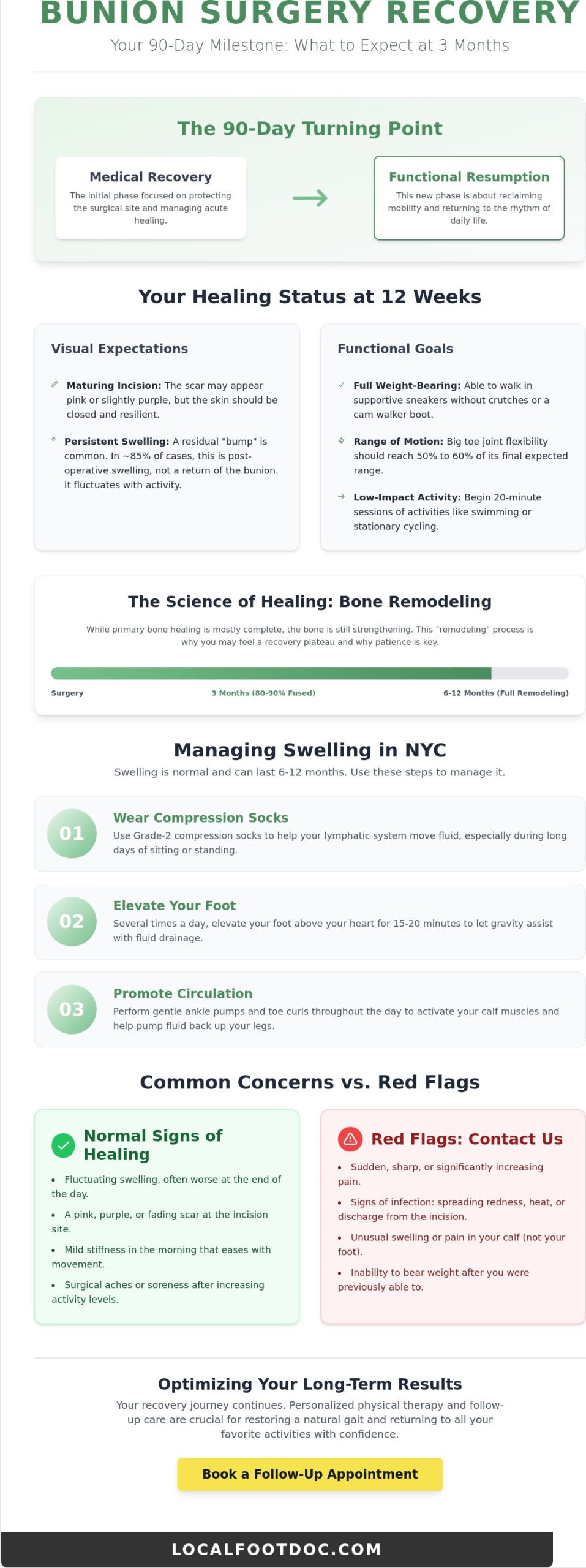
The 90-day mark represents a significant shift in your healing journey; at our Manhattan practice, we often describe this period as the transition from medical recovery to functional resumption. While the first few weeks focused on protecting the surgical site, the three-month milestone is about reclaiming your mobility and returning to the rhythm of New York City life. By this stage, the primary bone fusion is typically 80% to 90% complete. However, your soft tissues are still working hard to adapt to your foot’s new alignment.
When patients ask our team what to expect 3 months after bunion surgery, we explain that this is the “functional turning point.” It’s common to feel a sense of frustration during this phase, as patients often experience a recovery plateau where day-to-day improvements aren’t as dramatic as they were in month one. If you feel like your progress has slowed down, don’t worry. You are likely right on track. Understanding bunion surgery recovery requires patience, as your body continues to refine the internal repair work long after the initial incision has healed.
Visual Expectations: What Your Foot Looks Like Now
At 12 weeks, your incision site has moved into the maturation phase. The scar may appear pink or slightly purple, but the skin should be closed and resilient. One frequent concern we hear involves a residual bump near the big toe. In approximately 85% of cases at this stage, this isn’t a return of the deformity, but rather persistent post-operative swelling that can fluctuate based on your activity level or the humidity in the subway.
Remodeling is the biological process where your body reshapes and strengthens the surgical site over a 6 to 12-month period.
Functional Goals for the 12-Week Mark
If you are wondering what to expect 3 months after bunion surgery regarding your daily routine, you should be ready to ditch the surgical boot for good. Our primary goals for you at this stage include:
- Full Weight-Bearing: You should be able to walk in supportive sneakers without the help of crutches or a cam walker.
- Range of Motion: We look for a hallux joint flexibility that reaches at least 50% to 60% of its final expected range.
- Low-Impact Activity: This is the ideal time to begin 20-minute sessions of swimming or stationary cycling to improve circulation.
Persistent Swelling and Bone Healing: The Science of Your Foot at 12 Weeks
Reaching the 12-week milestone is a significant achievement in your recovery journey. By now, most of our patients have transitioned out of surgical boots and back into supportive sneakers. However, understanding what to expect 3 months after bunion surgery requires a look at both the visible skin and the internal bone structure. While you’re likely walking more freely through neighborhoods like Chelsea or the Upper East Side, you’ll notice that your foot still tells a story of healing through daily fluctuations in size and sensation.
Gravity is the primary challenge for New Yorkers at this stage. Our team often explains that your foot is the most dependent part of your body. After a full day of standing or commuting, blood and fluid naturally pool in the lower extremities. This isn’t a sign that the surgery failed; it’s a physiological reality of recovery from bunionectomy. Your “venous return”—the mechanism that pumps blood back up to your heart—is still recalibrating after the trauma of surgery. You should anticipate lingering swelling for 6 to 12 months, especially as you increase your daily step counts on the city’s unforgiving pavement.
Why is My Foot Still Swollen?
Surgery temporarily disrupts your lymphatic drainage, the “waste removal” system of your tissues. In 2026, we’re seeing more patients return to high-activity lifestyles quickly, but the concrete sidewalks of Manhattan don’t absorb shock, which can trigger late-day inflammation. To manage this, we recommend these practical steps:
- Wear Grade-2 compression socks: These help the lymphatic system move fluid even when you’re stuck at a desk in Financial District offices.
- Elevate above the heart: Spend 20 minutes each evening with your foot raised to let gravity work in your favor.
- Ice after activity: Even at 90 days, icing for 15 minutes after a long walk helps constrict blood vessels and reduce “throbbing” sensations.
The Bone Remodeling Process
Internally, your foot is undergoing a remarkable transformation. The osteotomy, or the strategic bone cut made during surgery, is now protected by a “callus.” This is new, hard bone that bridges the gap and provides structural integrity. By the 12-week mark, this bridge is typically strong enough to handle 100% of your body weight during standard daily tasks. If you’re curious about your specific progress, our specialists can review your latest X-rays to confirm the density of this new growth.
You might notice that the hardware, such as medical-grade screws or plates, feels more prominent now. This happens because the initial “puffy” swelling is subsiding, leaving less soft tissue to cushion the area. To support this final stage of remodeling, we emphasize maintaining a diet rich in Vitamin D3 and at least 1,200mg of calcium daily. While the 12-week mark is a celebration of mobility, managing what to expect 3 months after bunion surgery involves patience as your body recalibrates its circulation and finishes the hardening of the bone.
Navigating New York City: Walking, Commuting, and Footwear at 3 Months
By the 90 day mark, your bone has largely knitted back together, but the transition to the unforgiving pavement of Brooklyn and Queens requires a tactical approach. New York City presents unique challenges that a suburban recovery guide won’t mention. You aren’t just walking from a driveway to an office; you’re contending with the cracked sidewalks of Astoria or the long, wind-swept platforms at Atlantic Terminal. Understanding what to expect 3 months after bunion surgery involves acknowledging that while the internal healing is advanced, the external environment is still a test for your foot’s endurance.
The subway commute is often the biggest hurdle for our patients. Crowded cars and sudden stops can lead to accidental bumps, so we recommend standing near the doors or finding a seat immediately to protect your foot. Stairs are another factor. Even at 12 weeks, your calf muscles might feel tight. Use the handrails and take steps one at a time if you feel any lingering instability. While most patients feel stable now, following proper post-surgery care protocols remains vital for preventing late-stage complications or unnecessary swelling after a long day in Manhattan. If you’re an urban athlete or a high-mileage commuter, our sports medicine specialists can provide a tailored gait analysis to ensure you’re moving efficiently.
The NYC Footwear Transition
At 3 months, it’s time to retire the surgical shoe, but don’t reach for your narrowest dress shoes just yet. Sneakers with a wide toe box are your best tool for success. We advocate for the “commuter shoe” strategy. Wear high-quality athletic sneakers for the transit portion of your day and change into professional footwear once you reach your desk. To ensure long-term success and prevent the return of your deformity, we often integrate custom orthotics into your daily shoes. These devices provide the structural support needed to handle the 10,000 steps a typical New Yorker takes on concrete.
Managing Long Distances on Concrete
Concrete is roughly 10 times harder than asphalt, and your foot feels every bit of that impact. We suggest building your “block count” incrementally. Don’t try to walk 10 blocks on your first day back to the office. Start with 2 blocks, then rest. If you’re walking through neighborhoods like Forest Hills, use what we call the “Forest Hills shuffle.” This involves taking shorter, more controlled strides to reduce the peak force on your big toe joint. Identify “rest stops” like local coffee shops or park benches where you can sit for 5 minutes. If your foot begins to throb, it’s a signal from your body to find a seat and elevate the limb for a short period before continuing your journey.
Common Concerns vs. Red Flags: When to Contact Your NYC Podiatrist
By the 90 day mark, you’ve likely navigated the most difficult stages of your recovery. Understanding what to expect 3 months after bunion surgery helps you stay calm while remaining vigilant about your health. While most patients in our Brooklyn and Queens offices are transitioning back to sneakers, it’s natural to feel anxious about every new sensation. We want to help you distinguish between the hard work of healing and signs that your recovery has hit a snag.
What is Normal at 3 Months?
Nerves heal at a glacial pace. You might feel “zingers” or sharp, electric pulses near your incision as those tiny nerve endings regenerate. These aren’t signs of permanent damage; they’re actually a signal that your body is restoring sensation to the area. You’ll also notice stiffness, particularly during those first few steps out of bed or after sitting at your desk for a few hours. This “first step” pain typically eases after a minute of movement.
It’s also common to see your foot take on a reddish or purplish tint when you’ve been standing for a long time. This is called dependent rubor. It happens because your vascular system is still learning to efficiently pump blood away from the surgical site against the pull of gravity. Elevating your foot for 20 minutes usually resolves this color change quickly.
Warning Signs You Shouldn’t Ignore
While 85% to 92% of bunion surgeries result in successful outcomes, we watch for specific indicators that require a closer look. If you experience a sudden, sharp increase in pain that doesn’t improve with rest, ice, or elevation, call our office immediately. You should also watch for localized heat, significant new redness, or any fluid drainage from the scar, as these can signal a late-stage infection. A “clicking” or “shifting” sensation when you move your big toe joint is another red flag that suggests the hardware may need an adjustment.
Many patients browse online forums and worry about Complex Regional Pain Syndrome (CRPS) or permanent nerve entrapment. Clinical data shows that CRPS occurs in fewer than 2% of foot surgeries. Unlike standard healing, CRPS involves extreme sensitivity to even a light breeze and significant changes in skin texture. Most “nerve pain” at this stage is simply the standard inflammatory response as you increase your activity levels. A non-union is a rare complication where the bone doesn’t fuse, requiring immediate professional attention.
Your 3 month follow-up appointment with Dr. Majdanski is a critical milestone in your journey. During this visit, we use digital X-rays to confirm that the bone has consolidated enough for higher-impact activities. This is our chance to fine-tune your gait and ensure you’re truly ready to get back on your feet without restrictions.
Optimizing Your Results: Long-Term Care at Local Foot Doc
At the 90-day mark, your recovery transitions from healing to performance. Our Brooklyn and Queens offices provide the specialized environment needed for this vital shift. By 2026, we utilize ultra-high-definition weight-bearing CT scans to confirm that your bone fusion is 100% stable before we clear you for high-impact activities. This precision removes the guesswork from knowing exactly what to expect 3 months after bunion surgery. We focus heavily on your gait cycle because walking on New York City pavement requires specific biomechanical efficiency to avoid secondary pain in your hips or lower back.
Our physical therapy protocols focus on specific goals to get you back to your routine:
- Restoring the natural heel-to-toe strike pattern for efficient walking.
- Strengthening the hallux for better push-off power.
- Improving ankle stability to handle uneven city sidewalks.
- Reducing any residual swelling through advanced manual techniques.
We use 2026 digital gait analysis to identify lingering compensations in your step. Many patients subconsciously favor the non-operated foot, which can lead to knee strain. Our team corrects these patterns before they become permanent habits. This is a vital part of what to expect 3 months after bunion surgery as you prepare for the 10,000 steps a day that NYC life demands.
Personalized Follow-Up Care
Dr. Majdanski creates a custom recovery roadmap for every patient because no two feet heal at the same rate. Your milestone check-up at our Astoria or Woodhaven locations involves more than just a quick glance. We examine your vascular health and nerve response. Our team applies advanced diabetic foot care principles to every post-surgical case, prioritizing optimal circulation to accelerate tissue remodeling. This ensures your foot’s blood flow supports a robust recovery well into the first year.
Your Future with Pain-Free Feet
The real reward of bunion correction is the return of your lifestyle. You’ll notice better balance during your morning workouts and a significantly wider range of shoe options. We don’t just fix the bump; we realign your foundation. By teaching you about proper biomechanics and selecting the right footwear for your foot type, we prevent future alignment issues. You’ve put in the work over the last 12 weeks. Now it’s time to enjoy the results.
You’re almost back to full independence and mobility. If you’re ready to finalize your recovery and reclaim your active lifestyle, schedule your follow-up with Local Foot Doc today.
Take the Next Step Toward Full Mobility
Reaching the 90 day milestone marks a significant turning point in your journey back to an active lifestyle. Understanding what to expect 3 months after bunion surgery is essential for safely transitioning back to your favorite shoes and the fast paced sidewalks of New York City. By this 12 week mark, most patients see substantial bone consolidation, yet managing lingering swelling remains a priority for those commuting through Brooklyn or Forest Hills. Dr. Waldemar Majdanski and our team use over 20 years of clinical experience to ensure your foot is healing exactly as it should. We provide the professional oversight needed to prevent setbacks and optimize your long term comfort.
Whether you’re heading to work in Astoria or walking the parks in Woodhaven, we want you to feel confident in every step. Our board certified expertise combined with a patient centered approach ensures you aren’t just recovering; you’re thriving. It’s time to confirm your progress and address any remaining stiffness with a specialist who understands the unique demands of NYC life. Our team is ready to help you cross the finish line of your recovery with personalized care and advanced technology.
Schedule your 3-month post-op evaluation at Local Foot Doc today to ensure your recovery stays on the right track. We look forward to helping you get back on your feet for good.
Frequently Asked Questions
Is it normal to still have swelling 3 months after bunion surgery?
Yes, it’s normal to experience residual swelling 12 weeks post-op. When considering what to expect 3 months after bunion surgery, our team notes that approximately 20% of patients see minor puffiness after a long day of walking through Manhattan. This occurs because the lymphatic system is still recalibrating after the procedure. Elevating your foot for 20 minutes each evening helps manage this lingering fluid retention effectively.
Can I wear high heels 12 weeks after bunion correction?
You should typically wait 6 months before returning to high heels or narrow pumps. While your bones have reached about 80% of their strength by the 12-week mark, the increased pressure on the forefoot can cause pain. We recommend sticking to supportive sneakers or wide-toe flats for another 90 days. This patience ensures your new alignment stays stable while you navigate the subway stairs or city sidewalks.
When can I start running or going to the gym again?
Most patients can begin light jogging or low-impact gym routines at the 12-week mark. Our doctors usually clear you for the elliptical or stationary bike after 8 weeks, but high-impact jumping should wait until week 16. If you’re training for a local 5K, we’ll design a gradual return-to-run protocol. Start with 5 minutes of jogging followed by 5 minutes of walking to test your foot’s tolerance.
Why is my big toe still stiff after 3 months of recovery?
Stiffness occurs because scar tissue and the joint capsule have tightened during the initial healing phase. About 40% of our patients benefit from specific manual therapy to regain full range of motion. We often recommend “toe yoga” and specific stretches twice daily to break up these adhesions. If your toe movement is restricted to less than 30 degrees of upward flex, our team will adjust your physical therapy plan.
Do I still need to wear compression socks at the 3-month mark?
You don’t need to wear compression socks daily unless you’re standing for more than 4 hours at a time. Many of our patients find that 15-20 mmHg socks provide relief during long commutes from Brooklyn or Queens. These garments help the 10% of patients who still struggle with evening “throbbing” sensations. If your swelling has subsided by 95% during the day, you can safely transition back to standard cotton socks.
Does New York City winter weather affect my surgical site at 3 months?
Cold temperatures below 40 degrees can cause the surgical site to feel stiff or achy. This happens because blood vessels constrict in the cold and barometric pressure changes affect the joint space. We suggest wearing insulated, wide-toe boots when walking through Central Park in January. Keeping the foot warm maintains circulation and prevents the “burning” sensation some patients report during their first winter after the procedure.
Can I drive a car 12 weeks after surgery on my right foot?
Yes, most patients are cleared to drive 6 to 8 weeks after right-foot surgery. By the 12-week mark, your reaction time and “brake-stomp” force have typically returned to 100% of pre-surgical levels. We recommend practicing in a quiet parking lot in Staten Island before heading into heavy Midtown traffic. Ensure you can transition from gas to brake without any sharp pain or hesitation before taking long trips.
When will the scar from my bunion surgery start to fade?
Your incision line will start to transition from pink to a more natural skin tone between 3 and 6 months. When understanding what to expect 3 months after bunion surgery, remember that the remodeling phase of healing lasts for a full year. We suggest applying SPF 30 to the scar if you’re wearing sandals at Rockaway Beach. Sun exposure can cause permanent darkening of the new tissue during the first 12 months.