Last Tuesday, Sarah discovered that her 20-minute walk from Grand Central to her office had become an unbearable ordeal because she needed professional wart removal for a growth that simply wouldn’t quit. If you’ve felt that sharp, pebble-like pressure against the Manhattan pavement, you know how quickly a small foot issue can disrupt your entire commute. It’s frustrating to hide your feet at the gym or skip your favorite Brooklyn yoga class because of a lesion that keeps returning despite multiple drugstore treatments.
We understand that you want a solution that actually works the first time. Our team has compared the latest 2026 at-home trends with clinical podiatric interventions to help you find the fastest path to clear skin. We’ll show you how modern medical techniques offer a 95% success rate; far exceeding the unpredictable results of over-the-counter liquids and patches.
This guide provides a clear roadmap to eliminate stubborn warts and prevent their recurrence. You’ll learn exactly how to get back on your feet with minimal downtime so you can return to the activities you love without the embarrassment or discomfort of chronic foot issues.
Key Takeaways
- Discover why the active New York City lifestyle makes you susceptible to plantar warts and how to identify them before they spread.
- Learn why professional wart removal offers a more cost-effective and reliable solution than months of struggling with failed over-the-counter drugstore kits.
- Explore the latest 2026 medical breakthroughs, including Swift Microwave Therapy, which clears stubborn growths without the need for bandages or downtime.
- Identify the critical “red flags” and underlying health conditions that mean you should stop home treatments and seek immediate podiatric care.
- Find out how our community-focused team in Forest Hills, Astoria, and Woodhaven helps you get back on your feet with personalized, expert care.
Understanding Warts in the New York City Lifestyle
Living in New York City demands a level of physical resilience that most other environments don’t require. Whether you’re rushing through Grand Central or walking the High Line, your feet bear the brunt of the city’s relentless pace. We’ve found that Plantar warts are among the most frequent complaints at our practice, specifically because the Human Papillomavirus (HPV) thrives in the exact environments New Yorkers frequent. These benign skin growths occur when the virus enters the body through microscopic cuts or abrasions on the sole of the foot.
The NYC connection is real. High-traffic areas like Equinox locker rooms, public pools in Astoria, or shared yoga studios in Williamsburg are prime locations for transmission. When you combine these moist environments with the 10,000 steps most New Yorkers average daily, the result is often painful. The constant friction and pressure of walking on hard pavement don’t just irritate the skin; they actually push the wart deeper into the dermis. This makes professional wart removal a necessity for many active residents who can’t afford to be sidelined by foot pain.
Common Types of Warts Found on the Feet
Our team typically identifies two primary categories of warts during a clinical consultation:
- Solitary warts: These are single, large growths that can become deeply embedded, often causing a sensation like walking on a small, sharp pebble.
- Mosaic warts: These appear as clusters of smaller warts that spread across a larger area. They’re notoriously difficult to treat with over-the-counter kits because of their extensive surface area and viral resilience.
A common error we see is self-diagnosis. Many patients mistake a deep-seated wart for a corn or a callus. While corns are caused by mechanical pressure, warts are viral. If you notice tiny black dots within the growth, those are actually small clotted blood vessels, a hallmark sign that it’s time to seek professional wart removal services rather than reaching for a pumice stone.
How HPV Spreads in Urban Environments
Urban density accelerates the spread of HPV. Moisture is the primary vehicle, which is why barefoot activity in Brooklyn and Queens fitness centers increases your risk significantly. We also see many infections stemming from the micro-traumas caused by ill-fitting shoes during long commutes. A 30-minute walk in stiff dress shoes can create the perfect entry point for the virus. HPV’s role in wart development is a persistent but treatable viral infection that triggers abnormal skin cell growth. Ill-fitting footwear and tight shoes can also contribute to other painful conditions; if you notice a sharp, throbbing pinch near your toes alongside foot discomfort, it’s worth learning to recognize early ingrown toenail symptoms before they develop into a more serious problem.
Wart Removal Comparison: At-Home vs. Professional Care
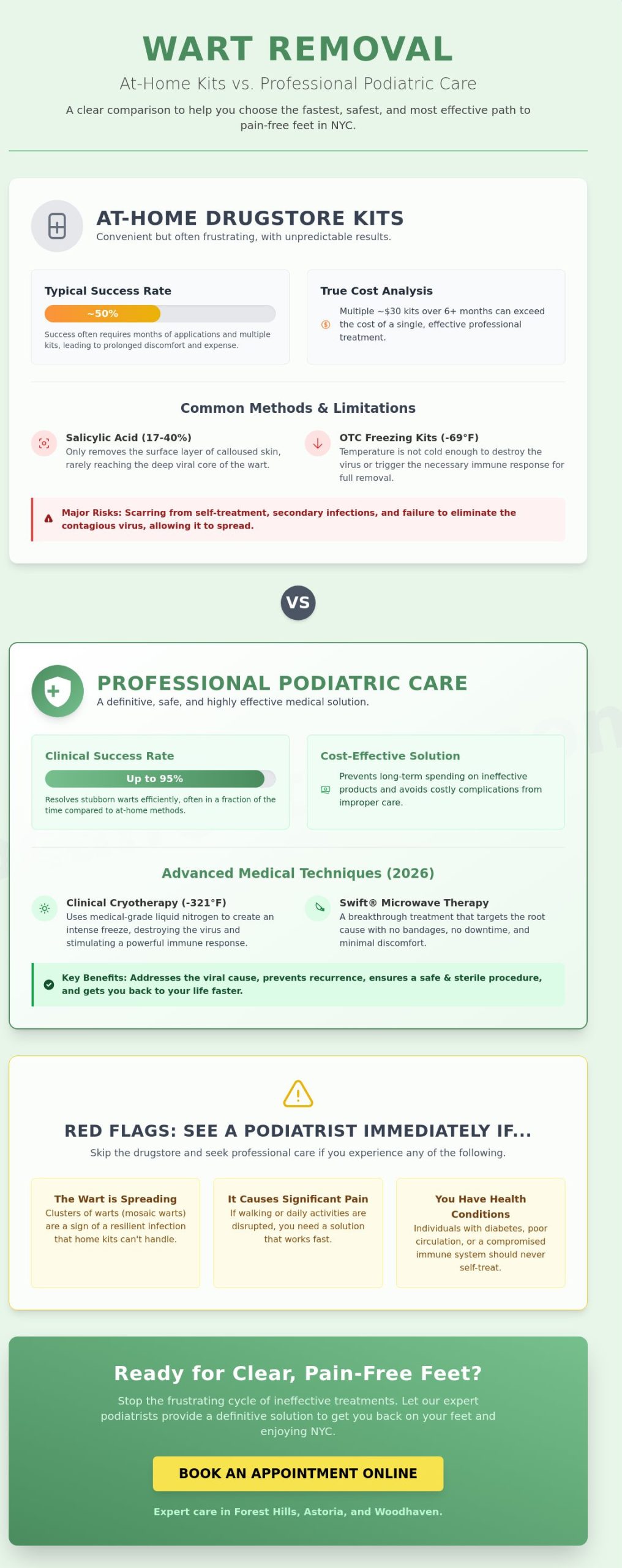
When a painful growth appears on your foot, the instinct for many New Yorkers is to grab a quick fix from a Manhattan pharmacy. However, there is a significant gap between the promise on the packaging and the clinical reality of wart removal. While drugstore kits offer convenience, they often fail to address the underlying viral infection. Clinical data suggests that over-the-counter success rates hover around 50%, whereas professional wart removal treatments performed by our team provide a much higher clearance rate in a fraction of the time. For someone preparing for a summer trip or a major event at the Javits Center, the “wait and see” approach of DIY kits can lead to months of frustration and wasted spending.
The cost-effectiveness of professional care becomes clear when you calculate the long-term expenses. A single clinical visit can often resolve a stubborn lesion that might otherwise require six months of daily acid applications and multiple $30 refill kits. More importantly, professional intervention prevents “bathroom surgery” mishaps. Attempting to cut or scrape a wart at home frequently leads to deep scarring or secondary bacterial infections that require emergency care. We prioritize your safety and your schedule, ensuring you spend less time worrying about your feet and more time navigating the city.
The Limits of Salicylic Acid and OTC Freezing
Most drugstore acids contain a 17% to 40% concentration of salicylic acid. While this sounds high, it rarely penetrates the thick, calloused skin developed from walking miles on NYC concrete. These kits often only peel the top layer of skin, leaving the viral core intact. Similarly, home freezing kits only reach temperatures of about -69°F. In our office, we use clinical-grade liquid nitrogen at -321°F. This extreme temperature is necessary to trigger the immune response required for total wart removal. These stubborn viral infections often thrive in the same damp, shared environments as other podiatric issues like fungal nail treatment, making professional sanitization and care essential.
Why Duct Tape and Folk Remedies Are Unreliable
The popular myth that duct tape “suffocates” a wart is medically inaccurate because the Human Papillomavirus (HPV) doesn’t breathe. Instead, keeping a wart covered with non-breathable tape often causes skin maceration. This creates a soggy, broken skin barrier that actually helps the virus spread to surrounding areas. We often see patients who delayed care for a single spot, only to arrive at our clinic with a cluster of “satellite” warts. This delay allows the virus to shed and infect other parts of the foot or even other family members. If you’re tired of DIY methods that don’t work, our specialists can help you find a faster path to clear skin.
Advanced Podiatric Techniques for Wart Removal in 2026
Our team at Local Foot Doc understands that New Yorkers don’t have time for treatments that keep them off the sidewalk. By 2026, podiatric medicine has moved toward solutions that prioritize both clinical success and patient convenience. We offer a range of professional wart removal treatment options that move beyond simple over-the-counter patches to address the root of the viral infection. Our objective is to eliminate the HPV virus while ensuring you remain mobile and comfortable.
For large or particularly stubborn lesions, CO2 Laser treatment provides a precise, bloodless solution. This technology uses a concentrated beam of light to vaporize the wart tissue while sealing blood vessels simultaneously, which significantly reduces the risk of post-operative bleeding. We also utilize immunotherapy through Cantharidin, a substance that triggers a controlled blister to alert your immune system to the presence of the virus. For our youngest patients in Brooklyn and Queens, we often recommend chemical cautery. This approach uses specialized acids to gradually break down the wart, offering a gentler experience for children who might be nervous about more intensive procedures.
Swift Microwave Therapy: The No-Downtime NYC Solution
Swift microwave therapy has become the gold standard for wart removal in our Manhattan and Astoria offices. This system delivers a precise dose of microwave energy to a depth of exactly 3.5 millimeters, specifically targeting the water molecules within the infected cells. This localized heat “unmasks” the virus, allowing your body’s natural defenses to recognize and eliminate the infection from the inside out.
- No Bandages: Because the surface of the skin remains intact, you won’t need to wrap your foot or worry about bulky dressings fitting into your shoes.
- Immediate Activity: NYC commuters can walk out of the office and head straight to the subway or a workout session without any lingering discomfort.
- Proven Protocol: Swift therapy typically requires 3-4 sessions for complete resolution, with each session spaced roughly four weeks apart to match the skin’s natural renewal cycle.
Cryotherapy and Surgical Excision
While technology advances, traditional methods still play a vital role in specialized cases. Cryotherapy, which involves applying liquid nitrogen at temperatures of -320 degrees Fahrenheit, remains a reliable choice for smaller, superficial warts. It’s a quick process that we’ve refined over the years to minimize the stinging sensation often associated with “freezing” treatments.
In cases where a wart is extremely resistant to conservative care or causes sharp, localized pain during every step, we may perform a surgical curettage. This involves numbing the area with a local anesthetic and physically removing the lesion with specialized tools. After this procedure, you’ll need to manage a small blister for 5 to 7 days. Our goal is always to get you back on your feet and enjoying the city with a clear, pain-free stride as quickly as possible. We prioritize your recovery and provide detailed aftercare instructions to ensure the wart removal process is permanent and your skin heals perfectly.
Decision Guide: When Should You See a NYC Podiatrist?
Deciding when to transition from over the counter patches to professional wart removal is a critical step in your foot health journey. We often see patients who’ve waited until a single lesion has multiplied into a painful cluster. If you notice new warts appearing on your toes or the soles of your feet, it’s a clear signal the HPV virus is winning the battle against your immune system. This “spreading factor” indicates that the virus is active and shedding; making it easy to infect other parts of your foot or even other members of your household.
Beyond the spread of the virus, a professional diagnosis is vital to rule out more serious skin conditions. Some lesions, such as amelanotic melanoma, can mimic the appearance of a common plantar wart. These malignant growths don’t always look like typical “cancerous” moles; they can appear as pinkish, flesh colored bumps that bleed easily. Our team uses specialized dermatoscopic tools to ensure every lesion is benign before we begin any treatment protocol. If your “wart” changes color, has irregular borders, or bleeds without provocation, you need a medical evaluation immediately.
Wart Removal and Diabetic Health
For the approximately 1.1 million New Yorkers living with diabetes, foot care isn’t just about comfort; it’s about limb preservation. You must strictly avoid DIY acid treatments or “medicated” drugstore pads. These products use caustic chemicals that can’t distinguish between viral tissue and healthy skin. In patients with poor circulation or neuropathy, these treatments often lead to deep, non-healing ulcers and secondary infections. We provide specialized diabetic foot care in Brooklyn to manage these risks safely. If you have any underlying condition that affects your blood flow, professional intervention is the only safe way to handle a plantar wart.
Pain, Bleeding, and Lifestyle Interference
Pain is your body’s way of saying the virus is interfering with your biomechanics. Many of our patients describe the sensation as walking on a sharp pebble or a piece of glass that never goes away. We recommend the “commuter test” for our NYC patients: if you can’t walk from the subway station to your office without a noticeable limp, the wart has become a functional disability. This is especially urgent for athletes and runners. If you’re planning to start training for the NYC Marathon or joining a local soccer league, professional wart removal ensures you don’t develop compensatory injuries in your knees or hips due to an altered, guarded gait. Keep in mind that toe pain during your commute isn’t always wart-related; understanding the difference between wart discomfort and ingrown toenail symptoms can help you seek the right treatment faster and avoid unnecessary delays in your recovery.
Don’t let a treatable virus keep you off the New York streets. Schedule a consultation with our NYC podiatry team today to reclaim your mobility.
Expert Wart Removal at Local Foot Doc: Getting You Back on Your Feet
Choosing a specialist for wart removal shouldn’t feel like a cold, corporate transaction. At Local Foot Doc, we’ve spent more than 20 years building a reputation as New York City’s “Expert Neighbor.” Led by Dr. Waldemar Majdanski, our team combines world-class clinical training with the kind of compassionate care you expect from a trusted local institution. We understand that a persistent plantar wart can cause a sharp, stinging sensation with every step you take on a subway platform or city sidewalk. That is why we prioritize both advanced medical technology and a reassuring bedside manner.
We make professional care accessible by maintaining three convenient locations across Queens. Whether you are near our offices in Forest Hills, Astoria, or Woodhaven, you’ll find the same high standard of podiatric excellence. Our process is designed to be efficient and results-oriented, ensuring your treatment fits into your busy NYC schedule without unnecessary delays. We focus on the person, not just the pathology.
Personalized Treatment Plans for Every Borough
We don’t believe in one-size-fits-all medicine. Our team tailors your treatment plan to your specific lifestyle and daily activity level. A marathon runner training for the NYC Marathon requires a different approach than a professional who spends ten hours a day in leather oxfords or high heels. We evaluate your shoe gear and biomechanics to ensure the selected method offers the fastest possible recovery. Education is a core part of our mission. We provide clear guidance on how to prevent HPV reinfection in communal spaces like gyms or local pools. For those who lead a high-impact lifestyle, we also offer specialized sports medicine to help urban athletes maintain their peak performance during and after treatment.
Your Path to Healthy, Wart-Free Feet
Your first visit to our Queens or Brooklyn offices focuses on clarity and comfort. We begin with a thorough examination of the lesion to confirm the diagnosis and rule out other conditions like corns or calluses. We explain the underlying cause of the virus in plain English, stripping away the medical jargon. Our primary goal is getting you back on your feet with minimal disruption to your daily life. We use precise techniques to target the root of the issue, reducing the risk of recurrence and ending the physical discomfort of a throbbing wart. Starting your journey toward clearer skin is simple. Schedule your wart removal consultation at Local Foot Doc today and take the first step toward pain-free mobility.
Take the Next Step Toward Healthy, Clear Feet
Living in New York City means your feet carry you through miles of concrete every day. You shouldn’t let the discomfort of a plantar infection slow your pace or affect your confidence. While drugstore kits often fail to reach the root of the virus, our team provides permanent solutions through advanced 2026 medical technology. Board-certified surgeon Dr. Waldemar Majdanski utilizes Swift Microwave Therapy to target the source of the issue with precision. This modern approach eliminates the need for messy acids or painful freezing methods used in previous years.
We’ve established three neighborhood clinics in Forest Hills, Astoria, and Woodhaven to ensure specialized care is always within reach. Choosing professional care ensures you receive a personalized treatment plan designed for your specific skin type and activity level. We’re here to help you move without pain and reclaim your active lifestyle. Our experts are ready to provide the clinical excellence you deserve right in your own community. It’s time to get back on your feet with confidence.
Book Your Wart Removal Appointment at Our NYC Offices
Frequently Asked Questions About Wart Removal in New York City
Is professional wart removal painful?
Professional wart removal is generally a low-discomfort procedure because we use local anesthetics to numb the area first. While you might feel a slight pinch during the numbing process, the actual treatment is painless. Patients often describe the post-procedure sensation as a mild throb, similar to a small bruise, which typically fades within 48 hours. Our goal is to ensure you remain comfortable throughout your visit to our NYC clinic.
How many treatments will I need to get rid of a plantar wart?
Most patients require between 1 and 3 treatments to completely eliminate a stubborn plantar wart. According to clinical data from the American Podiatric Medical Association, approximately 70% of cases resolve after two sessions of advanced cryotherapy or laser treatment. Larger clusters, known as mosaic warts, might need 4 or more visits spaced 2 to 3 weeks apart to ensure the virus is fully eradicated from the skin tissue.
Can I go back to work immediately after a wart removal procedure?
You can return to your job immediately following most wart removal procedures in our office. We use minimally invasive techniques that don’t require heavy sedation or downtime. If your job involves standing for more than 8 hours, we might recommend a small protective pad inside your shoe for the first 24 hours. Most of our Manhattan patients walk out of the clinic and head straight back to their daily routines.
Does health insurance in New York cover wart removal?
Most major health insurance providers in New York, including Blue Cross Blue Shield and UnitedHealthcare, cover the procedure when the lesion causes physical pain or limits mobility. Since warts are viral infections, they’re typically classified as a medical necessity rather than a cosmetic issue. We recommend checking your specific 2026 plan details, as 90% of our patients find their consultation and treatment are covered after their standard co-pay is met.
Are foot warts contagious to other people in my household?
Foot warts are highly contagious because they’re caused by the Human Papillomavirus (HPV), which thrives in moist environments. If you walk barefoot in shared bathrooms, you have a 30% higher risk of spreading the virus to family members. We advise wearing flip-flops in the shower and avoiding sharing towels until the lesion is fully healed. This simple step protects your household and prevents the virus from recycling through your home.
What happens if I leave a plantar wart untreated?
Leaving a plantar wart untreated often leads to the lesion doubling in size within 6 months or spreading into a cluster of mosaic warts. Beyond the cosmetic concern, untreated warts can alter your gait to avoid pain, leading to secondary issues in your knees or lower back. A 2025 clinical review found that 40% of neglected warts eventually become painful enough to interfere with basic walking or exercise routines.
How can I prevent warts from coming back after they are removed?
You can prevent warts from returning by keeping your feet dry and wearing breathable footwear in public spaces like NYC gyms or pools. We recommend rotating your shoes every 24 hours to allow them to dry completely, as the virus loves damp synthetic materials. Applying an over-the-counter antimicrobial spray to your gym shoes can reduce viral presence by up to 95%, helping you stay clear after your professional treatment.
Is it a wart or a corn? How can I tell the difference?
You can tell the difference by looking for pinpoint bleeding or tiny black dots, which are unique to warts. When we gently scrape the surface, a wart shows small clotted blood vessels, while a corn consists of clear, concentric circles of dead skin. Warts also hurt more when squeezed from the sides, whereas corns hurt when pressed directly. Our team uses dermatoscopes to make a 100% accurate diagnosis during your exam. If you’re also experiencing sharp pain along the edge of your toenail alongside foot discomfort, it may be worth exploring ingrown toenail removal options, as the two conditions can sometimes occur simultaneously and both benefit from professional podiatric care.