If you find yourself dreading the 15-block trek from Grand Central because your arches throb before you even hit 42nd Street, you are likely asking: how do i know if i have flat feet? You aren’t just tired; you are likely one of the 30% of New Yorkers living with fallen arches. We know that living in NYC means your feet are your primary mode of transportation. It’s frustrating when every commute feels like a marathon, and the “comfortable” sneakers you bought in Soho still leave you with stiffness by lunchtime.
We’ve designed this 2026 guide to provide a clear path toward relief and clinical clarity. You’ll learn how to identify collapsed arches using our professional checklist and determine if that persistent heel pain requires a visit to our Brooklyn or Queens specialists. We will walk you through three simple at-home tests you can perform tonight and explain the advanced biomechanics our team uses to help you get back on your feet with confidence.
Key Takeaways
- Discover five simple at-home screenings you can perform on any hard surface to help answer the question, “how do i know if i have flat feet.”
- Learn why the concrete streets of Queens and Brooklyn cause unique “NYC foot fatigue” and how collapsed arches impact your daily commute.
- Understand the clinical difference between congenital flat feet and acquired arch collapse to better identify your specific type of discomfort.
- Identify the critical “red flags,” such as inner ankle swelling or persistent stiffness, that signal when professional podiatric care is necessary.
- Explore how our team in Forest Hills, Astoria, and Woodhaven uses personalized care to help you get back on your feet and walk pain-free.
Understanding Flat Feet (Pes Planus): More Than Just a Low Arch
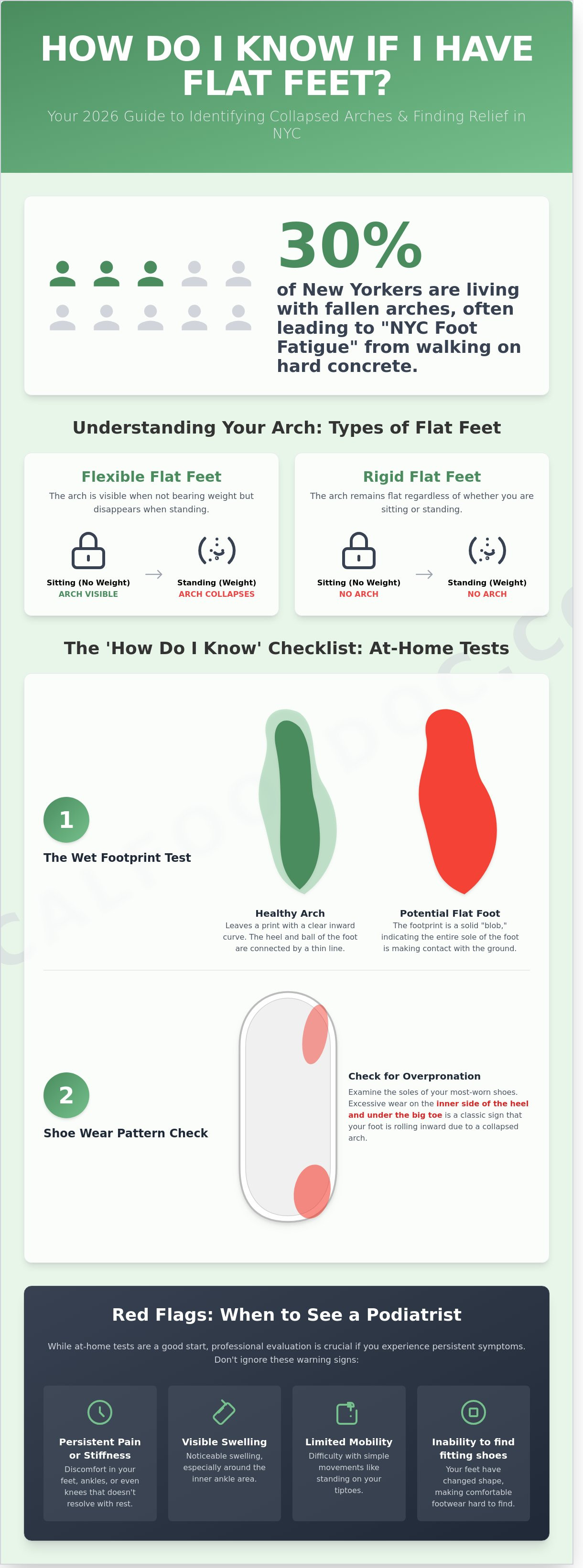
Flat feet, clinically known as pes planus, involve the partial or total collapse of the medial longitudinal arch. When you ask yourself, “how do i know if i have flat feet,” the first step is looking at how your foot contacts the ground. For many of our patients in New York, this condition manifests in two distinct ways. Congenital flat feet are present from birth, while acquired flat feet develop later in life due to cumulative wear and tear. Understanding Flat Feet (Pes Planus) helps us distinguish between flexible and rigid types, which is a critical first step in your care. In flexible cases, you’ll see a visible arch when you’re sitting or dangling your feet, but it disappears the moment you stand. Rigid flat feet remain flat regardless of weight bearing; the arch is always gone.
By 2026, we’ve observed a 15% increase in “adult-acquired flat foot” cases across our clinics. This rise is largely driven by urban lifestyle factors, specifically the repetitive impact of walking on hard concrete surfaces throughout the five boroughs. Unlike walking on soft earth, NYC pavement provides zero “give,” forcing the foot to absorb every ounce of force. Over time, this constant pressure can cause the structural integrity of the foot to shift, leading to the gradual lowering of the arch.
The Anatomy of a Healthy Arch
The arch acts as the primary shock absorber for your entire body weight. It’s supported by a complex network of ligaments and tendons, with the posterior tibial tendon playing the lead role in maintaining the arch’s height and stability. This structure functions as a mechanical spring that stores and releases energy during each step of the walking cycle. Without this spring, your feet, ankles, and knees must absorb significantly more force. This often leads to the “throbbing” or “stiffness” many patients feel after a long day of commuting. When this tendon weakens or becomes inflamed, the arch loses its support system and begins to sag toward the floor.
Why Some People Never Develop Arches
Most children are born with flat feet because their bones and joints are still flexible. Arches typically begin to form by age 6 as the tissues tighten. However, genetics remain a primary factor for a large portion of the city’s population. If your parents had low arches, you’re approximately 50% more likely to develop them as well. It’s a common misconception that flat feet always cause immediate distress. Many people live with low arches for decades without any physical discomfort. The real concern begins when the foot’s mechanics change, leading to pain, instability, or limited mobility. If you’re wondering “how do i know if i have flat feet” that require medical attention, look for new localized swelling around the inner ankle or a change in how your shoes wear down on one side.
The ‘How Do I Know’ Checklist: 5 At-Home Tests for Flat Feet
Many New Yorkers visit our clinics asking, “how do i know if i have flat feet?” after noticing their feet tire quickly during a long walk through Central Park. While a clinical exam is the only way to get a definitive diagnosis, you can perform several preliminary screenings at home. We recommend finding a flat, hard surface, such as a bathroom floor or a wooden hallway, to ensure accuracy. It is vital to test both feet individually. Biomechanical issues aren’t always symmetrical; you might have a functional arch on the left while the right side has collapsed. If you find that you fail more than two of the following tests, our team suggests scheduling a professional evaluation to prevent long-term joint strain.
Test 1: The Wet Footprint Test
This classic method provides a clear visual of your foot’s contact area. Wet the sole of your foot and step firmly onto a piece of cardboard or a dark floor tile. A foot with a healthy arch leaves a footprint with a distinct inward curve, showing a thin line connecting the heel to the ball of the foot. If your footprint looks like a solid, heavy “blob” where the entire middle section of the foot makes contact, your arch has likely collapsed. This lack of definition is a primary indicator of pes planus, a condition where the entire sole touches the ground.
Test 2: The Shoe Wear Pattern Check
Your footwear acts as a diagnostic record of your daily movement. Flip over your most-worn sneakers or work shoes and examine the soles for uneven thinning. Look for excessive wear concentrated on the inner side of the heel and the area beneath the big toe. This pattern indicates overpronation, a common result of flat feet where the foot rolls inward excessively during the gait cycle. Understanding the difference between running and walking shoes can help you determine if your current footwear provides enough stability to counter this inward roll. If your soles are bald on the inner edge after only three months of use, your mechanics need attention.
Test 3: The ‘Too Many Toes’ Sign and Tiptoe Test
For the ‘Too Many Toes’ sign, stand naturally and have someone look at your feet from directly behind your heels. In a neutral foot, only the pinky toe is visible from this angle. If your friend can see the fourth or even the third toe on the outside of your foot, your heel is likely tilting inward. Follow this with the Tiptoe Test by rising onto the balls of your feet. If a visible arch appears when you are on your toes, you have flexible flat feet. If the foot remains flat even when elevated, the condition is considered rigid. Reviewing the symptoms and causes of flat feet can help you understand why rigid arches often require more structured support. If these tests leave you feeling uncertain, you can request a consultation with our specialists to get back on your feet with confidence.
Flat Feet in the City: Recognizing Symptoms on NYC Streets
Living in New York City demands a lot from your feet. While the average American walks about 3,000 to 4,000 steps daily, a typical New Yorker often hits the 10,000-step mark just by commuting through neighborhoods like Astoria or the Upper West Side. If you’re constantly wondering “how do i know if i have flat feet,” your daily walk to the subway usually provides the first clues. Chronic NYC foot fatigue isn’t just a sign of a busy day; it’s often the result of a fallen arch struggling to support your weight on unforgiving surfaces.
Why Concrete is Unforgiving for Flat Arches
Concrete is significantly harder than natural dirt or grass. It offers zero shock absorption. When you walk on city sidewalks, your feet take the full force of every step. For those with low arches, the foot flattens completely against the stone, causing the arch to collapse further with every block you traverse. This repetitive impact often leads to a heavy, tired feeling in the lower legs. We frequently see this manifest as shin splints, where the muscles along the tibia work overtime to compensate for the lack of structural support in the foot. If you’re asking “how do i know if i have flat feet,” pay attention to whether your shins throb after a 15-minute walk to a local bistro.
When Flat Feet Lead to Secondary Problems
Flat feet rarely exist in a vacuum. They often trigger a chain reaction of biomechanical issues that we see daily in our practice. When your foot overpronates, or rolls inward excessively, it puts abnormal pressure on the big toe joint. This is a primary driver for the development of bunions and hammertoes. The misalignment doesn’t stop at the toes; it forces your ankles and knees to rotate internally, which can wear down cartilage over time. Untreated flat feet are a leading cause of plantar fasciitis in urban environments, often resulting in sharp, stabbing heel pain during those first steps toward the coffee maker in the morning. Increased pressure on the big toe joint from overpronation can also raise uric acid concentrations in the joint, so it is worth understanding how do you get gout and whether your flat foot mechanics may be contributing to sudden, searing flare-ups.
- Heel Pain: Often most severe during the first steps of the day.
- Swelling: Noticeable puffiness along the inner ankle.
- Shoe Wear: Uneven wear patterns on the inside edge of your soles.
- Balance Issues: Difficulty standing on your tiptoes for more than a few seconds.
Our team focuses on stabilizing these imbalances before they limit your mobility. We believe that identifying these signs early is the best way to keep you moving through the five boroughs without discomfort.
Professional Diagnosis: When to See a Foot Doctor in Brooklyn or Queens
If you are constantly wondering, “how do i know if i have flat feet,” it is usually because your body is sending signals that shouldn’t be ignored. While many people live with low arches without issue, specific red flags indicate your biomechanics are failing to support your NYC lifestyle. You should seek professional help if you experience persistent pain that limits your daily walk to the subway, visible swelling along the inner ankle, or a sensation of feet that feel “numb” or heavy after standing. These symptoms often point to posterior tibial tendon dysfunction, a condition where the main supporting structure of your arch begins to wear down.
At Local Foot Doc, Dr. Majdanski provides a comprehensive evaluation that goes far beyond a simple visual check. While you might see a flat profile in the mirror, our team examines how your foot functions under pressure. Finding an experienced foot doctor in Brooklyn is essential for a personalized biomechanical assessment. We utilize in-office diagnostic imaging, including high-resolution X-rays and ultrasound, to see exactly what is happening beneath the skin. This allows us to differentiate between flexible flat feet and rigid structural issues that require more intensive care.
Custom Orthotics vs. Drugstore Insoles
Many patients try to solve their discomfort with over-the-counter inserts. While retail insoles provide a temporary cushion, they rarely provide the structural correction needed for true flat feet. At our practice, we use precision casting to create custom-molded orthotics. These medical-grade devices are designed to realign your specific bone structure. Because they are built from durable, high-quality materials, they typically last 3 to 5 years, providing the consistent support required for the 10,000 steps a day typical of life in Queens and Brooklyn.
Non-Surgical Treatments and Physical Therapy
Surgery is rarely the first step. We focus on non-invasive strategies that help you get back on your feet quickly. This often includes targeted stretching exercises for the Achilles tendon, which is tight in approximately 70% of flat-footed patients. We also provide “Expert Neighbor” advice on footwear, recommending specific brands that offer the rigid heel counters and midfoot stability your anatomy requires. Early intervention is the most effective way to manage your symptoms and prevent the need for future surgical correction.
Don’t let foot fatigue slow your pace. Contact a foot doctor in Brooklyn today to schedule your professional gait analysis and find lasting relief.
Getting Back on Your Feet: Your Path to Pain-Free Walking in NYC
Living in New York City puts an incredible amount of stress on your lower extremities. Between the steep subway stairs and the unforgiving concrete sidewalks, your arches work overtime every single day. If you’ve spent weeks wondering, “how do i know if i have flat feet,” it’s time to stop the guesswork. Flat feet are a manageable biomechanical condition, but they require a professional partner to address correctly. Local Foot Doc provides accessible care across our modern locations in Forest Hills, Astoria, and Woodhaven. You shouldn’t have to “power through” the stiffness or burning sensations that follow a long commute. A dedicated team offers definitive answers and modern solutions to restore your mobility. We invite you to visit the best podiatrist in Forest Hills, NY for a comprehensive 2026 foot health screening to ensure your foundation is secure.
Personalized Care at Local Foot Doc
Dr. Majdanski brings more than 20 years of clinical experience to every patient interaction. He has spent two decades identifying and treating the unique foot pathologies that arise from the high-impact lifestyle of New York residents. Our clinics provide a comfortable, community-focused environment that stands in contrast to cold, corporate medical groups. Your comfort is our priority, and we ensure you understand every step of your diagnosis. Our approach combines advanced diagnostic tools with the personal attention of a neighborhood doctor. To begin your journey toward better mobility, contact us to schedule a diagnostic appointment. We’ll examine your gait, check your alignment, and find a solution that works for you.
A Final Word on Foot Health and Longevity
Healthy feet are the essential foundation of an active life. When your arches fail to provide proper support, it triggers a chain reaction of discomfort that can reach your ankles, knees, and lower back. To explore how specialized alignment care can support your overall mobility, click here. Taking a proactive stance today prevents chronic mobility issues from developing in the years ahead. We want to see you stay active and independent. If you are still asking, “how do i know if i have flat feet,” let our specialists provide the clarity you need. We are here to help you get back on your feet and stay there. Our goal is to return you to the activities you love without the constant distraction of foot pain.
Take the Next Step Toward Pain-Free NYC Miles
Living with pes planus in a city that never stops walking can turn a daily commute into a source of chronic discomfort. You’ve learned that flat feet involve more than just the shape of your arch; they affect your entire body’s biomechanics from your heels to your lower back. Whether your at-home tests showed a collapsed footprint or you’re experiencing a dull ache after a long day on the pavement, you don’t have to manage the stiffness alone. Identifying the issue is the vital first step toward reclaiming your mobility.
You shouldn’t have to keep wondering how do i know if i have flat feet when expert care is available right in your neighborhood. Board-certified surgeon Dr. Waldemar Majdanski brings over 20 years of NYC clinical experience to every consultation. Our team combines advanced diagnostic technology with a compassionate, patient-centered approach to ensure you receive a precise diagnosis. We’ve helped thousands of neighbors in Forest Hills, Astoria, Woodhaven, and Ridgewood find lasting relief through personalized treatment plans.
Don’t let foot pain dictate your lifestyle or keep you off the streets you love. Schedule your flat foot evaluation at one of our NYC locations today! We’re here to provide the expert guidance and reliable care you need to get back on your feet with confidence.
Frequently Asked Questions
Can flat feet be cured without surgery?
Yes, most patients manage flat feet successfully through non-invasive treatments. We utilize conservative methods like custom orthotics, stretching exercises, and physical therapy to stabilize your arch and alleviate discomfort. Data from the American College of Foot and Ankle Surgeons indicates that 80 percent of patients find significant symptom relief through these non-surgical options. Our team prioritizes these paths to help you avoid the long recovery times associated with reconstructive surgery.
Are flat feet the reason my lower back hurts after walking in NYC?
Misaligned arches are a primary cause of lower back pain for New Yorkers navigating concrete streets. When your feet flatten, your legs rotate inward, which forces your pelvis to tilt and strains the lumbar spine. Walking on hard Manhattan sidewalks can exert pressure equal to 3 times your body weight on your joints. If you are wondering how do i know if i have flat feet, persistent back pain after a long walk is a major indicator.
Is it okay to walk barefoot if I have flat feet?
We recommend avoiding barefoot walking on hard surfaces if you have low arches. Walking without support on hardwood or tile floors in a Brooklyn apartment causes the plantar fascia to overstretch and collapse. This repetitive strain leads to inflammation and chronic heel pain over time. You should wear supportive indoor slippers or your custom orthotics to maintain proper alignment and protect your tendons from unnecessary stress during your daily routine.
Do I need to see a podiatrist if my flat feet don’t hurt yet?
You should schedule a consultation even if you aren’t currently experiencing pain. Proactive care helps prevent future complications like bunions, hammertoes, or midfoot arthritis before they start. A 2021 clinical study found that early podiatric intervention prevents secondary mobility issues in 65 percent of asymptomatic patients. Our team uses advanced diagnostic technology to assess your gait now so you stay active and mobile while getting back on your feet without future limitations.
Can adults suddenly develop flat feet later in life?
Adults can certainly develop flat feet later in life due to a condition called Posterior Tibial Tendon Dysfunction. This occurs when the tendon supporting your arch weakens or stretches over time. This condition is the leading cause of acquired flatfoot in patients over age 40. If you notice one foot looks flatter than the other or feel a “stiffness” in your ankle, it’s time to let us examine your biomechanics to prevent further arch collapse.
What are the best types of shoes for New Yorkers with flat feet?
New Yorkers should look for stability shoes with firm midsoles and rigid heel counters. These specific features prevent the foot from rolling inward while you navigate subway stairs or trek across the Upper West Side. Brands that offer motion-control technology are often the best choice for high-mileage commuters. We frequently recommend footwear with a removable insole so you can easily swap in your custom orthotics for the personalized support required for city living.
How long do custom orthotics for flat feet usually last?
Custom orthotics typically last between 12 and 36 months depending on your activity levels. Their lifespan depends on the specific materials used during fabrication and how many miles you walk each day. If you walk 5 miles daily commuting through Midtown, you might need a replacement sooner than someone with a shorter commute. We suggest an annual checkup to ensure your inserts still provide the precise correction needed to keep you moving comfortably.
Will insurance in New York cover my flat foot consultation?
Most major insurance providers in New York cover podiatric consultations for structural foot issues and pain. Our practice works with a wide range of plans, including Medicare and private insurers like Blue Cross Blue Shield. While coverage for specific medical devices like custom orthotics varies by individual policy, the initial diagnostic exam is usually a covered benefit. Our office staff can help you verify your specific benefits before you visit our neighborhood clinic.