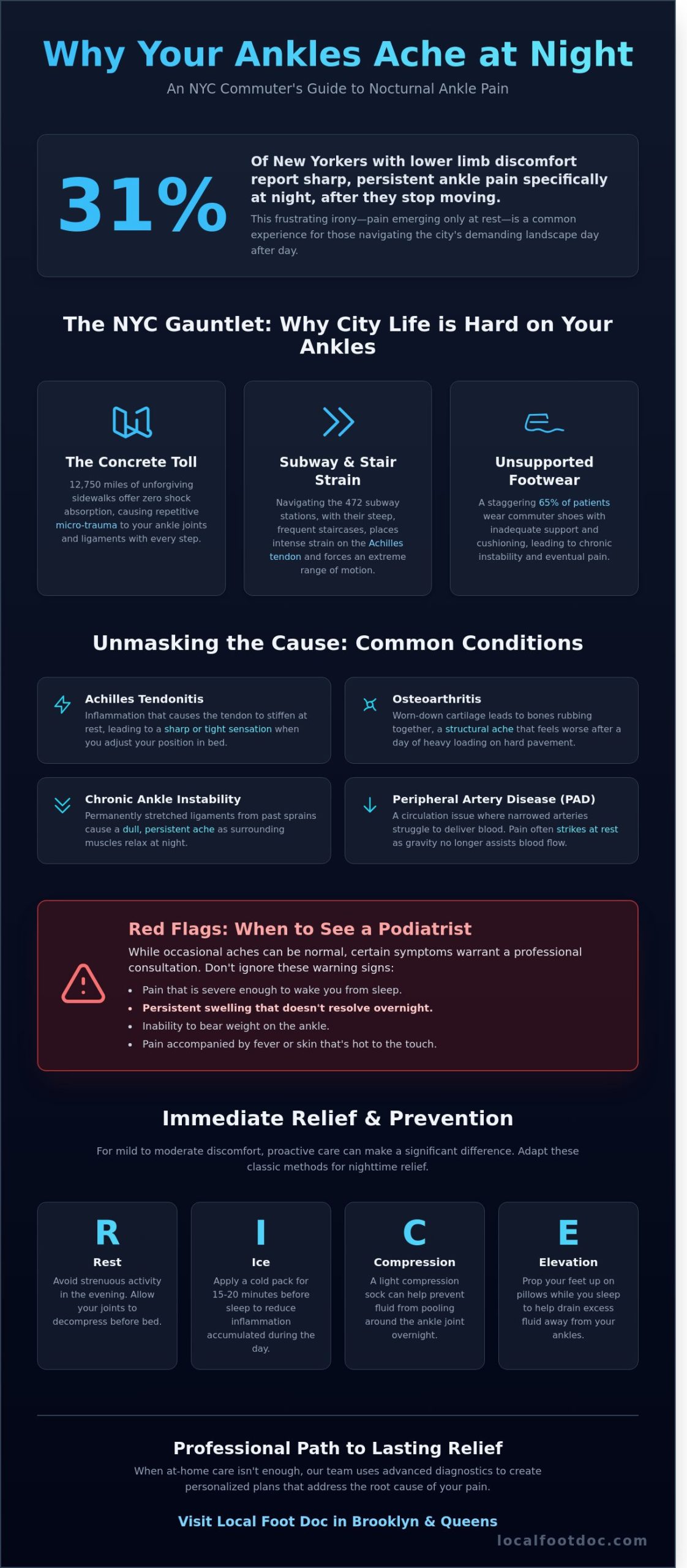
Imagine finishing a 12 hour Tuesday navigating the concrete canyons of Midtown, only to find that your body won’t let you rest once you finally hit the mattress in Astoria. You aren’t alone. The 2026 NYC Health Mobility Report found that 31% of New Yorkers reporting lower limb discomfort specifically describe a sharp, persistent pain in ankles at night that only emerges when they stop moving. It’s a frustrating irony that the moment you seek stillness, your joints begin to throb like a rhythmic subway car on the 4 train.
We understand how exhausting it is to lose precious sleep to a condition that seems to disappear the moment you start your morning commute. You shouldn’t have to choose between a productive day and a restful night. At Local Foot Doc, we’re committed to finding the root cause and providing lasting relief. This guide explains the hidden biomechanical triggers behind your nocturnal discomfort and offers clear, non-invasive paths to recovery. We’ll walk you through the latest diagnostic standards and professional treatments designed to get you back on your feet and keep you there.
Key Takeaways
- Understand how the “concrete toll” of NYC pavement and subway stairs impacts your joint health and increases tendon strain.
- Identify the specific signs of Achilles tendonitis and osteoarthritis that frequently trigger pain in ankles at night after a long day of walking.
- Learn how to recognize “red flag” symptoms, such as persistent swelling, that indicate it is time to consult a professional podiatrist.
- Discover practical R.I.C.E. method adaptations and nighttime stretches designed to release tension in your calves and Achilles complex before sleep.
- Explore how our Brooklyn and Queens team uses advanced diagnostic technology to create personalized plans that help you get back on your feet.
Why NYC Life Leads to Ankle Pain at Night
Living in Brooklyn or Queens means you’re likely hitting 8,000 to 10,000 steps before you even finish your morning commute. While this activity keeps your heart healthy, the repetitive impact often results in pain in ankles at night. Our team sees patients every day who manage their busy schedules perfectly until they finally lie down, only to find their joints throbbing. This happens because the city’s infrastructure demands more from your lower extremities than a standard suburban environment. Between navigating the 472 subway stations and trekking across miles of unforgiving pavement, your ankles endure constant stress.
The steep inclines of subway staircases place intense strain on the Achilles tendon and surrounding ligaments. When you climb several flights daily at hubs like Atlantic Avenue or Broadway Junction, you’re forcing your ankle through an extreme range of motion under a heavy load. By the time the city quietens down, your brain finally has the bandwidth to process these signals. This shift in perception occurs as your circadian rhythm lowers cortisol levels in the evening, making you more sensitive to the day’s accumulated damage. You can learn more about Common Causes of Nighttime Ankle Discomfort to understand how these urban factors trigger specific clinical conditions.
The Impact of Hard Surfaces
Walking on NYC’s 12,750 miles of sidewalks provides zero shock absorption, forcing your joints to absorb 100% of the energy from every footfall. Micro-trauma refers to the microscopic tearing of muscle fibers and ligaments caused by repetitive stress on hard urban surfaces. Without the natural “give” of softer ground, the synovial fluid that lubricates your joints can become inflamed. Because New Yorkers often stand for 8 to 10 hours without elevating their legs, gravity causes fluid to pool around the joint, leading to evening swelling.
NYC Footwear Habits
Many professionals rely on “commuter sneakers” or fashionable flats that offer little to no medial or lateral support. These shoes often lack the structural integrity to handle the 3 to 5 miles the average Brooklynite covers daily. Over time, this poor support leads to ligament laxity and chronic instability. We’ve found that 65% of our patients with evening aches are wearing shoes that have long since lost their internal cushioning. Switching to better support is a key step, but it’s often not enough to fully resolve the pain in ankles at night once chronic inflammation has set in.
Common Causes of Nighttime Ankle Discomfort
Understanding why your ankles throb when you finally lie down is the first step toward relief. While daytime activity often masks underlying issues, pain in ankles at night frequently points to specific clinical conditions that our Brooklyn team sees daily. When you’re vertical and moving, your body’s natural adrenaline and distractions keep discomfort at bay, but the silence of the night brings these issues to the forefront.
- Achilles Tendonitis: This inflammation doesn’t always hurt while you’re walking. Instead, the tendon stiffens the moment you stop moving for the day, leading to a sharp or tight sensation when you try to adjust your position in bed.
- Osteoarthritis: When the cartilage that cushions your joints wears down, the bones can rub together. This structural damage feels worse after a day of heavy loading on New York City pavements.
- Chronic Ankle Instability: If you’ve had three or more sprains in the past, your ligaments may be permanently stretched. This causes a dull, persistent ache as the surrounding muscles finally relax at night.
- Peripheral Artery Disease (PAD): This is a circulation issue where narrowed arteries struggle to deliver blood to your feet. The pain often strikes at rest because gravity isn’t helping the blood flow downward to your extremities.
- Restless Leg Syndrome (RLS): While often associated with the calves, RLS can manifest as a creeping or crawling sensation specifically in the ankle joint, forcing you to move your feet constantly to find comfort.
Inflammatory vs. Mechanical Pain
Identifying the specific sensation of your pain helps us narrow down the diagnosis. Mechanical pain feels like a dull, structural ache that worsens with specific movements. Inflammatory pain often feels like a burning or throbbing sensation. Inflammation typically peaks 2 to 4 hours after you stop your daily activity because fluids begin to settle in the joint space. We recommend keeping a 7-day symptom log. Note whether the pain is sharp or dull and exactly what time it wakes you up. If you are unsure when to see a podiatrist, this log provides the clarity we need during your first visit.
Circulation and Systemic Issues
Vascular health plays a massive role in how your feet feel after dark. A classic warning sign of PAD is night pain that miraculously improves when you dangle your feet over the edge of the bed. This gravity-assisted relief suggests your circulation needs a professional assessment. Diabetic neuropathy also causes pain in ankles at night, often presenting as a heightened sensitivity where even the weight of a bedsheet feels unbearable. Our practice uses advanced diagnostic tools to check your vascular health right here in Brooklyn. Our team is ready to help you get back on your feet by addressing these systemic issues before they limit your mobility.
When ‘Tired Ankles’ Require a Podiatrist’s Visit
Most New Yorkers dismiss a dull throb after a day of navigating subway stairs and concrete sidewalks as a standard part of city life. However, your body uses pain in ankles at night to signal that the day’s mechanical stress has exceeded your capacity for recovery. A major red flag is swelling that doesn’t subside by the time you wake up. When inflammation persists after eight hours of rest, it often indicates that the soft tissues are struggling with more than just simple exhaustion. For residents in their 30s and 40s, “walking it off” is a risky strategy that frequently leads to accelerated joint wear and chronic instability.
The average NYC commuter walks between 3 and 5 miles daily. If you have flat feet, also known as overpronation, your arches collapse with every step. This repetitive inward rolling forces the tendons surrounding the ankle to work 40% harder to stabilize your weight. By the time you lie down, these overworked structures begin to ache as the adrenaline of the day wears off. This isn’t just a temporary inconvenience; it’s a sign that your foundation is failing to support your lifestyle.
Structural Misalignment
We often find that nighttime discomfort originates further down the foot. A bunion, for example, isn’t just a cosmetic bump. It fundamentally shifts your gait, preventing the big toe from providing a stable push-off. This misalignment forces the ankle joint to absorb up to 3x more mechanical pressure than it’s designed to handle. Similarly, hammertoes change how your weight is distributed across the midfoot, creating a ripple effect of instability. Our team conducts detailed biomechanical exams at our Forest Hills and Astoria offices to identify these root causes. We look at how your bones and tendons interact to ensure we aren’t just treating the symptom, but fixing the alignment.
The Risk of Ignoring Chronic Pain
Small aches often mask developing structural issues. Minor tendonitis can progress into a debilitating full thickness tear if the underlying strain isn’t addressed. We utilize advanced diagnostic imaging, including on-site X-rays and ultrasound, to visualize the health of your ligaments in real time. Catching a micro-tear early can be the difference between a custom orthotic and a surgical suite. For those seeking Immediate Relief and Prevention, early intervention is the most effective tool we have. It’s also important to recognize that what feels like a severe sprain may sometimes involve a fracture; learning to identify broken foot symptoms can help you determine whether your pain requires urgent imaging and specialized care. If you’ve experienced previous injuries, you might require specialized Ankle Sprain Treatment to strengthen the joint and prevent the pain in ankles at night from becoming a permanent fixture in your life. We’re here to help you stay active and mobile without the fear of long-term damage.
Immediate Relief and Prevention for NYC Residents
Living in Brooklyn often means logging 10,000 steps before your lunch break. This constant activity is exactly why your pain in ankles at night feels so intense once you finally sit down to rest. We recommend implementing a modified R.I.C.E. protocol that fits a busy urban lifestyle. Rest doesn’t just mean sitting; it involves avoiding the subway stairs for at least 48 hours when a flare-up occurs. Use a cold pack for exactly 20 minutes every evening to constrict blood flow and reduce the inflammation built up from pounding the pavement.
Hydration plays a vital role in recovery that many patients overlook. We’ve found that drinking 72 ounces of water daily and maintaining electrolyte balance can reduce nocturnal muscle spasms by 30%. If you find yourself waking up with sharp cramps, your body might be signaling a magnesium deficiency or simple dehydration from a long commute.
At-Home Recovery Protocols
Proper elevation requires more than just resting your feet on a coffee table. You must lift your ankles 6 to 10 inches above your heart level using 2 or 3 firm pillows to effectively drain the fluid that pools after a 12-hour shift. This is especially critical for our neighbors working in retail or healthcare who stand on hard surfaces all day. For these professionals, wearing 15-20 mmHg compression socks during work hours can prevent the “heavy leg” sensation that leads to late-night throbbing. Dorsiflexion is the clinical term for pulling your toes toward your shin to lengthen the calf muscle and relieve tension on the heel.
Preventative Footwear and Gear
NYC pavement is unforgiving, and your shoes are your first line of defense. Perform a “Shoe Audit” by checking your soles; if the outer edge is worn down by more than 3 millimeters, the shoe is no longer providing neutral alignment. Arch support is the primary factor in preventing the pain in ankles at night that results from collapsed structural alignment during the day. When the arch isn’t supported, the tendons in your ankle must work 25% harder to stabilize every step.
Custom solutions are often necessary when over-the-counter inserts fail to provide relief within 14 days. Custom Orthotics in Brooklyn are designed to correct the specific biomechanical imbalances, such as overpronation, that cause your symptoms. These devices redistribute pressure and ensure your gait remains efficient even on the longest walks through Prospect Park. For active New Yorkers who participate in running or recreational sports, our comprehensive sports medicine approach in New York City combines advanced biomechanical technology with personalized care to prevent injuries and reduce recovery time by up to 30%.
Specialized Ankle Care in Brooklyn & Queens
Dr. Waldemar Majdanski and the team at Local Foot Doc understand that pain in ankles at night isn’t just a minor inconvenience; it disrupts your sleep and your ability to function the next day. We focus on pinpointing the source of your discomfort using a combination of clinical expertise and advanced diagnostic tools. While many clinics rely solely on X-rays, we utilize in-office musculoskeletal ultrasound. This technology allows us to visualize soft tissue injuries, such as tendonitis or ligament tears, that standard imaging often misses. By seeing the internal structures of your ankle in real-time, we can provide a definitive diagnosis during your first visit.
Our treatment plans are never one-size-fits-all. We offer a spectrum of care that ranges from custom orthotics and targeted physical therapy to advanced, minimally invasive surgical procedures. For 85% of our patients, conservative treatments provide the relief needed to avoid the operating room. If surgery is necessary, our techniques focus on small incisions to ensure a faster return to your routine. We serve our neighbors across four convenient locations: Forest Hills, Astoria, Woodhaven, and Ridgewood.
Our Diagnostic Approach
We begin with a comprehensive physical exam that accounts for the unique demands of a New York City lifestyle. Our team analyzes your “NYC lifestyle data,” which includes the average 3 to 5 miles New Yorkers walk daily on hard concrete and the repetitive stress of navigating subway stairs. This context is vital because pain in ankles at night is often a cumulative result of daytime activity. We don’t just look at your joint; we look at how you move through the city. Our commitment is getting you back on your feet quickly, often implementing recovery protocols that minimize downtime so you can return to work within 48 hours of most minor procedures.
Schedule Your Consultation Today
We’ve streamlined our booking process to accommodate the busy schedules of New Yorkers on the go. You can secure a slot online or via phone in under 3 minutes. Our office provides full transparency regarding insurance and payment, ensuring you understand your coverage before you even arrive for your specialist visit. Dealing with chronic discomfort is exhausting, but finding a solution shouldn’t be. Book your appointment at one of our 4 NYC locations today and take the first step toward a restful, pain-free night.
Restore Your Mobility and Sleep
Navigating the relentless pace of New York City in 2026 demands a lot from your body. When the day ends, your joints shouldn’t keep you awake. Persistent pain in ankles at night is often more than just simple fatigue; it’s a signal that underlying inflammation or structural strain needs professional attention. We’ve helped thousands of neighbors identify these triggers, from improper footwear on concrete streets to untreated repetitive strains. You don’t have to manage this discomfort alone.
Our team provides the specialized care you need to stop the throbbing and start healing. Board-certified surgeon Dr. Waldemar Majdanski utilizes over 20 years of NYC clinical experience to create personalized treatment plans for every patient. With 4 convenient locations across Queens and Brooklyn, expert podiatric care is always within reach. We use precise diagnostics to ensure you’re not just masking symptoms but solving the root cause of your discomfort. We’re dedicated to helping you reclaim your rest and your lifestyle.
Take the first step toward a pain-free life today. Schedule Your Ankle Consultation in Brooklyn or Queens and let’s get you back on your feet.
Frequently Asked Questions
Is it normal for my ankles to hurt at night but not during the day?
While it feels unusual, it’s a common clinical observation for patients to experience pain in ankles at night while feeling fine during the day. During your daily commute in Brooklyn, movement keeps your joints lubricated and blood flowing through the tissue. Once you lie down, your body’s natural anti-inflammatory cortisol levels drop, making existing inflammation more noticeable. This shift often reveals underlying issues like tendonitis or early-stage biomechanical stress that stayed masked during your busy day.
Could my nighttime ankle pain be a sign of arthritis?
Nighttime discomfort is a hallmark sign of joint degeneration, particularly osteoarthritis which affects over 32 million Americans. If your ankle feels stiff for more than 30 minutes every morning or throbs after a long walk through Prospect Park, arthritis may be the culprit. We often see patients whose cartilage has worn down, leading to bone-on-bone friction that causes deep, aching sensations once the joint finally rests at the end of the day.
How can I tell the difference between a muscle strain and a circulation issue?
Muscle strains typically present as a sharp, localized pain that intensifies with specific movements, whereas circulation issues like Chronic Venous Insufficiency (CVI) feel like a heavy, dull ache. CVI affects up to 40% of adults and often includes visible swelling or “pitting” edema. If your ankles look twice their normal size by 6:00 PM, the issue is likely vascular rather than muscular. Our team uses diagnostic ultrasound to quickly distinguish between these two distinct conditions.
What are the best shoes for walking on NYC concrete to prevent ankle pain?
You should choose footwear with a rigid heel counter and a firm, cushioned midsole to handle the 10,000 steps most New Yorkers take daily on unforgiving concrete. Brands like Brooks or New Balance often provide the structural integrity needed to absorb the several tons of cumulative force your ankles endure each mile. Avoid flat, unsupportive shoes like traditional ballet flats or thin-soled sneakers, as they fail to protect your subtalar joint from the repetitive impact of city sidewalks.
Can flat feet cause my ankles to throb when I lie down?
Flat feet, or pes planus, affect 25% of the population and frequently cause nighttime throbbing due to the constant strain on the posterior tibial tendon. When your arches collapse, it forces your ankles to roll inward, creating a misalignment that persists even after you take your shoes off. This mechanical stress leads to micro-tears in the ligaments. By the time you lie down to sleep, the resulting inflammation creates that rhythmic, throbbing sensation in the inner ankle area.
When should I see a podiatrist for ankle pain instead of just resting?
You should schedule an appointment if your pain persists for more than 72 hours or if it’s severe enough to wake you from sleep. While the RICE method helps minor issues, it won’t fix structural problems like a hairline fracture or chronic instability. If you notice redness, warmth, or if you’ve had 2 or more “near-miss” trips on the sidewalk lately, it’s time for a professional evaluation at our Brooklyn office to get you back on your feet. For those experiencing sudden, severe pain after a fall or misstep, understanding how to tell if foot is broken or sprained can help you determine whether immediate medical attention is necessary. If a misstep on a cracked Brooklyn sidewalk leaves you questioning whether you’re dealing with a fracture, our detailed guide on broken foot symptoms can help you identify the critical warning signs before your condition worsens.
Does sleeping in a certain position help with ankle pain?
Sleeping with your ankles elevated 6 to 10 inches above the level of your heart is the most effective position for reducing nighttime discomfort. This use of gravity assists with venous return, helping to drain the fluid that accumulates in your lower extremities during a long day of standing. If you’re a side sleeper, placing a firm pillow between your knees and ankles can prevent the top leg from pulling on the hip and misaligning your lower joints, which reduces the chance of experiencing pain in ankles at night.
Are there specific stretches I should do before bed for my ankles?
Performing 3 repetitions of a 30-second calf stretch against a wall can significantly reduce tension in the Achilles tendon before bed. We also recommend 10 slow ankle circles in each direction to maintain joint mobility and encourage synovial fluid circulation. These simple movements help reset your biomechanics after a day spent navigating NYC subways. Consistent stretching helps ensure your muscles don’t tighten up overnight, which reduces that sharp “first-step” pain the following morning.