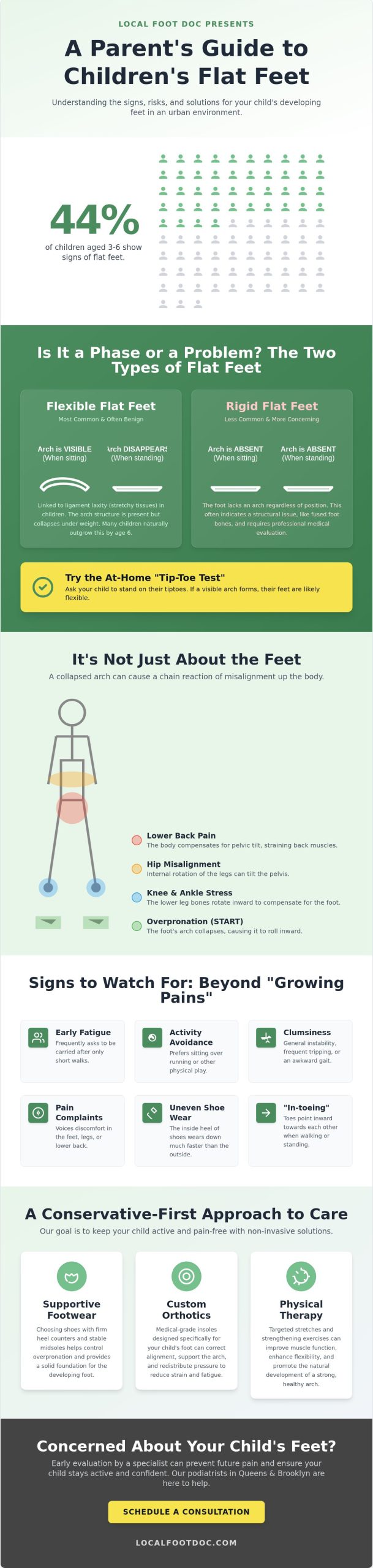
Did you know that nearly 44% of children aged three to six show signs of flat feet? While many cases resolve naturally as the arch develops, seeing your child lag behind during a walk through Prospect Park or struggle during soccer practice can be deeply concerning. If you are searching for effective children’s flat feet treatment NYC offers several specialized options to ensure your little one stays mobile and comfortable on our city’s busy streets.
It’s completely normal to feel torn between waiting for them to grow out of it and worrying about long-term structural damage. You want the best for your child’s future, and we understand the anxiety that comes with seeing them in discomfort. Our goal is to provide the clinical clarity you need to distinguish between common flexible arches and rigid issues that require professional medical care.
This guide will show you how to identify symptoms and manage your child’s foot health to avoid chronic pain or future surgery. We’ll explore non-surgical solutions like supportive footwear and custom orthotics, helping you find a trusted local podiatrist in Queens or Brooklyn to keep your family moving with confidence.
Key Takeaways
- Learn to distinguish between flexible flat feet, which often resolve naturally, and rigid structural issues that require professional medical attention.
- Identify behavioral red flags, such as your child asking to be carried or avoiding physical play, which may signal persistent discomfort rather than simple growing pains.
- Discover how children’s flat feet treatment NYC specialists use supportive footwear and custom orthotics to stabilize developing arches and prevent future mobility issues.
- Understand how to evaluate your child’s gait during daily walks in neighborhoods like Astoria or Forest Hills to determine if a clinical consultation is necessary.
- Explore a conservative-first approach to pediatric care that prioritizes non-invasive solutions to keep your child active and pain-free.
What Are Pediatric Flat Feet and Why Do They Matter in NYC?
When we discuss what are flat feet? we are looking at a condition professionally known as pes planus. In a clinical sense, this means the longitudinal arch of the foot has not developed or has collapsed, causing the entire sole to touch the floor when your child stands up. While many infants are born with a fat pad that hides the arch, most children develop a visible curve by age six. However, for a significant number of New York City kids, this development doesn’t follow a standard path. Understanding the nuances of children’s flat feet treatment NYC families require starts with recognizing how your child’s feet interact with the world around them.
Flat feet aren’t just a cosmetic concern. The feet are the foundation of the entire skeletal system. When the arch is absent, the foot often rolls inward, a movement called overpronation. This shift puts unusual stress on the ankles, which then forces the knees and hips to rotate internally to compensate. Over time, this misalignment can lead to chronic discomfort in the lower back and a higher risk of sports-related injuries as they grow into their teenage years.
The ‘Concrete Jungle’ Factor for Developing Feet
New York City presents a unique challenge for growing feet. Unlike suburban environments where children might spend more time on soft grass or carpeted playrooms, NYC kids spend their lives on unyielding concrete and asphalt. Every trip to the subway or walk to the schoolyard involves thousands of steps on hard surfaces that offer zero shock absorption. This environment accelerates muscle fatigue in children with low arches, often making them feel “tired” much sooner than their peers. Proper foot mechanics are the foundation of physical growth; they ensure that gross motor developmental milestones are reached without the burden of chronic fatigue or instability. Because the city demands so much mobility, traditional flexible footwear often fails to provide the structural protection necessary for a child with a collapsing arch.
Flexible vs. Rigid Flat Feet: The Key Distinction
We categorize pediatric flatfoot into two primary types: flexible and rigid. Flexible flatfoot is the most common variety. In these cases, the arch is visible when the child is sitting or dangling their feet, but it disappears the moment they stand up. This is often linked to ligament laxity, where the “stretchy” nature of a child’s connective tissue prevents the arch from holding its shape under weight. Rigid flatfoot is less common and more concerning, as the arch is absent regardless of whether the child is standing or sitting. This often indicates a structural issue, such as tarsal coalition, where two or more bones in the foot have fused together.
You can perform a simple ‘Tip-Toe Test’ at home to check for flexibility. Ask your child to stand on their tiptoes while you observe their feet from behind. If a visible arch appears when they rise up, the foot is flexible. If the foot remains flat even on their toes, it’s time to seek a professional evaluation. Identifying these differences early allows us to implement conservative management strategies that keep your child active and prevent the need for more invasive interventions later in life.
Signs Your Child Needs Flat Feet Treatment: Beyond ‘Growing Pains’
Many parents assume that if their child complains about sore legs after a day at Central Park, it’s just a temporary phase. However, persistent discomfort is rarely just “growing pains.” While it’s true that many children have flexible flatfoot in children, the condition should never be ignored if it interferes with their daily life. Identifying the need for children’s flat feet treatment NYC experts provide starts with recognizing behavioral shifts that suggest your child’s feet aren’t supporting them as they should.
Watch for red flags during your weekend outings. If your child frequently asks to be carried after walking only a few blocks in Brooklyn or Queens, or if they suddenly prefer sitting on the sidelines instead of running through the playground, their arches may be struggling. You might also notice physical indicators like “in-toeing,” where the toes point toward each other, or a general clumsiness. Flat feet reduce the foot’s ability to act as a stable lever, which often leads to frequent tripping and a lack of coordination during high-energy play.
Checking your child’s footwear can provide immediate clues. Look for uneven wear patterns on the soles; shoes that wear out much faster on the inner edge are a classic sign of overpronation. This mechanical imbalance doesn’t just affect the feet; it forces the entire lower body to compensate, which can lead to fatigue long before the school day is over.
Common Symptoms Parents Often Overlook
Nighttime leg cramping is one of the most frequently dismissed symptoms. When a child’s arch collapses, the calf muscles must work significantly harder to stabilize the body, leading to muscle exhaustion that manifests as “tired legs” or sharp cramps once they finally rest. From a clinical perspective, we also look for calcaneal valgus, which is a visible inward tilting of the heel bone when the child is viewed from behind. If you notice this tilting or if your child begins withdrawing from sports like soccer or track, seeking professional children’s flat feet treatment NYC can prevent these minor aches from becoming chronic developmental obstacles.
The Impact on Sports and Activity Levels
For the young urban athlete, arch health is vital for both performance and safety. Overpronation significantly reduces the foot’s natural shock absorption, which can lead to early-onset sports medicine issues such as shin splints or stress on the knee joints. Proper arch height acts as a natural spring that optimizes energy return and lateral stability during quick pivots on the field. When the foundation is unstable, the risk of ankle sprains increases. If you are concerned about your child’s gait or activity levels, we can help you determine if a specialized approach to pediatric foot care is the right path forward.
Treatment Options: Orthotics, Footwear, and Physical Therapy
Managing pediatric flatfoot isn’t just about creating an arch; it’s about restoring functional independence so your child can keep up with their friends. We prioritize conservative children’s flat feet treatment NYC families can rely on to avoid long-term complications. Most children respond exceptionally well to a combination of mechanical support and targeted strengthening, allowing them to resume their active lifestyles without the shadow of persistent pain. The goal of any treatment for flat feet is to ensure the foot can handle the repetitive impact of city living while promoting healthy bone development.
In rare instances, such as rigid flatfoot caused by structural abnormalities like tarsal coalition, conservative measures might not be enough. If non-surgical options fail to alleviate severe, life-altering pain, we may discuss surgical intervention to realign the bones and restore the foot’s function. However, surgery is considered a last resort. It’s only reserved for the small percentage of cases where the deformity is fixed and significantly impacts a child’s quality of life.
Physical therapy plays a vital role in our partnership with your family. We focus on exercises that strengthen the posterior tibial tendon and the intrinsic muscles of the foot. Simple movements like toe curls, marble pickups, and heel cord stretches help build the “active” support system of the arch. This strengthening ensures that once we align the foot with mechanical supports, the body has the muscular power to maintain that healthy position during movement.
Custom Orthotics: The NYC Gold Standard
For symptomatic children walking miles on city sidewalks, custom orthotics provide a level of precision that generic inserts cannot match. While store-bought cushions might offer temporary relief, they don’t address the specific biomechanical imbalances of your child’s unique foot structure. We use advanced 3D scanning techniques to create a perfect pediatric fit. These devices redistribute pressure and align the gait, effectively neutralizing overpronation. By stabilizing the heel and supporting the midfoot, custom solutions allow the foot to develop correctly while protecting the knees and hips from secondary strain.
Choosing the Right Shoes for NYC Walking
The right footwear is the first line of defense against foot fatigue. When shopping for shoes in Brooklyn or Queens, look for models with a firm heel counter. This is the back part of the shoe that stabilizes the heel bone. If you can easily squeeze the back of the shoe together, it’s too flimsy for a child with flat feet. Mid-foot stability is also essential; the shoe should only bend at the toes, not in the middle of the arch. Many popular “fashion” sneakers lack these structural features, which often contributes to the very discomfort you’re trying to solve. We often recommend athletic brands that offer specific “stability” lines designed specifically for overpronation.
The NYC Parent’s Checklist: When to Visit a Brooklyn or Queens Podiatrist
Deciding when to transition from watchful waiting to active children’s flat feet treatment NYC specialists provide can be difficult for any parent. It’s often the subtle changes in a child’s routine that offer the most clarity. We recommend keeping a simple log of how often your child complains of discomfort or asks for a break during your daily commute. If these complaints occur more than twice a week, or if they are localized specifically to the arch and ankle, it’s time for a professional evaluation to prevent long-term damage.
A walk through neighborhoods like Forest Hills or Astoria serves as an excellent diagnostic environment. Observe your child’s gait from behind as they navigate the sidewalk. Look for the “too many toes” sign. This occurs when you can see the pinky toe and fourth toe peeking out from the outside of their heel, suggesting the foot is collapsing significantly. You should also consider your own foot health history. Since foot structure is often hereditary, children with a family history of flat feet or early-onset bunions are more likely to require intervention to ensure healthy development.
Local Indicators for NYC Families
New York life is a series of endurance tests for our feet. Is your child struggling with the walk to the subway or falling behind on the way to school? Pain that specifically flares up after walking on hard concrete or climbing subway stairs is a major indicator that the foot’s natural shock absorption is failing. If you are noticing these patterns, consulting a foot doctor Brooklyn and Queens parents trust can help you address the issue before it impacts their school performance or social play.
What to Expect During the Diagnostic Visit
Our diagnostic process is designed to be thorough yet gentle. We begin with a comprehensive gait analysis. We watch how the foot moves through the entire walking cycle to identify exactly where the arch is collapsing and how it affects the alignment of the ankle. We also perform a physical examination of joint flexibility and muscle strength to check for ligament laxity. In some cases, we use in-office diagnostic imaging to rule out structural bone issues. This data-driven approach ensures we create a personalized roadmap for your child’s recovery. If you’re ready to ensure your child’s foundation is secure, we invite you to schedule a consultation for Flat feet treatment today.
Compassionate Pediatric Care at Local Foot Doc
At Local Foot Doc, we believe that every child deserves a life of movement without limitation. Dr. Waldemar Majdanski leads our team with a “conservative first” philosophy. We understand that the prospect of a medical visit can be daunting for both parents and children. That’s why we’ve designed our approach to be as transparent and reassuring as possible. When you seek children’s flat feet treatment NYC families trust, you’re looking for more than just a diagnosis; you’re looking for a partner in your child’s long-term health. Our goal is always to restore functional independence using non-invasive methods whenever possible.
We’ve found that children thrive when they feel empowered rather than poked and prodded. During a consultation, we take the time to explain how the foot works in language your child can understand. By showing them how their “foot foundation” helps them run faster or jump higher, we turn a clinical visit into a collaborative journey toward better health. We create personalized recovery plans that prioritize a swift return to play, ensuring your child doesn’t miss out on the activities they love.
Why Families Choose Local Foot Doc
Our practice combines board-certified expertise with the warm, personal touch of a neighborhood doctor’s office. We don’t believe in one-size-fits-all solutions. Instead, we integrate modern technology to provide the highest standard of care. This includes digital gait analysis to see exactly how your child’s feet move in real-time and 3D scanning for custom orthotics. This precision ensures that every device we prescribe is perfectly tailored to your child’s unique anatomy. We’re also deeply committed to patient education. We ensure that you leave our office with a clear understanding of the “why” behind every recommendation, from shoe choices to daily stretching routines.
Booking Your Consultation in Queens or Brooklyn
We know that NYC parents have incredibly busy schedules. To make specialized pediatric care accessible, we maintain convenient locations across the boroughs. Whether you live near our Forest Hills, Astoria, or Woodhaven offices, you’ll find the same high standard of reliable, community-focused care. We accept a wide range of insurance plans and offer clear information on payment options for specialized pediatric services. Our team is ready to help your child regain their independence and walk the city streets with confidence. Schedule your child’s foot evaluation at Local Foot Doc today.
Securing Your Child’s Foundation for a Lifetime of Activity
Your child’s foot health is the foundation for their future mobility. We’ve explored how to identify the signs of structural issues and why the hard pavement of New York City makes early intervention so important. By choosing the right footwear and utilizing conservative therapies, you can prevent chronic pain and keep your little one active on the playground and beyond.
When you need specialized children’s flat feet treatment NYC, our team at Local Foot Doc is here to help. Led by board-certified surgeon Dr. Waldemar Majdanski, we bring over 20 years of experience to every consultation. We focus on specialized pediatric orthotic solutions that are tailored to your child’s unique gait and lifestyle. We want to ensure every step they take in Brooklyn or Queens is one of comfort and strength.
Don’t let “growing pains” hold your child back from the sports and city adventures they love. Book a Pediatric Foot Evaluation in Brooklyn or Queens to ensure their arches develop correctly. We’re committed to helping your family navigate the path to recovery with confidence and care. Your child’s independence is our ultimate goal.
Frequently Asked Questions
Is it normal for a toddler to have flat feet?
Yes, it is completely normal for toddlers to have flat feet because they are born with a fat pad that hides the arch. Research shows that about 44% of children between the ages of three and six exhibit signs of flat feet. Most children naturally develop a visible arch by age six as their ligaments tighten and the fat pad disappears. We only recommend intervention if your child experiences pain or has trouble keeping up with peers.
Can flat feet cause knee or back pain in children?
Yes, flat feet often create a chain reaction of misalignment that affects the entire lower body. When the arch collapses, the foot rolls inward, which forces the knees and hips to rotate internally to compensate for the lack of stability. This mechanical shift puts unusual stress on the joints. It can manifest as chronic aching in the knees or lower back, especially after a long day of walking through neighborhoods like Astoria or Forest Hills.
Will my child have to wear special shoes forever?
Not necessarily, as many children only require extra support during their primary developmental years. The goal of using specialized footwear or inserts is to stabilize the foot while the bones and ligaments are still maturing. Once the arch structure is strong enough to handle city walking without collapsing, many children can transition back to standard athletic shoes. We focus on providing the support they need now to ensure a lifetime of independent movement.
What is the difference between flexible and rigid flatfoot?
The main difference is whether the arch appears when your child is not standing. Flexible flatfoot shows a visible arch when the child sits or stands on their tiptoes, whereas rigid flatfoot remains flat in every position. Rigid cases are much less common and often indicate a structural bone issue. This type of condition usually requires the more intensive children’s flat feet treatment NYC specialists provide to restore proper function and comfort.
How do I know if my child is just having ‘growing pains’?
True growing pains usually occur at night and don’t involve limping or swelling during the day. If your child experiences pain specifically during physical activity, or if they consistently ask to be carried after walking a few blocks in Brooklyn, the issue is likely mechanical. Persistent soreness that is localized in the arch or heel is a clear signal that their feet need professional support rather than just time to grow.
At what age should I be concerned about my child’s flat feet?
You should consider a professional evaluation if the flat appearance persists beyond age six or if your child complains of pain at any age. While many children grow out of the condition, those who still have flat arches as they enter elementary school often benefit from a clinical assessment. Early intervention helps us prevent the development of secondary issues like bunions or chronic heel pain as your child becomes more active in school sports.
Are custom orthotics better than store-bought inserts for kids?
Custom orthotics are significantly more effective for symptomatic children because they are molded to your child’s exact foot shape. Unlike generic store-bought inserts, custom devices address specific biomechanical imbalances and redistribute weight with high precision. This level of customization is essential for providing the effective children’s flat feet treatment NYC families need to manage the high impact of walking on concrete surfaces every day. They offer a reliable path to pain-free play.
Does insurance typically cover pediatric flat feet treatment in NYC?
Many insurance providers do cover pediatric consultations and treatments when they are medically necessary to address pain or gait abnormalities. Coverage for specific items like custom orthotics varies depending on your individual plan and provider requirements. We recommend checking with your insurance company or our office staff to confirm the specific benefits available for your child’s specialized foot care. We work with you to make the process as clear and manageable as possible.