Every morning, thousands of New Yorkers log an average of 10,000 steps on 12,000 miles of sidewalks that are 10 times harder than natural soil. If you have noticed your sneakers wearing down faster on the inner edge after just 30 days of commuting through Midtown, you likely want to know what is pronation in feet and why it’s causing you pain. You aren’t just imagining the discomfort; you’re feeling the physical toll of your body’s biomechanics reacting to the city’s concrete jungle.
We understand how frustrating it is when a walk to the subway leaves your arches throbbing or your lower back stiff. You likely suspect your stride is off. However, you might not know if your foot’s natural movement is helping or hurting you. Our team is here to provide clinical clarity on how New York City’s unforgiving pavement can turn a normal gait into a source of chronic pain.
We will clarify the difference between healthy shock absorption and overpronation so you can walk from Chelsea to the Upper West Side without discomfort. This guide explains your gait mechanics. It identifies when it’s time to see a specialist and outlines the personalized steps we take to get you back on your feet.
Key Takeaways
- Learn exactly what is pronation in feet and how this natural inward rolling motion serves as your body’s essential shock-absorption mechanism.
- Discover why walking miles on New York City’s hard concrete surfaces forces your feet to work harder and how to mitigate the impact on your joints.
- Identify the subtle symptoms of overpronation, such as persistent arch pain or a feeling of instability, that may be affecting your daily stride.
- Explore how our team uses advanced diagnostic gait mapping to identify biomechanical issues and create personalized paths to recovery.
- See how custom-molded orthotics can restore balance to your gait, helping you get back on your feet and move through the city without discomfort.
Defining Pronation: The Natural Shock Absorber of Your Foot
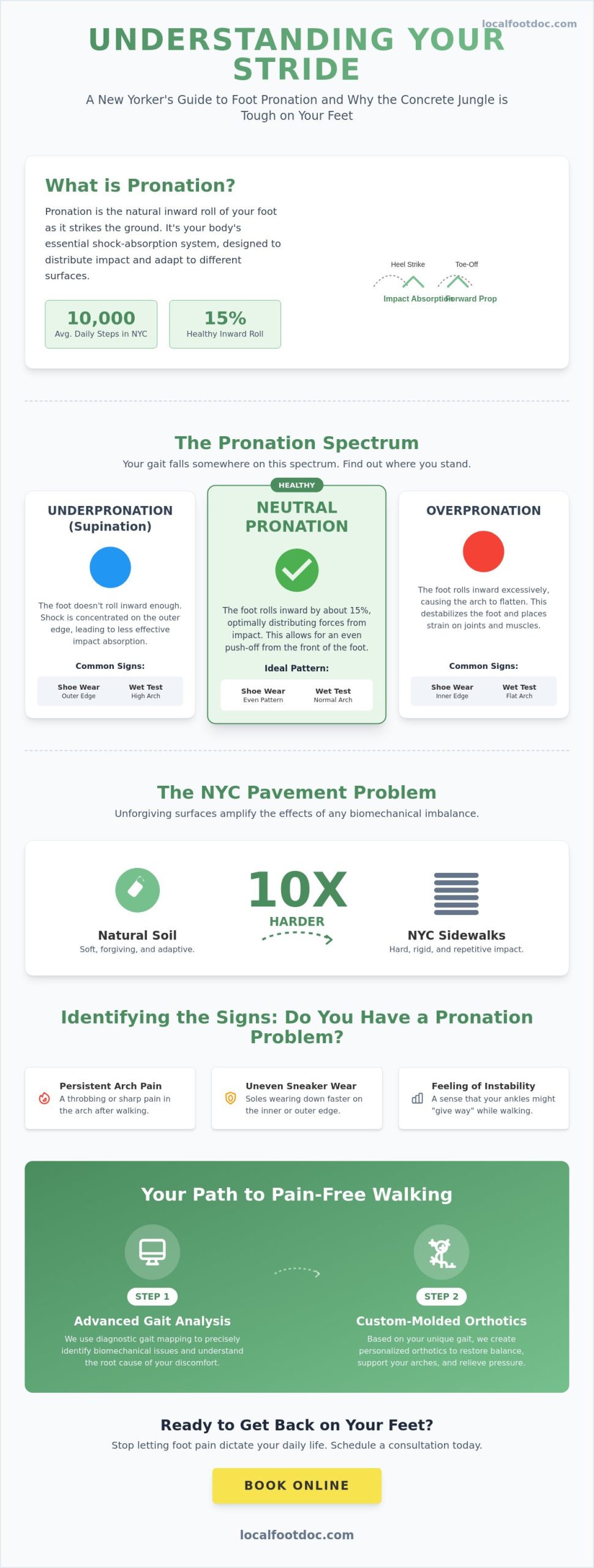
Pronation isn’t a medical condition or a flaw. It’s a vital, natural movement that happens every time your foot hits the pavement. When you’re walking through the busy streets of New York City, your feet undergo a complex series of motions to keep you stable. Pronation of the foot refers to the way your foot rolls inward to distribute the impact of your stride. This inward roll allows the arch to flatten slightly, acting as the body’s primary shock-absorption mechanism. Without this movement, the force of each step would travel directly into your ankles, knees, and hips, leading to premature wear and tear on your joints. Understanding what is pronation in feet helps you realize that your body has a built-in suspension system designed for the urban environment.
A healthy level of pronation helps your foot adapt to different terrains, whether you’re navigating a paved sidewalk in Queens or the soft grass of Central Park. It ensures that your weight is distributed evenly across the bottom of the foot, preventing localized pressure points that can cause sharp pain or stiffness. Our goal at Local Foot Doc is to help you understand if your foot is performing this task efficiently or if a biomechanical abnormality is putting your mobility at risk. Understanding what is pronation in feet is the first step toward identifying why you might feel fatigued after a short walk.
The Mechanics of a Healthy Stride
A normal gait cycle is a masterpiece of biological engineering. It begins with a heel strike, where the outer edge of your heel touches the ground first. Within 250 to 300 milliseconds, the foot begins to roll inward and the arch elongates. This phase turns your foot into a mobile adapter, allowing it to conform to the surface beneath you. After the foot absorbs the initial impact, it reverses the process. The arch rises, and the foot becomes a rigid lever. This transition is what gives you the necessary leverage to push off your toes and move forward with purpose and power.
Pronation vs. Flat Feet: Clearing the Confusion
We often see patients in our offices who are confused about the difference between their foot shape and how they walk. Pronation is a dynamic movement, whereas flat feet, known clinically as pes planus, is a structural description of the arch. It’s a common misconception that only people with low arches have issues. In fact, a person can have high arches but still overpronate significantly during their gait. If you’re concerned about the physical structure of your feet, you might ask, How Do I Know If I Have Flat Feet? Our team uses digital gait analysis to separate structural shape from functional movement, providing a clear path to getting you back on your feet without pain.
Overpronation vs. Underpronation: Understanding the Spectrum
Understanding what is pronation in feet requires looking at foot movement as a spectrum rather than a single fixed position. A neutral gait involves a controlled inward roll of approximately 15 percent, which allows the foot to absorb shock and support your body weight. However, many New Yorkers find themselves at the extreme ends of this curve. Overpronation occurs when the foot rolls too far inward, causing the arch to collapse excessively. Underpronation, or supination, happens when the foot fails to roll inward enough, keeping the weight focused on the outer edges. Both extremes disrupt your body’s natural alignment, often causing pain that radiates from the ankles up to the lower back.
You can perform a simple “Wet Foot Test” at home to see where you fall on this spectrum. Wet the bottom of your foot and step firmly onto a piece of cardboard or a dry concrete surface. If your footprint looks like a complete, solid oval, you likely overpronate. If you see a very thin line connecting the heel and the ball of the foot, or no line at all, you are likely a supinator. Identifying these patterns early helps our team design a plan to keep you moving comfortably through the city.
The Risks of Excessive Overpronation
Overpronation is the most frequent biomechanical issue we treat at our NYC clinics. When the arch flattens too much, it puts significant strain on the posterior tibial tendon and the plantar fascia. This constant tugging can lead to Overpronation causes and symptoms such as painful bunions and hammertoes. Because the foot rolls inward, the lower leg bone rotates internally as well. This creates a “knock-knee” effect that contributes to patellofemoral pain syndrome, a condition affecting roughly 25 percent of active urban walkers. If you feel a dull ache in your arches after a day of walking in Midtown, your feet are likely working too hard to stabilize themselves.
Supination: The Less Common Challenge
Supination affects about 10 percent of the population and presents a different set of obstacles. While overpronators are too flexible, supinators have feet that are too rigid. These high arches don’t flatten enough to absorb the impact of hard pavement. Instead of the foot dispersing the force of a step, the shock travels directly up the tibia. This lack of shock absorption frequently leads to stress fractures and chronic tightness in the Achilles tendon. If the outer edges of your sneakers wear down faster than the rest of the sole, it’s a clear sign your gait is supinated. To protect your joints from the repetitive impact of city life, you may want to schedule a professional gait analysis with our specialists.
Why NYC Pavement Makes Pronation Issues Worse
New Yorkers are a unique breed of urban athletes. Whether you are rushing to catch the L train in Brooklyn or power-walking through Midtown for a meeting, you likely cover an average of 2 to 5 miles daily. This distance is covered almost exclusively on unforgiving concrete and asphalt. Unlike natural surfaces like grass or sand, which provide a degree of shock absorption, city pavement has zero “give.” Every step sends a jarring force back into your skeletal system, and your feet are the first line of defense.
When you consider pronation of the foot, it’s important to realize that this movement is a natural part of the gait cycle designed to absorb shock. However, the repetitive impact on hard NYC surfaces forces the foot to work significantly harder than nature intended. Over time, this constant pounding can lead to “urban foot fatigue,” where the muscles and tendons that support your arch simply wear out. At Local Foot Doc, our team takes the “Expert Neighbor” approach. We understand the specific physical demands of living in the five boroughs, and we focus on helping you maintain your mobility without the constant threat of pain.
The “Concrete Jungle” Effect on Your Arches
Walking on pavement is fundamentally different from walking on soft terrain. On a trail, the ground molds to your foot, which helps distribute your weight. On a New York sidewalk, your foot must mold to the ground. This creates a biomechanical crisis for those with alignment issues. If you have ever wondered what is pronation in feet and why it matters, look no further than the cumulative effect of a daily commute. The repetitive impact on hard surfaces accelerates arch collapse, leading to a condition known as overpronation. This isn’t just about tired feet; it’s about the structural integrity of your gait being compromised by the environment you live in.
Commuting and Shoe Wear Patterns
The streets of Queens and the subway stairs of Manhattan act as a diagnostic tool for podiatrists. We often identify “NYC shoe wear” patterns where the heels of a patient’s shoes are worn down aggressively on the inner or outer edge. If you notice your soles are unevenly thin after just three months of wear, your foot is likely struggling to manage the impact of the city. This often leads to a “burning” sensation in the ball of the foot or the arch by the time you reach your front door.
Choosing the right footwear is your first defense against these stressors. You can learn more about selecting the right gear in our guide on the difference between running and walking shoes. Using the wrong shoe for your specific pronation type while navigating uneven sidewalks and steep subway stairs can lead to chronic inflammation. We focus on providing personalized care that accounts for these daily obstacles, ensuring you have the support needed to keep getting back on your feet and enjoying everything the city has to offer.
Identifying the Signs: Do You Have a Pronation Problem?
NYC’s concrete surfaces are unforgiving. Walking 10,000 steps a day on Manhattan pavement quickly reveals whether your gait is healthy or harmful. Understanding what is pronation in feet begins with listening to the signals your body sends after a long commute. If you experience a dull, throbbing ache in your arch or sharp pain in the heel during your first steps each morning, your feet may be rolling inward excessively. This misalignment doesn’t just stay in the feet. It often manifests as persistent knee, hip, or lower back pain that worsens by the time you reach your front door in the evening.
Instability is another major red flag. We often see patients who suffer from frequent ankle sprains or a general feeling that their balance is “off” while navigating subway stairs. This happens because overpronation prevents the foot from becoming a rigid lever for push-off, leaving the ankle vulnerable. You might also notice thick calluses forming on the inside of the big toe or the ball of the foot. These are not just cosmetic issues; they are your body’s attempt to protect itself from the abnormal friction caused by a collapsing arch.
Physical Red Flags to Watch For
You can perform a simple assessment at home by checking the “Too Many Toes” sign. Stand naturally and have someone look at your feet from directly behind. In a neutral foot, you should only see the pinky toe. If the fourth or third toes are visible on the outside, it indicates the midfoot has collapsed inward. Next, inspect your favorite pair of walking shoes. Excessive wear on the inner edge of the sole or a heel that tilts inward when placed on a flat surface confirms a biomechanical issue. Check for swelling or tenderness specifically along the inner ankle bone, which often indicates strain on the posterior tibial tendon.
When to See a NYC Podiatrist
Don’t wait for a minor ache to become a debilitating injury. While occasional soreness after a heavy workout is normal, chronic pain that persists for more than 72 hours requires a professional evaluation. Early intervention is the most effective way to prevent the structural shifts that lead to bunions or hammertoes. Our team uses advanced gait analysis to identify exactly how your foot strikes the ground. If you are searching for the Best Podiatrist in Forest Hills, NY, we offer personalized orthotic solutions designed to stabilize your stride and keep you moving comfortably.
Professional Solutions: From Custom Orthotics to Gait Training
Understanding what is pronation in feet is only the first step toward pain-free movement. If you’ve spent months asking what is pronation in feet while dealing with persistent arch pain, our 2026 diagnostic suite provides the answers. Dr. Majdanski utilizes advanced biomechanical analysis to map your unique gait. We use digital pressure sensors and high-speed video capture to see exactly how your foot strikes the pavement. This data-driven approach removes the guesswork from your recovery. For the 25% of New Yorkers who experience symptomatic overpronation, these insights are life-changing.
The Power of Custom Orthotics
Many patients try over-the-counter inserts before visiting our Brooklyn or Queens offices. While these generic pads provide temporary cushioning, they often fail serious overpronators because they aren’t built for your specific bone structure. Custom-molded orthotics act as a functional prescription for your feet. They redistribute pressure across the plantar surface and realign your entire lower limb, from the ankle to the lower back. Our casting process involves a precise 3D scan or physical mold that captures your foot in its neutral position. This ensures your orthotics provide the exact level of arch support needed to combat the collapsing sensation common in flat feet.
Getting Back on Your Feet in NYC
Living in New York City means walking miles on unforgiving concrete every day. We focus on strengthening the urban athlete through targeted physical therapy and stretching routines. Exercises like short foot contractions and calf stretches protect the posterior tibial tendon, which is the primary stabilizer of your arch. If structural issues like bunions or severe tendon dysfunction have progressed too far, we discuss surgical options to restore alignment. Most patients find success with a combination of custom gear and the right footwear.
When shopping for shoes, look for these specific categories to support your gait:
- Stability Shoes: These are best for mild to moderate overpronation and feature a firmer foam under the arch.
- Motion Control Shoes: These are designed for severe overpronation or flat feet to prevent excessive inward rolling.
- Neutral Cushioning: These are reserved for those with high arches or supination.
Our team is here to help you navigate these choices and find a permanent solution to your discomfort. You don’t have to live with the throbbing or stiffness that follows a long day in Manhattan. Schedule a consultation at Local Foot Doc to analyze your gait today and start your journey toward better mobility.
Step Toward Lasting Comfort and Mobility
Understanding what is pronation in feet is the essential first step toward pain-free movement on New York City’s unforgiving concrete. Whether you’re navigating the busy streets of Astoria or walking the residential blocks of Forest Hills, your feet absorb thousands of pounds of pressure every day. Board-certified surgeon Dr. Waldemar Majdanski and our team specialize in correcting the biomechanical imbalances that lead to chronic stiffness or throbbing pain. We provide specialized custom orthotic casting on-site at our three locations to ensure your support is tailored specifically to your unique foot structure. Clinical data from 2024 suggests that professional gait correction can significantly reduce secondary strain on the knees and hips by improving weight distribution.
Don’t let a misaligned gait limit your independence or keep you from the activities you love. With modern clinics across Queens and Brooklyn, including our Woodhaven office, we combine advanced diagnostic technology with the personalized care of a trusted neighborhood doctor. We’re committed to helping you regain your mobility and get back on your feet with total confidence. Our team is ready to guide you through a predictable and professional recovery process starting today.
Book an Appointment with Dr. Majdanski in Brooklyn or Queens
Frequently Asked Questions
Is pronation a bad thing for my feet?
Pronation isn’t a bad thing; it’s a natural and necessary movement that occurs during your gait cycle. When you walk on NYC sidewalks, your foot rolls inward by about 15 percent to absorb shock and adapt to the surface. It only becomes a clinical concern when the rolling is excessive. Our team monitors these biomechanics to ensure your stride remains efficient and pain-free.
How can I tell if I am overpronating at home?
You can identify overpronation by examining the soles of your favorite walking shoes. If more than 80 percent of the tread wear is concentrated on the inner edge of the heel and the ball of the foot, you’re likely overpronating. Another method is the wet foot test on a piece of cardboard. If the imprint shows your entire sole without a visible arch, it’s time for a professional gait evaluation.
Can overpronation be cured without surgery?
Yes, overpronation is successfully managed without surgery in approximately 90 percent of our patients. We focus on non-invasive strategies like custom orthotics, physical therapy, and specific footwear modifications to stabilize your gait. These treatments aim to realign your feet and prevent secondary injuries. While we can’t change your bone structure without an operation, we can certainly optimize how your feet function so you can get back on your feet comfortably.
What is the best type of shoe for overpronation?
The best footwear for this condition is a stability or motion control shoe that features a firm medial post. This denser piece of foam on the inside of the midsole reduces the inward roll. When shopping in Manhattan, look for shoes that don’t twist easily in the middle. Understanding what is pronation in feet helps you select shoes that provide the structured support necessary to protect your arches during long days of walking.
Does overpronation cause lower back pain?
Overpronation frequently leads to lower back pain because your feet are the foundation of your entire kinetic chain. When your feet roll inward excessively, it forces your lower leg to rotate, which can tilt the pelvis forward by 5 to 10 degrees. This misalignment creates tension in the lumbar spine. We often find that correcting a patient’s foot mechanics provides relief for 85 percent of our chronic back stiffness cases.
Can children outgrow overpronation?
Approximately 80 percent of children appear to overpronate because their longitudinal arches don’t fully develop until they reach age 6 or 7. During these early years, a flat appearance is often just a normal developmental stage. However, if your child experiences pain or trips more than 3 times a day, a professional evaluation is necessary. Our team tracks these developmental milestones to ensure their growing bones and ligaments align correctly for a healthy future.
What happens if I leave overpronation untreated?
Leaving overpronation untreated increases your risk of developing chronic conditions like plantar fasciitis, bunions, and Achilles tendonitis. Clinical data indicates that improper gait mechanics can increase the strain on the plantar fascia by 30 percent. Over time, this repetitive stress can lead to micro-tears and persistent inflammation. Addressing the issue now prevents these painful complications and ensures you don’t have to miss out on your active New York lifestyle.
How do custom orthotics help with pronation?
Custom orthotics provide a precise level of support that over-the-counter inserts can’t match. We use advanced 3D scanning technology to map your foot’s unique contours down to the millimeter. These devices act as a corrective foundation, redistributing pressure and guiding your foot into a neutral position. By understanding what is pronation in feet, we design orthotics that specifically counteract your unique degree of inward rolling to restore balance and long-term comfort.