Imagine finishing a morning run along the East River only to realize that the familiar ache in your heel has turned into a sharp, localized throb. You aren’t alone, as ankle sprains account for 22% of all injuries in sports like football and remain a constant risk for anyone navigating the uneven pavement of the five boroughs. Dealing with foot and ankle sports injuries in 2026 requires more than just rest; it requires a strategy tailored to the high-impact reality of New York City life.
We know how much you rely on your mobility to manage the daily commute or climb those subway stairs without hesitation. Our team is here to ensure you don’t have to choose between your fitness goals and a pain-free lifestyle. This guide provides the clear path you need to secure an accurate diagnosis and access the fastest recovery methods available today.
We will walk you through the latest recovery trends, from telehealth physical therapy options to the impact of the NYCE PPO plan transition that took effect on January 1, 2026. You will discover how to prevent recurring pain on hard city surfaces and exactly what to expect from modern podiatric care. Let’s get you back on your feet and back to the city you love.
Key Takeaways
- Learn why the “concrete factor” of New York City streets increases your risk for chronic strain and how to adapt your training for urban surfaces.
- Understand the difference between acute and chronic foot and ankle sports injuries to determine if your pain requires professional intervention or simple home care.
- Explore how advanced in-office diagnostics like ultrasound and X-rays provide immediate answers, helping you avoid the long wait times of traditional hospitals.
- Discover how custom orthotics serve as a long-term foundation for recovery by correcting the biomechanical imbalances that cause recurring pain.
- Identify the signs that conservative care isn’t enough and how minimally invasive surgical techniques can get you back to your active lifestyle faster.
Understanding Foot and Ankle Sports Injuries in the NYC Athlete
Being an athlete in New York City is a unique challenge. While most sports medicine advice focuses strictly on the field or court, we understand that your training often continues on the walk to the office or while carrying groceries up a four-story walk-up. In our practice, we define foot and ankle sports injuries as any damage to the bones, ligaments, or tendons that occurs during physical activity, but for a New Yorker, that activity includes the relentless impact of the city itself. Understanding the mechanics of foot and ankle sports injuries allows us to create a recovery plan that accounts for your specific neighborhood and daily commute.
Acute vs. Overuse Injuries: Which One Do You Have?
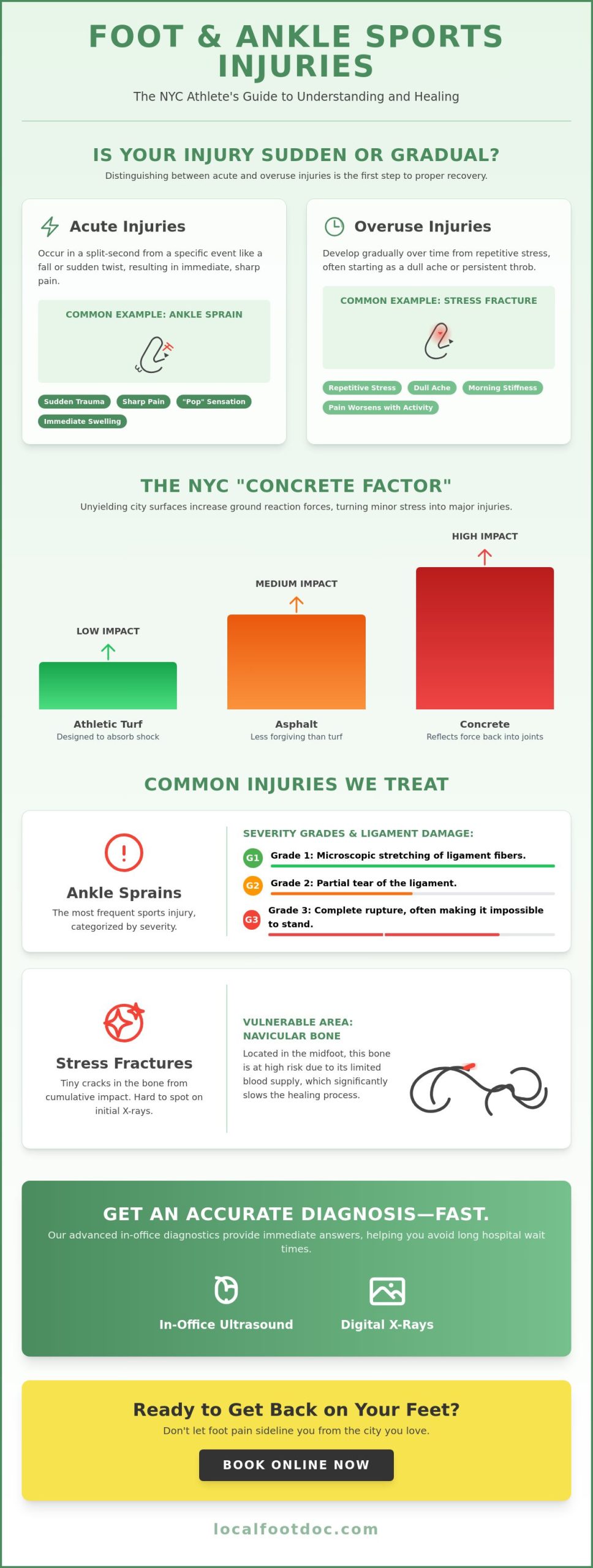
Distinguishing between a sudden accident and a lingering ache is the first step toward recovery. An acute injury happens in a split second. You might hear a “pop” or feel immediate sharp pain after a fall or a sudden change in direction. A Sprained ankle is the most common example of this sudden trauma, often resulting in immediate swelling and an inability to bear weight. Overuse injuries, however, are quieter. They manifest as a persistent “throbbing” or morning “stiffness” that seems to fade once you start moving, only to return with a vengeance after your workout. These gradual issues, like Achilles tendonitis or stress fractures, often stem from repetitive stress that hasn’t been properly addressed by a professional.
The Role of NYC Terrain in Foot Health
The “concrete factor” is a very real clinical concern for anyone living in the five boroughs. Most athletic surfaces are designed to absorb shock, but New York’s streets are made of unyielding materials that reflect that force right back into your joints. Concrete is significantly harder than asphalt, and both are far less forgiving than the synthetic turf found in Central Park or local gyms. This environment increases ground reaction forces with every step. When you add the thousands of steps taken on subway stairs and the miles spent walking to work, the cumulative impact is staggering. We’ve seen how this environmental stress turns minor muscle soreness into a clinical injury. Early intervention is vital because, in this city, your feet are your primary mode of transportation. Ignoring a “burning” sensation in your arch today could mean being unable to navigate the subway system tomorrow. Our team focuses on “Expert Neighbor” care, combining clinical precision with an understanding of exactly what your feet endure between the gym and your front door.
Common Sports Injuries: From Ankle Sprains to Stress Fractures
Athletes across the five boroughs often push through minor discomfort to keep up with their training schedules. However, distinguishing between a temporary ache and a clinical condition is essential for long-term mobility. Identifying foot and ankle sports injuries early prevents a minor setback from turning into a season-ending problem. We see these conditions frequently in our Brooklyn and Queens offices, where the combination of high-impact sports and hard city surfaces creates a perfect storm for lower extremity trauma.
Ankle Sprains and Ligament Tears
Ankle sprains are the most common injury we treat, particularly among basketball players and distance runners. A “rolled ankle” isn’t always a simple fix. We categorize these by severity to determine the best recovery path. A Grade 1 sprain involves microscopic stretching of the fibers, while a Grade 2 sprain indicates a partial tear. Grade 3 is a complete rupture of the ligament, often making it impossible to stand. Without professional rehabilitation, these injuries often lead to chronic ankle instability, where the joint feels weak or “gives out” during simple movements. If you aren’t sure of the severity, you can learn more about how to tell is my foot broken or sprained before your appointment.
Stress Fractures and the Navicular Bone
Stress fractures are tiny cracks in the bone caused by repetitive force rather than a single impact. For New Yorkers who walk miles on concrete, these are a significant risk. The navicular bone, located in the midfoot, is especially vulnerable because it has a limited blood supply, which can slow down the healing process. These injuries are notoriously difficult to spot because they often don’t show up on initial X-rays taken right after the pain starts. You might notice a dull ache that gradually transforms into a sharp, localized pain when you’re walking across town or finishing a HIIT workout. If you’re experiencing this type of persistent stiffness, consulting a specialist can prevent a minor crack from becoming a complete break.
Achilles Tendon Health
The Achilles tendon is the largest tendon in the body, and it bears the brunt of every jump and stride. Achilles tendinitis is an inflammation of the tendon connecting calf muscles to the heel bone. We see two primary types: mid-substance tendinitis, which affects the middle of the cord, and insertional tendinitis, which occurs where the tendon meets the heel bone. It’s vital to monitor for “burning” sensations or thickening of the tendon. A sudden, sharp pain that feels like a “kick in the calf” is a major warning sign of a rupture. This requires immediate medical attention to restore your ability to push off the ground and resume your active lifestyle.
Beyond these common issues, we also treat conditions like turf toe, which is a sprain of the big toe joint, and plantar fasciitis. Both involve significant ligament strain that can make every step toward the subway feel like a chore. Our goal is always to identify the underlying biomechanical cause so we can treat the source, not just the symptoms.
Advanced Diagnostics for Sports Injuries in Brooklyn and Queens
General urgent care centers are helpful for a sudden fever or a minor cut, but they often lack the specialized equipment needed to accurately assess foot and ankle sports injuries. When you’re an athlete in a city that demands constant movement, a “wait and see” approach isn’t an option. Our diagnostic process moves beyond simply identifying where it hurts. We focus on a comprehensive clinical evaluation that looks at the entire structure of your foot to understand how an injury in one area might be caused by a weakness in another. This specialized focus ensures we don’t just treat the symptom; we treat the athlete.
Digital X-Ray and Ultrasound Imaging
In 2026, diagnostic technology allows us to provide answers in minutes rather than days. We use high-resolution digital X-rays to identify subtle bone changes and stress fractures that are frequently missed on older, traditional film. For soft tissue concerns like ligament tears or “stiffness” in the tendons, musculoskeletal ultrasound is an invaluable tool. It allows Dr. Majdanski to visualize your anatomy in real-time while you move your foot, providing a dynamic view of “throbbing” inflammation or partial ruptures. This immediate feedback means we can create a personalized recovery plan during your very first visit, saving you from multiple trips to imaging centers across the city.
Gait Analysis and Biomechanical Assessment
We believe that understanding the “why” behind your pain is just as important as the diagnosis itself. If you’re dealing with recurring pain after running through Astoria or walking to your office in Downtown Brooklyn, the culprit is often your gait. Our team performs a detailed biomechanical assessment to analyze how your feet strike the ground. We look for signs of overpronation or supination, as these imbalances force your muscles to work harder to stabilize your body on unyielding concrete. Understanding what is pronation in feet is a critical step in this process. Structural issues like flat feet can lead to a chain reaction of stress that eventually results in a clinical injury. By identifying these patterns early, we can use 3D scanning technology to design interventions that correct your foundation and prevent the injury from returning. Our goal is to provide the technical proficiency required to get you back on your feet with total confidence in your long-term mobility.
Recovery Strategies: Getting New Yorkers Back on Their Feet
Recovery in this city requires a balance of immediate action and long-term structural support. For most foot and ankle sports injuries, the first 48 to 72 hours are critical for managing inflammation. We recommend following the R.I.C.E. protocol (Rest, Ice, Compression, and Elevation) immediately after an injury occurs. While this helps with initial swelling, it doesn’t address the underlying biomechanical issues that caused the injury in the first place. Our team works with you to build a comprehensive plan that ensures you don’t just heal, but return stronger than before. To see how other wellness experts approach structural health through gentle care, you can discover Livelovelife Chiropractic and their transformative methods.
The Power of Custom Orthotics
Many athletes try to solve their discomfort with store-bought inserts, but these generic products often fail to provide the specific support required for navigating NYC’s unyielding pavement. Unlike mass-produced foam, custom orthotics are medical devices molded precisely to your foot’s unique shape. They serve to redistribute pressure across your entire foot, which is essential when you’re walking miles on concrete. By correcting alignment issues like overpronation, these devices prevent the repetitive stress that leads to “throbbing” heels or “burning” arches. We use advanced 3D scanning to ensure your orthotics fit perfectly into your athletic shoes and your daily work footwear.
Rehabilitation and Prevention
Physical therapy is a cornerstone of recovery, focusing on strengthening the “intrinsic” muscles of the foot. These small muscles are responsible for stabilizing the ankle and supporting the arch during high-impact activities. We design rehabilitative exercises that mimic the demands of city life, such as climbing subway stairs or maintaining balance on a moving train. Prevention also relies heavily on your choice of gear. Proper footwear should be replaced every 300 to 500 miles to maintain adequate shock absorption. If you’ve been wearing the same running shoes for a year of NYC commuting, they likely aren’t providing the protection you need.
Returning to your sport should be a gradual process, not a sudden jump. We provide specific return-to-play protocols that slowly increase your mileage or intensity to ensure the tissues have fully adapted. If you’re ready to start your journey toward pain-free movement, schedule a consultation with our sports medicine team today. Our goal is to provide the fastest, safest path back to your active New York City lifestyle.
When Surgery is Necessary: Expert Podiatric Care at Local Foot Doc
While we always exhaust conservative treatments first, some foot and ankle sports injuries demand a surgical solution to ensure a full return to activity. If you’re dealing with a complete tendon rupture or a complex fracture that hasn’t responded to bracing, surgery becomes the most reliable path to regaining your independence. We understand that the prospect of an operation can be overwhelming. That’s why our approach focuses on clear communication and the most advanced, minimally invasive techniques available in 2026. Our goal is to stabilize the injury while preserving as much natural range of motion as possible.
Surgical Options for Sports Trauma
Severe trauma, such as Grade 3 ligament tears or unstable fractures, often requires surgical fixation to restore the joint’s integrity. We also address structural issues that are frequently exacerbated by athletic activity on city pavement. For example, a runner might find that their bunion pain becomes unbearable due to the repetitive impact on concrete. In these cases, we provide specialized bunion surgery Queens athletes trust to correct the bone’s alignment. By fixing these underlying structural problems, we don’t just treat the immediate sports injury; we build a foundation that prevents future breakdowns and chronic “stiffness” in the forefoot.
The Local Foot Doc Difference
Choosing a surgeon is a significant decision. Dr. Majdanski brings board-certified expertise and over 20 years of clinical experience specifically within the New York City community. We perform these procedures in modern outpatient settings in Forest Hills and Astoria, allowing you to recover in the comfort of your own home on the same day. Our team prioritizes your specific lifestyle goals, whether that’s finishing your next marathon or simply walking to the office without a “throbbing” sensation in your foot. We use the latest technology to minimize incision size and reduce downtime, helping you navigate the city again as quickly as possible.
Don’t let a severe injury sideline you permanently. We’re here to guide you through every step of the process, from the initial consultation to the final day of rehabilitation. Ready to get back in the game? Schedule a consultation with Dr. Majdanski today.
Take the First Step Toward Pain-Free Movement
Navigating life in the five boroughs is an athletic feat in itself. Whether you’re managing a sudden sprain from a weekend game or a persistent ache from daily miles on the pavement, addressing foot and ankle sports injuries with professional precision is the only way to ensure your long-term mobility. We’ve explored how advanced in-office imaging and custom orthotic casting provide the structural foundation you need to thrive on New York’s unyielding surfaces. Our goal is to move you past the “stiffness” and “throbbing” so you can embrace the city’s energy without hesitation.
Our team, led by Board-Certified Surgeon Dr. Waldemar Majdanski, brings over 20 years of clinical expertise to our neighbors in Queens. With convenient locations in Forest Hills, Astoria, and Woodhaven, we provide the specialized care required to get you back on your feet. Don’t let a lingering injury dictate your schedule or limit your potential. Book your sports injury evaluation with NYC’s expert podiatry team today. We’re ready to help you reclaim your active lifestyle and move through the city with total confidence once again.
Frequently Asked Questions
When should I see a podiatrist for a sports injury instead of just resting?
You should schedule an evaluation if your pain doesn’t improve after 72 hours of rest or if you’re unable to bear weight immediately after the trauma. Persistent throbbing or swelling that doesn’t subside with ice are clear indicators that professional intervention is needed. Early diagnosis of foot and ankle sports injuries prevents minor ligament strains from developing into chronic instability that could sideline you for months.
Can running on NYC pavement cause permanent damage to my feet?
Repetitive impact on unyielding concrete can lead to permanent structural changes if you ignore the warning signs of overuse. Asphalt and concrete reflect significantly more force back into your joints compared to natural surfaces like turf or dirt. This constant stress can cause chronic conditions like osteoarthritis or recurring stress fractures. We focus on biomechanical corrections to protect your joints from the concrete factor of the five boroughs.
How long does it typically take to recover from a high ankle sprain?
Recovery from a high ankle sprain typically takes between 6 and 12 weeks depending on the degree of syndesmotic ligament damage. These injuries involve the ligaments above the ankle joint and require a more cautious rehabilitation timeline than standard lateral sprains. We use specific return-to-play protocols to ensure the joint is stable before you resume high-impact activities like running or basketball in local parks.
Are custom orthotics worth it for casual runners in Brooklyn?
Custom orthotics are a vital investment for any New Yorker who spends significant time on their feet, regardless of their athletic intensity. Unlike generic inserts, these medical devices are molded to your unique foot structure to redistribute pressure and correct overpronation. By aligning your foundation, you reduce the risk of common issues like plantar fasciitis that often plague those walking or running on Brooklyn’s hard surfaces.
What is the difference between a foot fracture and a severe sprain?
A foot fracture is a break in the bone, while a severe sprain is a complete tear of the ligaments. Both conditions often present with similar symptoms like immediate swelling and bruising. Because it’s difficult to distinguish between the two based on physical sensation alone, we utilize in-office digital X-rays to get a definitive answer and start the correct treatment plan for your foot and ankle sports injuries immediately.
Does insurance typically cover sports medicine consultations at Local Foot Doc?
Most major insurance plans, including the New York City Employee PPO (NYCE PPO) plan that took effect on January 1, 2026, cover sports medicine consultations. We accept a wide range of providers to ensure our community has access to specialized care. It’s always a good idea to verify your specific co-payment, which typically ranges from $20 to $75 per visit in the New York area as of early 2026.
Can I still exercise while recovering from a foot or ankle injury?
You can often maintain your fitness through low-impact modifications that don’t stress the injured area. Activities like swimming or stationary cycling allow you to keep your cardiovascular health up without putting weight on a healing ligament or bone. We work with you to develop a modified activity plan that keeps you moving while ensuring your injury has the necessary environment to heal completely and safely.
How do I know if my Achilles tendon is at risk of rupturing?
Warning signs of a potential rupture include a noticeable thickening of the tendon or a persistent burning sensation in the back of your heel. If you feel a sudden, sharp pain that resembles a kick in the calf during activity, you must seek medical attention immediately. Identifying these symptoms early allows our team to implement conservative treatments and prevent a full rupture that would require a much longer recovery period.