Last August, Sarah discovered that even a simple trip to Coney Island felt impossible because of the embarrassment she felt about her feet. We understand that living with brachymetatarsia is about more than just aesthetics; it’s a daily struggle with throbbing pain during long commutes and the constant frustration of shoes that never quite fit right. If you’ve felt self-conscious about a toe that appears shorter than the others, you aren’t alone, even though this condition affects only about 0.05% of the population. Our team specializes in short toe surgery to help you regain your confidence and your mobility.
In this guide, we’ll show you how specialized lengthening and shortening procedures in Brooklyn and Queens can restore your foot function and symmetry. You’ll discover the latest minimally invasive techniques that prioritize faster healing and learn what to expect during a recovery that typically ranges from 6 to 16 weeks. We also explain how New York regulations updated on March 15, 2024, ensure your procedure meets the highest safety standards, allowing you to focus entirely on getting back on your feet and back to the NYC lifestyle you love.
Key Takeaways
- Understand the difference between lengthening for brachymetatarsia and shortening for long toes to identify the right solution for your foot structure.
- Discover how restoring toe symmetry improves your “forefoot tripod” to eliminate chronic pain and enhance your natural walking gait.
- Learn how specialized short toe surgery uses advanced plates and joint resection to provide both functional relief and aesthetic confidence.
- Gain a realistic recovery roadmap tailored for New Yorkers, from the first 48 hours at home to safely navigating the subway system.
- Explore our board-certified approach to podiatric care in Brooklyn and Queens, where we use state-of-the-art imaging to create your personalized treatment plan.
Understanding Short Toe Surgery in New York City
Many patients visit our offices in Brooklyn and Queens feeling confused about whether their foot concerns are purely cosmetic or truly medical. In our practice, we view short toe surgery as a vital intersection of restorative science and aesthetic balance. This category of procedures isn’t a one size fits all solution. Instead, it encompasses two distinct surgical paths: lengthening for those with brachymetatarsia and shortening for those struggling with an overextended second toe, often referred to as Morton’s Toe.
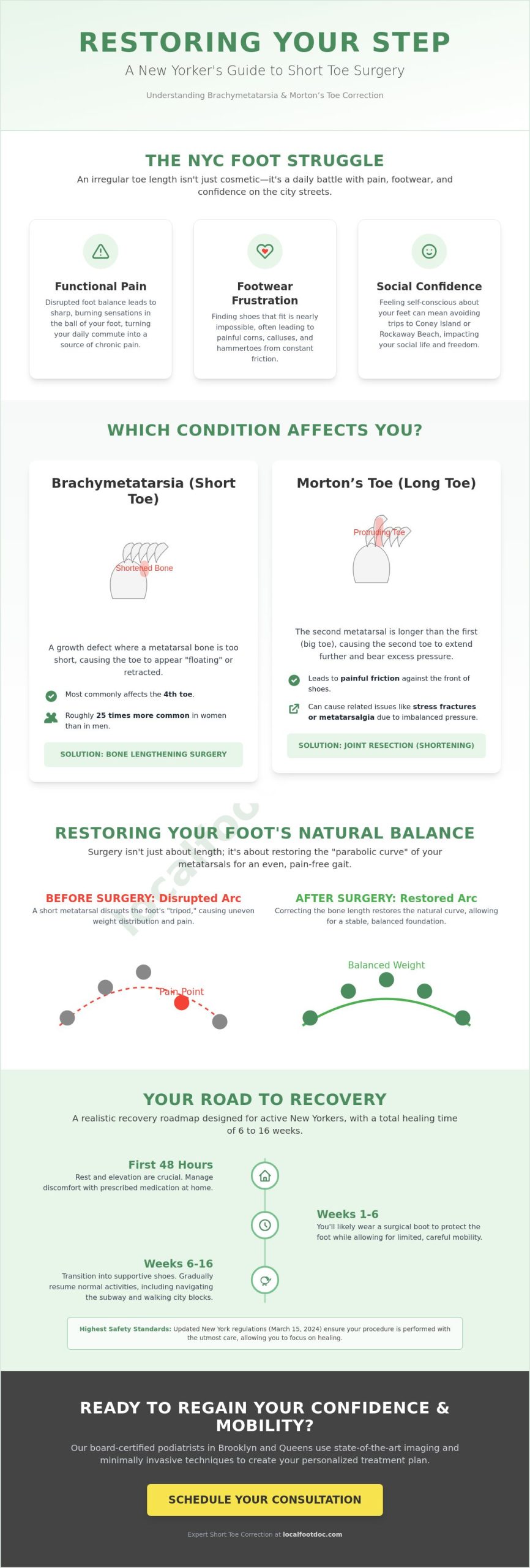
Brachymetatarsia is a growth defect affecting the metatarsal bones, not a birth defect. While the underlying cause is often genetic, the physical manifestation typically appears between the ages of four and ten as the other bones in the foot grow at a normal rate. This results in a “floating” toe that doesn’t touch the ground, which can be both physically painful and emotionally taxing. To better understand the clinical diagnosis and causes, patients often ask, What is Brachymetatarsia? It’s essentially the premature closure of a growth plate in one of the five long bones of the midfoot, a condition that is roughly 25 times more common in women than in men.
Why New Yorkers Seek Toe Correction
Living in New York City puts a unique level of stress on your feet. Walking through neighborhoods like Astoria or Park Slope often means logging several miles a day on unforgiving concrete. When your toes aren’t aligned, that daily commute becomes a source of chronic discomfort. We see three primary reasons why our neighbors seek out short toe surgery:
- Functional Pain: An irregular toe length disrupts the way your foot strikes the ground, leading to sharp, burning sensations in the ball of the foot.
- Footwear Frustration: Finding shoes that fit properly is nearly impossible when one toe is significantly longer or shorter, often resulting in painful corns, calluses, or “hammering” of the toes.
- Social Confidence: Many of our patients admit they’ve avoided trips to Rockaway Beach or Coney Island for years because they feel embarrassed to go barefoot in public.
The Anatomy of the Metatarsals
Your foot’s structural integrity depends on the five metatarsal bones working in a specific rhythm. These bones should ideally form a “parabolic curve,” a gentle arc that allows for even weight distribution across the forefoot. When a single metatarsal is abnormally short, it disrupts the “forefoot tripod,” the three point balance system required for a healthy gait. While the metatarsals act as the foundation, the phalanges (the smaller bones of the toes) determine the visible length. Our surgical approach focuses on correcting the bone length at the source, ensuring your foot doesn’t just look better but functions with the efficiency you need to stay active in the city.
Brachymetatarsia vs. Morton’s Toe: Which Procedure Do You Need?
Identifying whether you need short toe surgery depends on the specific alignment of your metatarsals. While both conditions affect the visual harmony of the foot, they require opposite surgical approaches. Brachymetatarsia presents as a “floating” toe that appears retracted and sits higher on the foot because the underlying metatarsal bone is too short. Conversely, Morton’s Toe involves a second metatarsal that is longer than the first, causing the second toe to protrude significantly past the big toe. This often leads to painful friction against the front of your shoes.
A common misconception we hear at our NYC offices is that these procedures are purely for vanity. In reality, correcting toe length is essential for restoring the balance of your foot. For a detailed clinical overview of brachymetatarsia, medical research shows that an uneven metatarsal arc forces other toes to compensate, leading to stress fractures or metatarsalgia. Dr. Majdanski performs comprehensive biomechanical evaluations at our Forest Hills and Astoria offices to determine how your specific bone structure impacts your gait. If you’re tired of managing foot pain on your own, our team can schedule a diagnostic consultation to review your digital X-rays and discuss your options.
Lengthening Procedures for Brachymetatarsia
For patients with a short fourth toe, which is the bone most frequently affected, we often utilize a one stage restoration. This involves placing a small titanium plate and a bone graft to bridge the gap in the metatarsal, providing an immediate increase in length. In more complex cases where the bone needs to be lengthened by more than 15 millimeters, we might recommend distraction osteogenesis. This is a gradual process where a specialized device slowly expands the bone over several weeks, allowing new tissue to grow naturally in the gap. Both methods aim to bring the toe back into the parabolic curve of the foot for a natural look and feel.
Shortening Procedures for Long Toes
When a protruding second toe causes constant irritation, we perform short toe surgery through minimally invasive joint resection. Instead of lengthening, we carefully remove a small portion of the toe joint to pull the toe back into alignment with its neighbors. We often address associated hammertoes during this same procedure to ensure the toe lays flat and comfortable. This not only creates a more symmetrical toe line but also prevents the tip of the toe from hitting the end of your sneakers during your daily walk to the subway. The result is a foot that fits comfortably in standard footwear without the need for constant padding or bandages.
Evaluating the Benefits: Beyond Foot Aesthetics
While the visual change is often what brings patients through our doors, the true victory of short toe surgery lies in the restoration of your foot’s structural integrity. Your foot relies on a “forefoot tripod” to distribute weight evenly between the heel and the first and fifth metatarsal heads. When one bone is shorter than the rest, this balance collapses. This shift often forces the adjacent toes to bear excessive weight, leading to a persistent burning sensation known as metatarsalgia. By correcting the bone length, we reestablish this tripod, allowing you to walk with a more natural, fluid motion.
Correcting these structural imbalances also prevents a cascade of secondary podiatric issues that we frequently treat at our NYC clinics. When a toe is retracted or “floating,” it often rubs against the top of your shoe, creating thickened skin and painful pressure points. These areas are prone to complications such as:
- Traumatic nail damage that may eventually require fungal nail treatment due to repeated shoe friction.
- Recurrent ingrown nails caused by the toe’s improper position.
- Chronic calluses on the ball of the foot where pressure is unevenly distributed.
- Increased risk of stress fractures in the neighboring metatarsal bones.
Researching various surgical options for brachymetatarsia highlights how these procedures do more than just change an appearance; they protect the long term health of your foot. Beyond the physical relief, there’s a profound psychological liberation in finally being able to go barefoot at the gym or a local beach without a second thought.
Improved Mobility for the Urban Athlete
For those who frequent the West Side Highway running paths or attend high-intensity classes in Manhattan, proper toe alignment is non-negotiable. An uneven metatarsal arc significantly increases the risk of injury because your foot can’t absorb shock correctly. Our focus on sports medicine in New York City ensures that every short toe surgery is planned with your specific activity level in mind. We want you back in your running shoes without the fear of biomechanical failure or recurring pain.
Comfortable Footwear and Reduced Irritation
Imagine walking from Midtown to Chelsea without having to stop because of a stinging callus. Correcting toe length ends the cycle of friction that produces corns and skin irritation. While surgery provides the permanent structural fix, some of our patients find that custom orthotics serve as a beneficial post surgical supplement to further optimize their gait. This combination of advanced technology and personalized care allows you to wear professional dress shoes or social footwear with a level of comfort you likely haven’t felt in years. We’re dedicated to helping you reach that goal so you can focus on your life, not your foot pain.
The Path to Recovery: What New Yorkers Should Expect
Recovery from short toe surgery requires a strategic approach, especially given the high-activity demands of life in New York City. While generic guides might suggest a simple six week timeline, we tailor your recovery plan to the specific complexity of your procedure and your daily step count. The first 48 hours are the most critical. You’ll need to stay in your Brooklyn or Queens home with your foot elevated above your heart to manage the initial “throbbing” sensation and minimize swelling. Our team provides detailed instructions on icing and medication to ensure your comfort during this transition.
Managing the NYC commute is one of the most common concerns our patients raise. You shouldn’t attempt to drive or use public transit immediately after the procedure. The sudden stops of the subway and the constant vibration of city buses can be jarring for a healing metatarsal. Most patients can safely return to driving within a few weeks if the surgery was on the left foot, but right foot procedures require a longer wait until you’ve regained full braking force. If you’re ready to start your journey toward pain-free walking, contact our team today to discuss your personalized recovery roadmap.
Week-by-Week Recovery Timeline
- Weeks 1 to 2: This period is dedicated to strict rest and elevation. You’ll visit our Astoria or Woodhaven clinics for your first follow up to ensure the surgical site is healing cleanly.
- Weeks 3 to 6: You’ll transition into a protective surgical boot. Light walking around your apartment is encouraged, but you should still avoid long treks across the borough.
- Week 8 and Beyond: Many patients return to standard sneakers by this point. However, for complex brachymetatarsia cases involving an external fixator, a non-weight-bearing period of 14 to 16 weeks may be necessary to ensure the bone has fully consolidated.
Navigating the City During Healing
Crowded sidewalks and busy subway platforms present unique risks during your recovery. We recommend using ride share services for the first few weeks to avoid navigating the steep stairs at stations like Queensboro Plaza or Atlantic Avenue. To protect your surgical site in urban environments, always wear your prescribed protective gear, even for short trips to the corner bodega. If you’re managing underlying health conditions, following specialized diabetic foot care in Brooklyn is essential to prevent circulation issues and ensure a successful outcome. Long term success also involves scar care; we’ll guide you through using silicone gels and massage techniques to ensure your results look as good as they feel.
Expert Short Toe Correction at Local Foot Doc
Dr. Waldemar Majdanski and our team at Local Foot Doc treat every case of short toe surgery as a unique architectural challenge. We don’t just look at a single bone; we evaluate how that bone interacts with your entire lower extremity. Our offices in Forest Hills, Astoria, and Woodhaven are equipped with state-of-the-art diagnostic imaging to capture the precise measurements of your metatarsals. This level of detail is necessary because even a two millimeter discrepancy can alter your gait and lead to the chronic pain we discussed in earlier sections. We’re committed to a dual focus approach that prioritizes functional restoration while never losing sight of the aesthetic excellence our patients expect.
Why Choose a Board-Certified Surgeon?
Board certification isn’t just a title; it’s a standard of safety and proficiency. When you’re undergoing complex metatarsal procedures, the precision of the surgeon dictates your long term mobility. Dr. Majdanski’s expertise allows him to utilize advanced techniques that minimize scarring, ensuring that the results look natural and the recovery remains on track. You can read more about our surgical philosophy in our guide to the best podiatrist in Forest Hills, NY. We believe that a well informed patient is a more confident patient, which is why we take the time to explain every step of the process. Following the New York State regulations updated on March 15, 2024, our facility meets the highest safety and care standards for office based surgery.
Your First Step Toward Confidence
Your first consultation is the beginning of your journey back to full activity. To make the most of this visit at our NYC locations, we recommend coming prepared with a few items that help us build your clinical profile. These include:
- Any previous diagnostic imaging or X-rays you’ve had taken.
- A detailed history of your foot pain and when it feels most intense.
- Examples of shoes that cause the most friction or discomfort.
- Your specific aesthetic and functional goals for the procedure.
This “shoe history” provides vital clues about how your current bone structure is affecting your everyday life. During this meeting, we’ll discuss your desired outcomes, such as symmetry in toe length and the ability to walk pain free in various shoe styles. We’ll use this information to create a tailored plan that aligns with your specific goals, whether that’s running a marathon or simply feeling comfortable in sandals again.
A new law signed on December 12, 2025, has modernized the scope of podiatric practice in New York, reinforcing the high standards we maintain at our clinics. We invite you to schedule a consultation and see how short toe surgery can change your life. Our team is ready to help you regain your mobility and your confidence. Let’s work together to get you back on your feet and enjoying everything our city has to offer.
Step Toward Pain-Free Walking and Restored Confidence
You don’t have to navigate another summer at Rockaway Beach feeling self-conscious or endure the burning pain of an uneven gait during your daily commute. We’ve explored how restoring the natural parabolic curve of your foot through short toe surgery corrects the weight distribution of your forefoot tripod. Whether you’re addressing brachymetatarsia or a protruding second toe, the goal is a functional, symmetrical result that stands up to the high-activity demands of New York City. Correcting these structural imbalances isn’t just about aesthetics; it’s about protecting your long-term mobility.
With over 20 years of NYC clinical experience, Dr. Majdanski provides board-certified surgical expertise across our multiple locations in Brooklyn and Queens. We combine advanced technology with the personalized care of a neighborhood practice to ensure you feel supported from your first X-ray through your final recovery milestone. It’s time to stop letting foot discomfort dictate your footwear and your lifestyle. Schedule Your NYC Toe Surgery Consultation with Dr. Majdanski today and take the first step toward getting back on your feet with total confidence. We’re here to help you move through the city with ease once again.
Frequently Asked Questions
Is short toe surgery covered by insurance in New York?
Insurance coverage depends entirely on whether the procedure is deemed medically necessary. If your condition causes chronic pain, difficulty walking, or structural instability, many New York plans will provide coverage for the correction. However, procedures performed strictly for cosmetic reasons, often called “Cinderella surgery,” typically range from $3,500 to $10,000 and are usually out-of-pocket expenses. We’ll help you review your specific plan during your consultation.
How long does the actual toe lengthening or shortening procedure take?
Most short toe surgery procedures take between 45 and 90 minutes to complete per foot. The exact time depends on the complexity of the correction, such as whether we’re using a titanium plate for a one-stage lengthening or performing a joint resection for shortening. If we’re addressing multiple toes or both feet in one session, the time in the operating suite will increase accordingly.
Will I have a visible scar after brachymetatarsia surgery?
You’ll have a small surgical scar, but we use advanced plastic surgery techniques to ensure it’s as discreet as possible. We often place incisions along the side of the toe or within natural skin folds to minimize visibility. By following our post-operative scar care protocols, including silicone gels and massage starting around week four, most patients see their scars fade significantly within the first year.
Can I have multiple toes corrected at the same time?
Yes, we can correct multiple toes on one or both feet during a single surgical session. Many of our patients choose this path to consolidate their recovery period and return to their normal NYC lifestyle more quickly. We frequently address a short fourth toe alongside a protruding second toe if both are disrupting your foot’s natural balance and causing discomfort in your shoes.
How soon can I wear high heels or narrow shoes after surgery?
Most patients can return to high heels or narrow dress shoes between 3 and 6 months after the procedure. Your bones must reach full consolidation, and residual swelling must subside completely before you can safely wear restrictive footwear. Given the high-walking demands of New York City, we prioritize a gradual transition from surgical boots to stable sneakers before moving into more fashionable styles.
What happens if I leave my brachymetatarsia untreated?
Leaving the condition untreated often leads to chronic metatarsalgia and secondary deformities in the neighboring toes. Because the short toe doesn’t bear its share of weight, the adjacent bones must absorb 100% of the impact during your gait. This imbalance frequently results in painful calluses, stress fractures, and the development of hammertoes as the foot attempts to compensate for the missing support.
Is toe shortening surgery painful during the recovery period?
Discomfort is usually most intense during the first 48 to 72 hours and is typically described as a “throbbing” or “stiff” sensation. We utilize long-acting nerve blocks during the surgery to keep you comfortable immediately afterward. Most patients find that staying consistent with elevation and their prescribed pain management plan allows them to navigate the initial healing phase with minimal distress.
Do I need to live in Brooklyn or Queens to be a patient at Local Foot Doc?
We treat patients from across the entire tri-state area, not just those living in Brooklyn or Queens. While our clinics are conveniently located in Forest Hills, Astoria, and Woodhaven, we frequently welcome individuals from Manhattan, Long Island, and New Jersey. Our offices are situated near major transit hubs to ensure your follow-up visits are as accessible as possible regardless of where you live.