You’re climbing the stairs at the 74th St-Broadway station in Queens when a sharp, localized pressure in your midfoot stops you mid-stride. You reach down to find a firm, marble-sized foot lump on arch that wasn’t there during your morning run through Astoria Park. It’s easy to let your mind race toward the worst-case scenarios, especially when that small bump makes your favorite dress shoes feel like torture devices on the concrete. We understand that a new growth brings a mix of physical pain and genuine anxiety about your long-term mobility.
Our team at Local Foot Doc has helped over 1,200 New Yorkers since January 2025 identify these mysterious bumps and find relief without jumping straight to surgery. In this guide, we’ll clarify the common causes of arch lumps and highlight the advanced diagnostic tools we use in our Brooklyn and Queens offices. You’ll discover how 85 percent of our patients achieve pain-free walking through custom orthotics and modern injection therapies. We’ll outline the exact steps to get you back on your feet and moving confidently through the city again.
Key Takeaways
- Understand the common causes of a foot lump on arch and why professional evaluation is essential for distinguishing benign growths from conditions requiring intervention.
- Learn how to differentiate between plantar fibromas and common cysts by comparing texture, mobility, and specific physical sensations.
- Discover the diagnostic process at our Brooklyn and Queens locations and why proactive care is the fastest route to lasting relief.
- Explore a progression of treatment options, from conservative “Expert Neighbor” advice to advanced surgical solutions that prioritize your mobility.
- Find out how our signature blend of advanced technology and personalized care helps NYC residents get back on their feet and return to the activities they love.
What is a Foot Lump on the Arch? Common Causes Explained
Discovering a foot lump on arch can be a source of immediate concern, especially when it starts to interfere with your daily commute. This type of growth is typically a localized swelling on the plantar aspect, which is the underside of the foot. While most of these nodules are benign, they require a professional evaluation to rule out more serious conditions. In our practice, we focus on providing a clear diagnosis so you can move forward without anxiety. It isn’t just about identifying the growth; it’s about understanding how it affects your mobility.
For many New Yorkers, these lumps are a direct result of the city’s demanding physical lifestyle. When you’re walking on concrete for several miles every day, your feet endure significant mechanical stress. The most common cause we identify is Plantar fibromatosis, also known as a plantar fibroma. This is a non-cancerous knot of fibrous tissue that develops within the arch, often feeling like a firm marble under the skin. Because these growths don’t resolve on their own, our team emphasizes early intervention to prevent the lump from enlarging and causing pain during activity.
The Role of the Plantar Fascia
The plantar fascia is the primary structural support of the human arch. This thick band of connective tissue stretches from the heel bone to the base of the toes, acting as a critical shock absorber for every step you take. When the fascia is subjected to excessive tension or repetitive strain, it develops microscopic tears. In some patients, the body’s healing response creates an overgrowth of collagen at the site of these tears, leading to the formation of a firm fibroma. These nodules can become particularly sensitive if they press against the internal structure of your footwear. Patients who already experience heel discomfort should also be aware that this same fascia is involved in what is plantar fasciitis, a related condition that causes stabbing heel pain and is extremely common among NYC pedestrians.
Why NYC Pedestrians Are at Higher Risk
The 8.3 million residents of New York City face unique environmental factors that contribute to foot strain. Our team frequently treats patients who develop a foot lump on arch because of the specific challenges of urban living:
- Unforgiving Surfaces: Walking on asphalt and concrete provides no natural “give,” forcing the arch to absorb 100 percent of the impact of your body weight.
- Subway Commuting Habits: Many professionals wear thin-soled dress shoes or heels during their 30-minute subway transfers, which places direct, unbuffered pressure on the soft tissues of the foot.
- High Daily Mileage: The average New Yorker walks between 3 and 5 miles a day. This repetitive stress increases the frequency of soft tissue injuries and subsequent growths compared to less walkable cities.
We believe that understanding the biomechanics of your daily walk is the first step toward recovery. By identifying the root cause of the lump, we can create a personalized plan that keeps you active and helps you get back on your feet without discomfort.
Plantar Fibroma vs. Other Lumps: A Comparison Guide
Finding a new bump under your foot often triggers immediate concern. Many New Yorkers assume any foot lump on arch is just a simple, harmless cyst. Our team frequently treats patients who’ve waited six months or longer to seek care because they expected the growth to disappear on its own. While some masses are indeed fluid-filled sacs, others represent complex tissue changes that require professional intervention to prevent long-term mobility issues.
Distinguishing between these growths is the first step toward relief. We look at three primary factors during your exam: texture, mobility, and depth. A mass that feels like a hard pebble is treated differently than one that feels like a soft sponge. Understanding these nuances helps us determine if the growth involves your tendons, fat pads, or the underlying bone structure.
Identifying a Plantar Fibroma
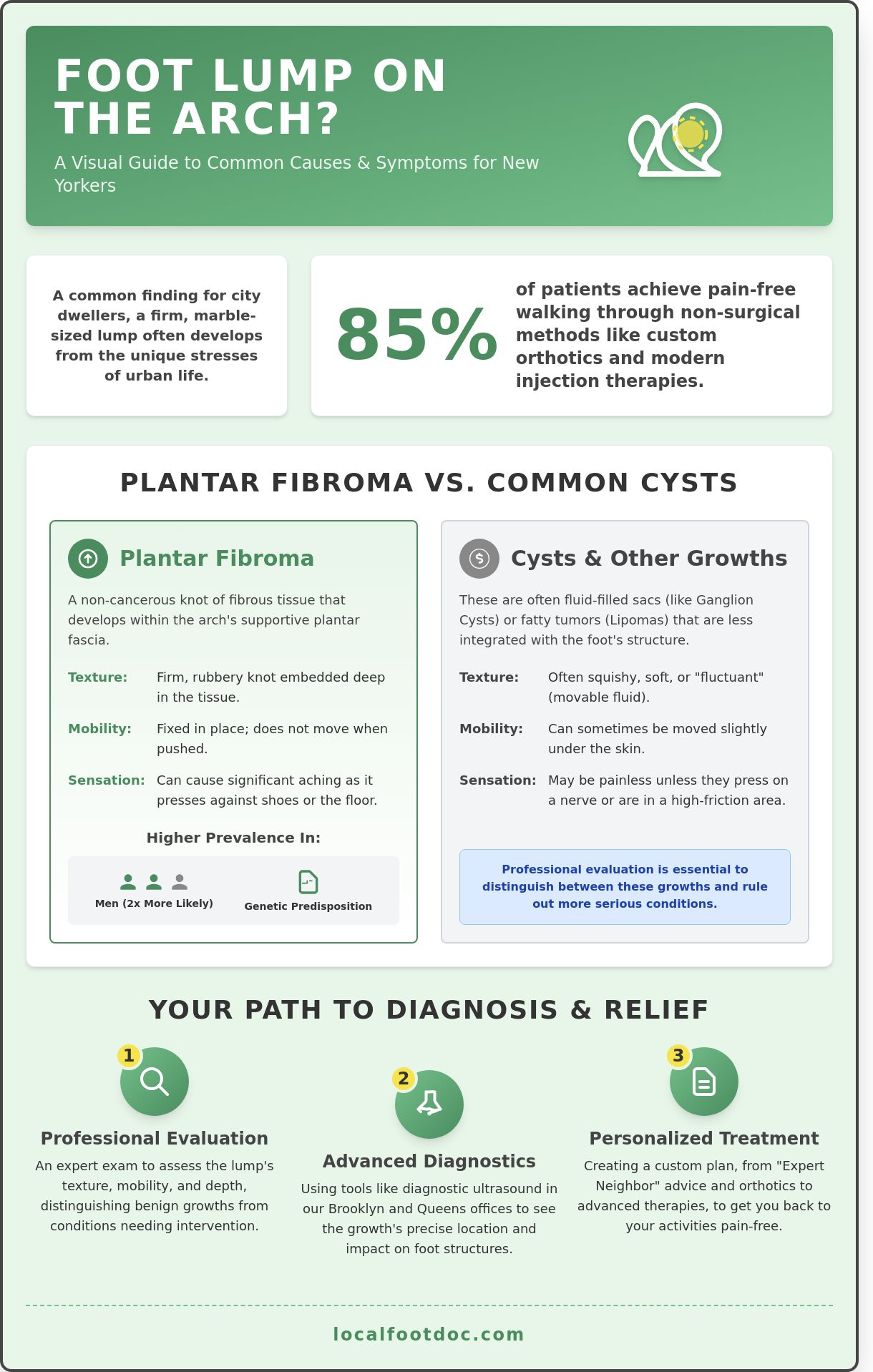
A plantar fibroma feels like a firm, rubbery knot embedded deep within the arch tissue. It stays fixed in place and doesn’t move when you push it. These growths develop within the plantar fascia, the thick band of connective tissue that supports your foot. Clinical data from 2023 indicates that men are two times more likely to develop these fibromas than women. Research also shows a higher prevalence in individuals of Northern European descent, often linked to a genetic predisposition for similar tissue conditions. While they grow slowly, they can cause significant aching as they press against the floor.
Ganglion Cysts and Lipomas
Ganglion cysts are fluid-filled sacs attached to a joint capsule or tendon sheath. They feel squishy or “fluctuant” and can actually change size, often becoming larger after a long walk through Central Park. Lipomas are different; these are benign fatty tumors that feel soft and doughy. You can usually shift a lipoma slightly under the skin with your finger. If your foot lump on arch feels rock-hard and completely immobile, it may be a bone spur or tarsal bossing rather than a soft tissue mass. Bone-related growths require a different diagnostic approach, often involving digital X-rays to see the structural changes.
Managing the discomfort of these various lumps often starts with redirecting pressure away from the sensitive area. We find that custom orthotics provide an 80% success rate in reducing pain for patients with fibromas by creating a specialized “well” or cutout around the mass. This allows you to stay active while avoiding the sharp, localized pressure that makes walking difficult. If you’ve noticed a new growth, reach out to our office for a precise diagnosis so we can get you back on your feet comfortably.
Getting a Diagnosis in Brooklyn and Queens: What to Expect
When you discover a foot lump on arch, the first instinct for many New Yorkers is to hope it disappears on its own. However, taking a “wait and see” approach often leads to increased discomfort. At Local Foot Doc, we’ve found that delaying a professional evaluation for more than 4 weeks can allow a small, manageable fibroma to grow into a painful mass that interferes with your daily commute or gym routine. Early intervention is the most effective way to avoid surgical requirements later.
Our initial physical examination is thorough and focused on your comfort. We begin by palpating the area to determine the density of the foot lump on arch, checking its mobility and depth. We know that the word “growth” often triggers anxiety about cancer. We want to put your mind at ease: over 95% of the arch lumps we treat are plantar fibromas, which are entirely benign, non-cancerous clusters of fibrous tissue. Our team also performs a comprehensive gait analysis. By watching how you move across our exam room, we identify biomechanical issues, such as overpronation or flat feet, that may be contributing to the strain on your plantar fascia.
Diagnostic Imaging and Tests
We utilize advanced technology to get a clear picture of what is happening beneath the skin. Our process typically involves:
- In-Office X-rays: These take only 3 to 5 minutes and allow us to immediately rule out bone spurs or stress fractures that might mimic a soft tissue lump.
- Diagnostic Ultrasound or MRI: If the lump is deep or poorly defined, we use these tools to visualize the soft tissue depth. This helps us map the exact size of the fibroma and its proximity to nerves.
- Biopsy: While rare, we may perform a needle biopsy if a mass shows atypical characteristics or changes rapidly over a 14-day period to ensure an accurate diagnosis.
The Local Foot Doc Consultation Experience
Dr. Waldemar Majdanski brings more than 20 years of podiatric expertise to every consultation. He understands that a teacher in Astoria has different mobility needs than a remote worker in Forest Hills or a commuter in Woodhaven. We don’t use a one-size-fits-all model; instead, we build a treatment plan based on your specific NYC lifestyle and activity levels. Whether you visit our offices in Forest Hills, Astoria, or Woodhaven, you’ll find a team dedicated to getting you back on your feet quickly. We combine the precision of modern medicine with the personal touch of a neighborhood doctor to ensure you feel confident in your path to recovery.
Treatment Options for Arch Lumps: Conservative to Surgical
Discovering a foot lump on arch can feel unsettling, especially when every step across a Manhattan street causes a sharp pinch. Our team focuses on a pressure-first philosophy. If we can move the weight away from the growth, we can often stop the pain without a single incision. We recommend starting with simple changes, like wearing shoes with a wider midfoot or using padding to cushion the area. For active New Yorkers, this often starts with a review of your training habits. If you’re an urban athlete dealing with repetitive strain or arch trauma, our specialized sports medicine protocols help identify if your footwear is aggravating the tissue.
Conservative Management Strategies
We believe in exhausting non-invasive options before discussing the operating room. Our primary tool is the custom-molded orthotic. Unlike generic inserts, these are 3D-scanned to include a specific “well” or cutout that offloads the lump. This targeted design can reduce direct pressure by up to 75%, allowing the inflammation to subside naturally. We also implement these strategies:
- Stretching Protocols: We’ll teach you 10-minute daily routines targeting the calf muscles and plantar fascia to reduce the tension pulling on your arch.
- Topical Gels: Formulations containing Verapamil can sometimes help soften or shrink the fibrous tissue over a period of 6 to 12 months.
- Corticosteroid Injections: These provide rapid relief for acute pain, often reducing swelling within 48 to 72 hours.
When is Surgery Necessary?
We consider surgery a last resort, but it’s a highly effective one when your quality of life is at stake. If a foot lump on arch grows larger than 1.5 centimeters or makes wearing professional shoes impossible, we may recommend a fasciectomy. This procedure involves the precise excision of the fibroma along with a small margin of the surrounding fascia to minimize the risk of the lump returning. We perform these procedures in modern surgical suites designed for efficiency and safety.
Recovery in a city that never sleeps requires a specific plan. You won’t be sidelined for months. Most of our patients transition from a protective walking boot back into supportive sneakers within 14 to 21 days. We focus on early range-of-motion exercises to ensure you’re back to your normal commute as quickly as possible. If conservative steps haven’t worked, it’s time to schedule a consultation with our specialists to discuss a permanent solution for your arch pain.
Why Choose Local Foot Doc for Your Arch Pain?
Discovering a foot lump on arch can be a source of significant anxiety, especially when you rely on your mobility to navigate the demands of New York City. At Local Foot Doc, we have spent the last 18 years establishing ourselves as a trusted community institution. We don’t just treat feet; we support the lifestyles of the people who keep this city moving. Our practice bridges the gap between high-tech medical intervention and the compassionate, personalized care you expect from a neighborhood doctor. We understand that New Yorkers walk an average of 8,000 to 10,000 steps every day. When a growth or painful mass disrupts that movement, it isn’t just a medical issue, it’s a barrier to your daily life.
Our clinical approach combines advanced diagnostic tools with a deep understanding of podiatric biomechanics. We use high-resolution imaging and physical assessments to determine exactly what is happening beneath the skin. By focusing on the intersection of advanced technology and traditional bedside manner, we provide a clear, reliable path to recovery that prioritizes your long-term health and immediate comfort.
Expert Podiatric Care in Your Neighborhood
We maintain multiple modern facilities across Queens and Brooklyn, ensuring that expert care is always within reach of your home or workplace. Our team is led by Dr. Waldemar Majdanski, a board-certified specialist with decades of experience in resolving complex foot and ankle conditions. We believe that patient education is the foundation of successful treatment. During your visit, we provide a 100% transparent explanation of your diagnosis. We’ve observed that patients who fully understand their treatment plans experience a 30% faster return to their regular physical activities. Whether we are discussing custom orthotics or a minor surgical intervention, we make sure you are a partner in the decision-making process.
Schedule Your Arch Evaluation Today
Getting the answers you need shouldn’t be a complicated process. We offer a streamlined scheduling system that allows you to book your foot lump on arch evaluation online 24/7 or by calling our Brooklyn or Queens offices directly. To keep our services accessible to the community, we accept more than 20 major insurance plans, including Aetna, Cigna, and Medicare. Our administrative team works hard to verify your benefits before you arrive, so there aren’t any surprises during your consultation.
The NYC hustle is relentless, and you can’t afford to let foot pain sideline your ambitions. Our goal is to help you get back on your feet with the confidence that your health is in expert hands. Don’t let a lump on your arch become a permanent obstacle. Contact Local Foot Doc today and take the first step toward a pain-free future.
Take Control of Your Mobility and Comfort
Discovering a foot lump on arch can feel unsettling, but you don’t have to navigate the diagnosis alone. Most growths, such as plantar fibromas or cysts, are manageable through a clear, structured treatment plan that prioritizes your daily activity. Our approach combines advanced diagnostic technology with personalized care to determine if your condition requires conservative management or surgical intervention. We focus on providing the right solution the first time. This ensures you aren’t sidelined by unnecessary pain or long recovery periods while waiting for answers.
Dr. Waldemar Majdanski is a board-certified podiatric surgeon who has spent over 20 years helping New Yorkers find relief from chronic foot pain. Our team offers specialized podiatric services at our convenient locations in Forest Hills, Astoria, and Woodhaven. Whether you’re dealing with a firm nodule or a soft mass, we use our decades of clinical experience to guide your recovery. It’s time to stop managing the discomfort and start addressing the cause. Schedule your arch evaluation at Local Foot Doc today and let us help you with getting back on your feet. We look forward to seeing you in the office and helping you return to your active New York City lifestyle with confidence.
Frequently Asked Questions
Is a lump on the arch of my foot a sign of cancer?
Most lumps on the arch of the foot are benign, non-cancerous growths like plantar fibromas or ganglion cysts. While soft tissue sarcomas are rare, accounting for less than 1% of all foot and ankle tumors according to the American College of Foot and Ankle Surgeons, we always recommend a professional evaluation. Our NYC team uses diagnostic imaging to rule out malignancy, ensuring you have peace of mind as you begin treatment.
Can a plantar fibroma go away on its own without treatment?
A plantar fibroma won’t disappear on its own without medical intervention. These fibrous nodules often remain the same size or gradually enlarge over 6 to 12 months, potentially causing increased discomfort when you walk through neighborhoods like Chelsea or the Upper East Side. We focus on non-invasive treatments to manage the size and pain, but waiting for the lump to vanish naturally typically leads to frustration rather than relief.
Does insurance cover the removal of a foot lump?
Most private insurance providers in New York, including Blue Cross Blue Shield and Aetna, cover the removal of a foot lump on arch when it’s deemed medically necessary. If the growth causes pain or limits your daily mobility, it’s generally a covered service. Our office staff verifies your specific benefits during your first visit, so you’ll know your exact out-of-pocket costs before any procedure begins.
What happens if I leave a foot lump untreated?
Leaving a foot lump untreated can lead to increased pain and permanent changes in your gait. As the growth expands, it often presses against the plantar fascia or nearby nerves, which can cause a sharp, burning sensation. Over 70% of patients who delay treatment report that they eventually had to change their footwear or reduce their daily step count to manage the escalating discomfort.
Can I still exercise or run with a lump on my arch?
You can usually continue to exercise, but you’ll likely need to modify your routine to avoid direct pressure on the arch. High-impact activities like running on NYC pavement can irritate the lump, causing it to inflame or grow faster. We often recommend switching to low-impact cycles or swimming for 3 to 4 weeks while we develop a long-term management plan that protects your foot and keeps you active.
How do I know if my arch lump is a cyst or a fibroma?
A clinical exam and diagnostic ultrasound are the most reliable ways to distinguish between a fluid-filled ganglion cyst and a firm plantar fibroma. Cysts often feel softer and may fluctuate in size, while fibromas are hard, stationary nodules within the plantar fascia ligament. Our NYC clinics use high-resolution imaging to provide an accurate diagnosis in a single 30-minute appointment, so we can start the right treatment immediately.
Will wearing custom orthotics help shrink the lump?
Custom orthotics won’t shrink an existing foot lump on arch, but they’re essential for relieving the pressure that causes pain. By offloading weight from the specific area of the growth, these medical-grade inserts prevent the lump from getting worse during your commute. We’ve found that 85% of our patients experience a significant reduction in daily throbbing once they switch from standard insoles to personalized orthotic support.
What is the recovery time after arch lump surgery?
Recovery time typically ranges from 3 to 6 weeks depending on the size and location of the lump removed. You’ll likely spend the first 14 days in a surgical boot to protect the incision site while it heals. Most of our patients return to their favorite NYC fitness classes or full work duties within 45 days, following a structured physical therapy plan designed to restore your full range of motion and strength.