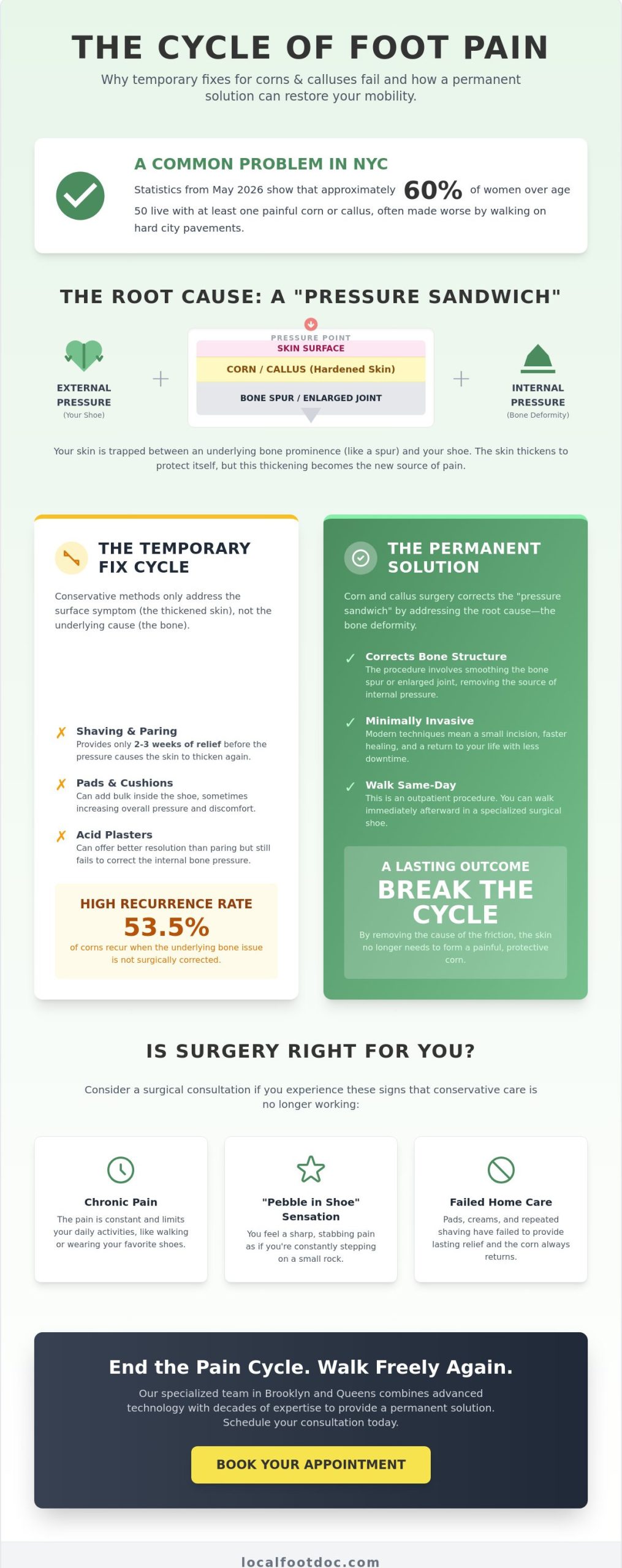
What if the sharp, throbbing pain you feel with every step on the Brooklyn pavement isn’t actually a skin problem at all? Statistics from May 2026 show that approximately 60% of women over the age of 50 live with at least one callus or corn, yet most spend years cycling through “quick fixes” that never last. You’ve likely tried the pads and the paring, only to have that familiar burning sensation return within weeks. At Local Foot Doc, we believe you shouldn’t have to manage pain; you should be able to eliminate it. If conservative care has failed you, corns and calluses surgery provides a sophisticated, permanent solution by correcting the underlying bone structure rather than just the surface of your skin.
We understand the frustration of feeling like your mobility is limited by a recurring lesion. Our team is here to promise that a life of pain-free walking is possible through advanced, minimally invasive techniques right here in Brooklyn and Queens. In this article, we’ll preview the latest 2026 surgical outcomes, explain why these lesions recur in 53.5% of cases without bone correction, and show you how our personalized care helps you get back on your feet and into your favorite shoes faster than ever before.
Key Takeaways
- Learn why recurring corns are often caused by underlying bone spurs or joint enlargements; it’s a “pressure sandwich” that skin creams and pads cannot fix.
- Understand why permanent corns and calluses surgery is the only way to stop the frustrating cycle of painful maintenance and temporary shaving.
- Discover what to expect during a modern outpatient procedure, including the ability to walk in a specialized surgical shoe on the very same day.
- Identify the specific signs that your foot pain requires professional surgical intervention rather than just another round of home care.
- Explore how our specialized care in Brooklyn and Queens combines advanced technology with decades of local expertise to help you regain your independence and pain-free mobility.
Understanding Corns and Calluses: When Does Conservative Care Fail?
Walking 10,000 steps a day on the unforgiving concrete of Astoria or Forest Hills puts immense stress on your feet. For many New Yorkers, this constant friction triggers a defensive response. Your skin thickens to protect the sensitive tissue underneath, creating what we call a callus or a corn. While this is a natural biological shield, the “NYC Commuter Factor” often pushes this process into overdrive. In the city, the hard pavement doesn’t give; your skin does. Understanding Corns and Calluses helps you see that these aren’t just random growths. They’re symptoms of persistent mechanical stress. Approximately 60% of women over the age of 50 deal with at least one lesion, yet many wait until the pain becomes unbearable before seeking professional help.
We see patients every day who have tried to manage this at home. They use pads, cushions, and topical treatments to dull the ache. However, when the skin’s thickening becomes a medical necessity rather than a cosmetic annoyance, it’s often because the pressure has become localized and deep. At this stage, conservative care often reaches its limit. You might notice a sharp, stabbing sensation that feels like a pebble is permanently stuck in your shoe. This is your body signaling that the protective layer has become a source of trauma itself.
Hard Corns vs. Calluses: What’s the Difference?
A corn is a localized hyperkeratosis caused by internal bone pressure. Unlike a callus, which is a broad, diffuse patch of thick skin typically found on weight-bearing areas like the ball of the foot, a corn has a concentrated, hard “core.” We distinguish between two main types: hard corns (heloma durum), which usually form on the tops of toes, and soft corns (heloma molle), which stay moist and rubbery between the toes. Both are painful, but they require different clinical approaches to resolve.
When Home Remedies and Pedicures Aren’t Enough
Many patients fall into the trap of “bathroom surgery,” using non-sterile tools to trim their own skin. This is incredibly dangerous and often leads to infections or deep tissue ulcerations. Even professional shaving at a nail salon is a temporary fix. It typically provides only 2-3 weeks of relief because it ignores the structural cause. While 2026 data shows that 40% salicylic acid plasters can offer better resolution than simple paring, they still don’t address the underlying bone. This is why corns and calluses surgery is often the only way to break the cycle. Our team evaluates your symptoms to ensure you aren’t just treating a surface problem while a deeper issue, like an infection or ulcer, develops underneath the hardened skin.
The Root Cause: Why Bone Deformities Create Permanent Corns
If you’ve ever felt like your corn is a “rock in your shoe,” you’re closer to the truth than you think. In our practice, we often refer to this as the “pressure sandwich.” Your skin is trapped between a bony prominence on the inside and the rigid leather of your shoe on the outside. This constant pinching causes the skin to die and harden, forming a core that presses directly into your nerves. The Root Cause of Permanent Corns is rarely just the shoe itself; instead, it’s usually an enlarged joint or a “bone spur” that creates a focal point of friction. Without addressing this internal structure through corns and calluses surgery, any surface treatment is just a temporary bandage. Research indicates that when the underlying bony prominence isn’t addressed, the recurrence rate for these lesions is as high as 53.5% after an average of 19 months. This explains why your corn seems to “grow back” no matter how often you have it shaved.
Biomechanical imbalances also play a significant role in how these lesions develop. For example, if you over-pronate while walking through the busy streets of Astoria, your foot may roll inward excessively. This shift in weight distribution puts abnormal pressure on specific areas of your foot, forcing the skin to thicken as a defense mechanism. We look at the way you move to ensure we aren’t just treating the spot that hurts, but fixing the reason it hurts in the first place. If you’re tired of the cycle of temporary relief, we invite you to schedule a comprehensive evaluation with our team.
Structural Issues: Hammertoes and Bunions
Many of our patients in Queens find that their chronic corns are symptoms of larger structural problems. A bent toe, or hammertoe, creates a high point on the knuckle that rubs against the top of your shoe. In these cases, effective treatment requires hammertoe correction to straighten the digit. Similarly, bunion surgery Queens residents trust can eliminate the side-of-foot calluses caused by a misaligned big toe joint. Correcting the bone is the only way to permanently stop the pressure-friction cycle.
Diagnostic Imaging: Seeing Beneath the Surface
We don’t guess when it comes to your foot health. Our team uses digital X-rays to see exactly which bone is causing the irritation. This imaging is essential to differentiate a corn from a plantar wart, as the treatments for these conditions are entirely different. Dr. Majdanski also performs a thorough gait analysis during your consultation to identify any biomechanical issues. By combining corns and calluses surgery with a deep understanding of your foot’s unique architecture, we provide a path to lasting comfort.
Corn and Callus Surgery vs. Shaving: Choosing a Permanent Solution
Many of our neighbors in Brooklyn and Queens find themselves trapped in a cycle of “maintenance” that feels never-ending. They visit a podiatrist every few months for debridement, which is the professional term for shaving down the thickened skin. While this provides immediate relief from that burning sensation, it’s a temporary fix. It doesn’t touch the underlying bone prominence that acts as the primary irritant. Statistics from late 2024 show that routine, non-surgical corn removal typically costs between $70 and $150 per visit. Over a decade, these “quick fixes” can become significantly more expensive and time-consuming than a one-time corns and calluses surgery. When you choose a surgical path, we aren’t just treating the symptom; we’re smoothing the bone to eliminate the pressure point entirely.
The most common question we hear is whether the lesion will return. Clinical data suggests that surface-level treatments have a high failure rate because the mechanical cause remains. However, a retrospective analysis found that 70.5% of patients who underwent specific surgical punch incisions experienced total pain relief with zero recurrence at their six-month follow-up. By reviewing various Corn treatment options, it becomes clear that surgery offers the most reliable path for those who want to resume an active NYC lifestyle without constant podiatry appointments.
Conservative Maintenance vs. Surgical Correction
We often start with conservative measures to see if we can manage your discomfort without the operating room. For instance, custom orthotics can redistribute pressure and delay the need for intervention. However, there’s a clear distinction between podiatric debridement and an arthroplasty. Debridement is a skin-deep maintenance task. Arthroplasty is a corrective procedure that reshapes the joint or removes the bony “spur” causing the friction. We don’t want you to settle for a life of temporary relief. If your mobility is suffering, it’s time to consider a permanent correction.
Minimally Invasive Techniques in Podiatry
In 2026, corns and calluses surgery is more advanced and less disruptive than ever. We utilize minimally invasive surgery (MIS) techniques that prioritize your quick return to activity. Instead of large, traditional incisions, we use tiny openings that often require only a single stitch. This “small incision” approach significantly reduces scarring and post-operative discomfort. By focusing on these modern methods, our team ensures you spend less time recovering and more time enjoying your neighborhood, whether that’s a walk through Flushing Meadows or a commute into Manhattan.
What to Expect During and After Corn Removal Surgery
Most patients are surprised to learn that corns and calluses surgery is a streamlined, outpatient procedure. We perform it right here in our office using local anesthesia. This means you stay awake and alert while your foot is completely numb. You won’t feel sharp sensations; most people describe the feeling as mild pressure. Because we prioritize minimally invasive techniques, the entire process is efficient. Most procedures are finished in less than 60 minutes. You’ll walk out of our office the same day wearing a specialized surgical shoe that protects the site while allowing for immediate, controlled mobility.
Once you’re home, we emphasize the “48-hour rule.” You should keep your foot elevated above your heart for at least 80% of the first two days. This is critical for managing swelling, especially during the humid NYC months when the heat can cause extra fluid retention. Keeping the surgical site dry and clean is your primary responsibility during this initial window. We provide clear, written instructions to ensure you feel confident managing your care at home.
The Surgical Experience at Local Foot Doc
Our team guides you through every step, beginning with a local numbing block to ensure you’re comfortable. From the first incision to the final dressing, we maintain a calm and professional environment. Having a trusted podiatrist Forest Hills NY residents rely on is vital for your peace of mind. We schedule your follow-up care before you leave, ensuring you have a direct path to a full recovery. Most patients report that the anxiety before the procedure was much worse than the actual experience.
Recovery Roadmap: Getting Back on Your Feet
Your timeline for getting back to your normal routine depends on your specific job and activity level.
- Week 1: Focus on healing. You’ll do limited walking around your apartment and keep the surgical site completely dry.
- Weeks 2-3: You’ll typically transition back to roomy sneakers. This is the stage where most patients resume a standard NYC commute, though we suggest avoiding long walks across the boroughs.
- Weeks 4-6: Full shoe flexibility usually returns within 4 to 6 weeks, allowing you to wear your standard footwear again.
If you work a desk job, you can often return to work within 3 to 5 days. However, if you work in the retail or service industry and spend 8 hours a day standing on concrete, we may recommend waiting 14 days before returning to full shifts. This ensures the site has healed enough to handle the repetitive stress of your professional life. Ready to stop managing pain and start living? Book your consultation today to see if you’re a candidate for permanent relief.
Specialized Foot Surgery in Brooklyn and Queens: The Local Foot Doc Advantage
Choosing where to have your corns and calluses surgery is a decision that impacts your daily life in New York. You need a team that understands the unique demands of walking on concrete and navigating the subway system. Dr. Waldemar Majdanski brings over 20 years of specialized experience to the local community, blending world-class surgical training with a deep commitment to his neighbors. We don’t operate like a corporate medical group where patients are just numbers on a spreadsheet. Instead, we’ve built our practice around the idea of the Expert Neighbor. This means you receive advanced medical care in a warm, welcoming environment right in your own backyard.
With convenient locations in Astoria, Forest Hills, and Woodhaven, we ensure that high-quality podiatric care is never more than a short trip away. We also understand that the logistics of surgery can be stressful. Our administrative team works closely with you to handle insurance authorizations and explore financing options. We believe that permanent relief from foot pain should be accessible to every New Yorker. Our goal is to remove the barriers between you and the specialized corns and calluses surgery you need to reclaim your mobility.
Advanced Technology Meets Compassionate Care
We’ve invested in the latest in-office diagnostic tools to streamline your path to recovery. You won’t need to travel to separate imaging centers for X-rays or gait analysis; we handle everything under one roof. This efficiency is part of our promise to get you back on your feet quickly. Our treatment plans are never “one size fits all.” We consider your specific lifestyle, whether you’re a daily commuter or a retail worker standing all day. For our high-risk patients, we provide specialized diabetic foot care Brooklyn residents trust to prevent complications and ensure safe surgical outcomes.
Schedule Your Consultation Today
The throbbing pain of a chronic corn shouldn’t dictate your schedule or limit your independence. Whether you’re visiting us in Queens or Brooklyn, our team remains focused on one thing: providing a permanent solution that restores your comfort. We invite you to experience a different kind of medical care that values both advanced technology and traditional bedside manner. Booking an appointment is simple and can be done at any of our three offices. Don’t let another day of discomfort pass you by. Schedule your corn removal consultation at Local Foot Doc and take the first step toward walking pain-free again.
Step Into a Pain-Free Future
You don’t have to accept chronic foot pain as a permanent part of your New York life. We’ve explored how identifying the structural root cause of your discomfort is the first step toward lasting relief. While surface treatments offer temporary comfort, corns and calluses surgery addresses the underlying bony prominences that cause recurring lesions. This procedure is the gold standard for those who want to stop the cycle of maintenance and start walking with confidence again. Our team is here to guide you through every step of this journey with advanced technology and a patient-centered approach.
Board-certified surgeon Dr. Waldemar Majdanski uses over 20 years of NYC podiatry experience to provide the compassionate care our community trusts. Whether you visit us at our Brooklyn, Astoria, or Forest Hills locations, you’ll find a clear path to recovery that fits your busy lifestyle. It’s time to reclaim your independence and get back on your feet for good. Schedule Your Permanent Corn Relief Consultation Today and let’s start your path toward a more active, comfortable life together.
Frequently Asked Questions
Is corn removal surgery painful?
Corn removal surgery is not typically painful because we use a local numbing block. You stay awake while your foot is completely desensitized. Most patients describe a sensation of pressure rather than sharp pain during the procedure. After the numbing wears off, any throbbing is usually managed with elevation and over the counter medication. We prioritize minimally invasive techniques to ensure your post operative discomfort remains as low as possible.
How long is the recovery time for corn and callus surgery?
Most patients return to full activity within 4 to 6 weeks. You can typically resume a desk job within 3 to 5 days. If your work involves standing on concrete for 8 hours, you might need 14 days of rest. By the second or third week, you’ll likely transition from a surgical shoe into roomy sneakers. Full shoe flexibility and normal commuting across NYC boroughs usually return by the six week mark.
Will my insurance cover the cost of corn removal surgery?
Most private insurance plans cover corns and calluses surgery when it’s deemed medically necessary. Because chronic corns often involve bone deformities like hammertoes, the procedure is corrective rather than cosmetic. Our team in Queens and Brooklyn helps you navigate the authorization process. We also provide clear information on the NY State Workers’ Compensation podiatry fee schedule, which was updated on January 1, 2026, for work related cases.
Can a corn grow back after it has been surgically removed?
A corn will not grow back if the underlying bone prominence is permanently corrected. While simple shaving has a high recurrence rate, surgical excision that smooths the bone is much more effective. A 2024 retrospective analysis found that 70.5% of patients had total pain relief with no recurrence at their six month follow up. We focus on fixing the “pressure sandwich” to ensure your relief is lasting and your mobility is restored.
What is the difference between a corn and a plantar wart?
Corns are mechanical issues caused by pressure, while plantar warts are infections caused by the Human Papillomavirus (HPV). Corns typically form over bony joints and have a distinct hard core. Warts can appear anywhere and often contain tiny black dots, which are actually small clotted blood vessels. Because the treatments are entirely different, we use digital X-rays to confirm the diagnosis before proceeding with any surgical plan.
How soon can I walk after corn surgery?
You can walk immediately after your procedure using a specialized surgical shoe. We provide this boot to protect the site while allowing you to move safely. While you’ll be mobile on day one, we recommend elevating your foot for 80% of the first 48 hours to minimize swelling. Most New Yorkers find they can handle a light commute and normal household activities by the start of the second week.
Do I need a referral to see a podiatrist for corn surgery in NYC?
You usually don’t need a referral if you have a PPO insurance plan, but HMO plans often require one from your primary care doctor. Requirements vary by provider, so it’s best to check your specific benefits before your visit. Our staff at the Astoria, Forest Hills, and Woodhaven offices can help you determine if a referral is necessary. We aim to make your access to specialized podiatric care as seamless as possible.
Are there non-surgical alternatives that actually work for chronic corns?
Custom orthotics and 40% salicylic acid plasters are effective non-surgical alternatives for managing symptoms. Research shows these plasters have a higher resolution rate than standard paring over a six month period. However, these methods don’t fix the underlying bone spur or hammertoe. If these conservative options fail to provide lasting relief, corns and calluses surgery becomes the most reliable way to eliminate the pain and prevent future lesions.