Imagine standing on a packed L train during the 8:15 AM rush while a sharp, throbbing ache radiates from the base of your big toe. For the 23% of adults who live with hallux valgus, this isn’t just a minor annoyance; it’s a daily barrier to life in the city. You likely feel the frustration of searching through shops in SoHo for professional shoes that don’t cause a burning sensation by lunchtime. We agree that the prospect of being off your feet for weeks is a source of genuine anxiety in a city that requires constant mobility.
Our team at Local Foot Doc is here to provide relief through proven non-surgical bunion treatment options NYC residents can rely on to delay or even avoid the operating room. We’ll show you how to manage your symptoms and slow the deformity’s progression using advanced biomechanical tools and personalized care. This guide outlines the specific conservative strategies we use in our Queens and Brooklyn offices to help you achieve pain-free walking and get back on your feet with confidence.
Key Takeaways
- Understand why bunions are a structural bone misalignment and how walking on NYC concrete can accelerate your pain and symptoms.
- Discover proven non-surgical bunion treatment options NYC commuters can use to manage discomfort, including the difference between custom orthotics and off-the-shelf inserts.
- Learn how to avoid the “commuter’s squeeze” by identifying footwear features that protect your feet during long walks through the city.
- Identify the specific “tipping point” signs that indicate when conservative treatments are no longer enough and surgery may be necessary to restore your mobility.
- Find out how our personalized, community-focused care in Brooklyn and Queens helps you stay active and get back on your feet without immediate surgery.
Understanding Bunions in the City: What Non-Surgical Treatment Can and Cannot Do
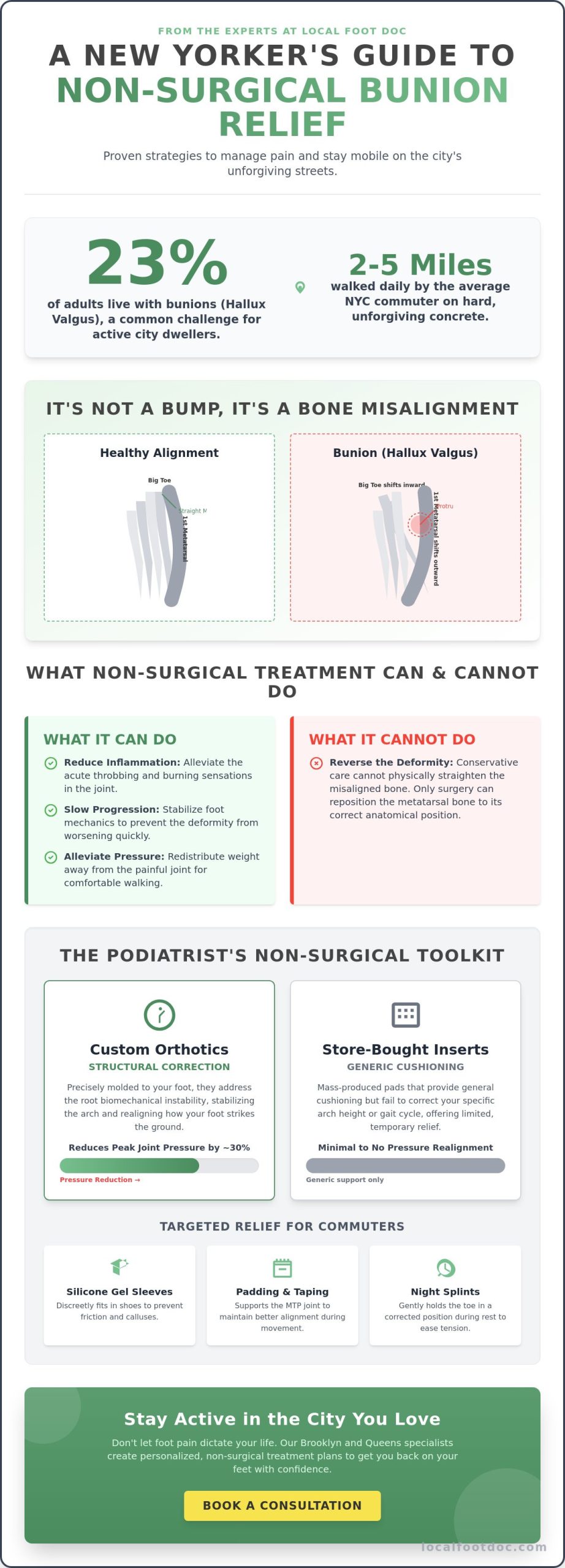
Walking the streets of New York City puts a unique strain on your feet. The average commuter covers between two and five miles daily on unforgiving concrete surfaces. This constant impact often accelerates the progression of Hallux Valgus, the clinical term for a bunion. Many people believe a bunion is simply a growth of skin or a callus on the side of the foot. In reality, it’s a complex structural bone misalignment. If you’re searching for non-surgical bunion treatment options NYC, you must first understand the nature of the deformity you’re facing. To get a foundational look at the condition, you can read more about What is a bunion? on Wikipedia.
The Anatomy of a Bunion
A bunion occurs when the long bone of the foot, the first metatarsal, shifts outward while the big toe moves inward toward the second toe. This shift leads to a subluxation of the Metatarsophalangeal (MTP) joint. The MTP joint is the hinge of the big toe that bears your weight during every step. When this hinge is out of alignment, the pressure of every step is distributed unevenly. While genetics play a role in approximately 70% of cases, narrow footwear and the mechanical stress of city walking often trigger the visible protrusion. Our team sees these issues daily in our Brooklyn and Queens clinics, where we help patients identify the specific biomechanical triggers behind their discomfort.
Managing Expectations for Conservative Care
We believe in being transparent about what non-surgical bunion treatment options NYC can achieve. It’s vital to distinguish between relieving your pain and physically straightening the bone. Conservative care cannot reverse the structural shift; only surgery can reposition the bone. However, non-surgical methods are highly effective at managing the throbbing and burning sensations that make a subway commute feel like an endurance test. We focus on these primary goals:
- Reducing acute inflammation within the joint capsule.
- Stabilizing the foot’s mechanics to prevent the deformity from worsening.
- Alleviating pressure through custom orthotics and footwear modifications.
A professional diagnosis is your first step toward avoiding unnecessary surgery. By intervening early at one of our locations, we can often slow the progression of the misalignment. This proactive approach helps you stay active and ensures you spend more time enjoying the city and less time worrying about the pain in your shoes. Our goal is always getting you back on your feet with the most effective, least invasive path possible.
The Podiatrist’s Toolkit: Top Non-Surgical Bunion Relief Options in NYC
Walking 10,000 steps a day is a standard benchmark for many Manhattan professionals. When a bunion begins to throb, every block feels like a mile. We focus on non-surgical bunion treatment options NYC residents can use to stay mobile without immediate surgery. Our goal is to address the mechanical causes of your discomfort while providing immediate relief from the “burning” or “stiffness” that makes your commute a challenge.
Custom Orthotics vs. Store-Bought Inserts
Off-the-shelf inserts often fail New York walkers because they provide generic cushioning rather than structural correction. These mass-produced pads don’t account for your specific arch height or gait cycle. Our team uses medical-grade casting to create custom orthotics that stabilize the foot arch and redistribute weight. This precision is vital for long-term health. Data from the Journal of Foot and Ankle Research suggests that properly fitted orthotics can reduce peak pressure on the first metatarsal by approximately 30 percent. By realigning how your foot strikes the pavement, we address the biomechanical instability that causes the bunion to progress.
Padding, Taping, and Splinting Techniques
For long subway transfers at hubs like Grand Central or Atlantic Avenue, we often recommend the “NYC Commuter Hack”: silicone gel sleeves. These thin, medical-grade shields fit discreetly inside professional footwear to prevent the friction that leads to calluses and inflammation. While you can find various home remedies for bunion pain, such as toe spacers or night splints, it’s vital to manage expectations. A night splint won’t reverse the bone’s position permanently, but it provides significant relief by stretching tight tendons and ligaments while you sleep.
Kinesiology taping is another professional tool we utilize to provide arch support. This technique helps pull the big toe into a more neutral alignment, reducing joint fatigue during a 12-hour workday. We also utilize pharmacological approaches to manage flare-ups. Utilizing topical analgesics or NSAIDs can safely reduce the throbbing sensation after a long day of walking through Midtown. These medications work most effectively when they’re part of a broader strategy that includes mechanical support.
If you’ve noticed your shoes fitting tighter or your big toe joint feels tender after a short walk, it’s time to take action. Our specialists help you get back on your feet by creating a customized plan that fits your active New York lifestyle. Using these non-surgical bunion treatment options NYC patients can often avoid the operating room and maintain their daily routines without pain.
The NYC Commuter’s Guide to Footwear and Lifestyle Adjustments
Living in New York means walking. Whether you’re navigating Grand Central or trekking across the Upper West Side, your feet take a beating every single day. We often see patients suffering from what we call the “Commuter’s Squeeze.” This occurs when narrow, high-fashion shoes force the big toe inward to fit the tapered shape of the shoe. This constant pressure aggravates Hallux Valgus, leading to that familiar throbbing pain at the base of the toe. When exploring non-surgical bunion treatment options NYC residents often find that simple lifestyle shifts provide the most immediate relief from daily discomfort.
Our team recommends looking for shoes with a wide toe box that allows your toes to splay naturally. Soft uppers made of suede or soft leather are superior to stiff synthetics because these materials stretch to accommodate the bunion rather than rubbing against it. If your commute involves a 20-minute walk to the subway, consider wearing supportive sneakers and changing into professional shoes once you reach the office. High-impact workouts like running on Manhattan pavement can increase MTP joint stress by up to 3 times your body weight. Switching to low-impact activities like swimming or cycling helps manage symptoms and keeps you moving without further damaging the joint.
Choosing Shoes for the New York Streets
Heel height is a major factor in bunion progression. Heels over 2 inches shift approximately 75% of your body weight onto the forefoot, which increases pressure on the bunion significantly. For those shopping in the city, stores like Eneslow Shoes on Park Avenue or Tip Top Shoes on the Upper West Side specialize in wide-width fittings and orthotic-friendly styles. Soft leather and suede are your best friends. These materials provide a natural flexibility that synthetic materials lack, preventing the “burning” sensation often felt during a long trek across town.
Exercises and Home Care for Bunion Relief
Strengthening the intrinsic muscles of your foot helps stabilize the joint and maintain mobility. You can try these simple exercises at home:
- The Towel Curl: Sit down and use your toes to scrunch a towel toward you.
- Marble Pickups: Use your toes to move 10 to 15 marbles from the floor into a bowl.
- Toe Splaying: Try to pull your toes apart without using your hands.
These movements are essential components of non-surgical bunion treatment options NYC patients can perform to maintain foot health. Foot exercises improve joint flexibility but cannot reverse bone growth. After a long day in the city, we suggest contrast baths to manage swelling. Alternate between 3 minutes of warm water and 1 minute of cold water for 15 minutes to improve circulation. You can also find more information about non-surgical bunion treatment options to help manage your daily discomfort and get back on your feet with confidence.
When to Stop Delaying: Identifying the Tipping Point for Bunion Surgery
Our team at Local Foot Doc always prioritizes the non-surgical bunion treatment options NYC residents can use to stay mobile. We exhaust every conservative path, from custom-molded orthotics to specialized footwear adjustments, to keep you out of the operating room. However, these methods are designed to manage symptoms and slow the progression of the deformity. They don’t physically realign the bone. You’ll know it’s time to reconsider your path when the pain begins to dictate your daily schedule.
The “three-block test” is a reliable benchmark for our patients. If walking three blocks to your local deli or the nearest subway entrance feels like an endurance trial, your quality of life is severely compromised. This physical limitation often leads to a heavy psychological toll. When you start declining invitations to walk the High Line or meet friends in a different borough because you’re worried about your feet, the bunion has moved from a minor nuisance to a lifestyle inhibitor. Your world shouldn’t shrink because of your footwear.
We also watch for secondary deformities that emerge as the condition advances. As the big toe drifts inward, it puts immense pressure on the neighboring digits. This often results in hammertoes or crossover toes, where the second toe literally climbs over the first. At this stage, the biomechanics of your entire foot are failing. Waiting longer only increases the complexity of the eventual correction, as we’ll have to address multiple toes instead of just one.
Red Flags That Conservative Care is Failing
You shouldn’t ignore a persistent, “throbbing” pain that keeps you awake at night. This deep ache suggests the joint is under constant inflammation that rest and ice can no longer resolve. Watch for visible skin breakdown, persistent redness, or chronic bursitis over the bunion bump. These are signs that even the widest shoes can no longer accommodate the joint. If you notice a 20% or greater loss of range of motion in the big toe joint, it’s often a sign that arthritis is setting in, making non-surgical management significantly less effective.
Minimally Invasive Alternatives to Traditional Surgery
Moving beyond conservative care doesn’t mean you’re facing a long, difficult recovery. We specialize in modern, low-downtime procedures that allow you to get back on your feet faster than traditional methods. If you’re ready to explore a permanent fix, read our guide on bunion surgery in Queens to see how advanced technology has changed the patient experience. Taking action now ensures you have access to the most efficient recovery paths before the joint damage becomes too severe.
The Local Foot Doc Approach: Personalized Bunion Care in Brooklyn and Queens
Dr. Waldemar Majdanski and the team at Local Foot Doc believe that your journey toward comfort shouldn’t automatically lead to the operating room. We prioritize a conservative-first philosophy, reserving surgery only for cases where non-invasive methods have been exhausted. This patient-centered strategy ensures that you explore all non-surgical bunion treatment options NYC offers before considering more intensive procedures. Our goal is to keep you moving through your daily life without the downtime associated with major surgery.
We provide world-class podiatric care with the familiarity of a neighborhood clinic. With convenient locations in Forest Hills, Astoria, and Woodhaven, we ensure that high-quality foot care is never more than a short commute away. Our offices feature advanced diagnostic imaging, including high-resolution in-office X-rays. This technology allows us to track the progression of your bunion with millimeter precision. We provide immediate feedback during your visit so you don’t have to wait days for results from an outside imaging center.
Our practice functions as the “Expert Neighbor.” We combine the technical proficiency of a top-tier medical institution with the personal touch of a local doctor who understands the physical toll of living in the five boroughs. We don’t just treat symptoms; we treat the person behind the pain.
What to Expect During Your First Consultation
Your initial visit focuses on understanding the unique mechanics of your feet. We conduct a comprehensive gait analysis and biomechanical evaluation to see how your bunion impacts your movement. Because every NYC commute is different, we tailor our treatment plans to your specific lifestyle. Whether you’re walking 15 blocks to a midtown office or standing on a crowded 7 train, your plan reflects those physical demands. We also simplify the administrative side of healthcare by helping you navigate insurance coverage. Our team works to ensure that professional podiatric care remains accessible and affordable for all New Yorkers.
Getting Back on Your Feet with Local Foot Doc
Our commitment extends beyond temporary pain relief. We focus on restoring your long-term mobility and independence. Data suggests that early intervention with custom orthotics and physical therapy can successfully manage symptoms in over 80% of patients without the need for immediate surgery. We support you through every stage of this journey, from the first sign of a “burning” sensation to the day you can walk through Flushing Meadows or Astoria Park without discomfort. You deserve a life free from foot pain, and our team is here to make that a reality.
Take the Next Step Toward Pain-Free NYC Commutes
Navigating the concrete jungle shouldn’t feel like a constant battle against your own feet. You’ve learned how custom orthotics and strategic footwear adjustments provide significant relief during your daily subway trek or walk across the bridge. By exploring the non-surgical bunion treatment options NYC commuters rely on, you’re choosing to manage your symptoms proactively before they interfere with your career or social life. Our team focuses on these conservative methods to keep you moving through the five boroughs without the immediate need for surgical downtime.
At Local Foot Doc, we combine advanced podiatric technology with a compassionate, neighborhood-focused approach. Dr. Waldemar Majdanski brings over 20 years of NYC clinical experience and board-certified expertise to every patient interaction. With multiple convenient locations established across Brooklyn and Queens, we ensure professional care is always within reach of your commute. We’ll help you determine exactly when conservative care has reached its limit and if more advanced interventions are necessary. Don’t let a stiff, aching joint dictate your route or your lifestyle. It’s time to get back on your feet and walk the city with confidence again.
Schedule your bunion consultation with Dr. Majdanski today and prioritize your mobility.
Frequently Asked Questions
Can I really get rid of my bunion without surgery?
No, you can’t physically reverse the bone’s position without a surgical procedure, but you can successfully manage the symptoms and prevent the deformity from worsening. About 23 percent of adults aged 18 to 65 experience this condition, and many find relief through non-surgical bunion treatment options NYC residents can access right in their neighborhoods. Our team focuses on realigning your gait and reducing pressure to keep you moving comfortably without the need for an operating room.
How much do custom orthotics for bunions cost in NYC?
The cost of custom orthotics varies depending on your specific biomechanical needs and insurance coverage. According to data from the American Podiatric Medical Association, custom inserts typically range from $300 to $800 when purchased through a clinical provider. While this is an investment, these medical-grade devices last significantly longer than over-the-counter inserts. We work with most major New York insurers to help minimize your out-of-pocket expenses for these essential tools.
Are bunion correctors and splints worth the money?
Bunion correctors provide temporary relief by stretching tight ligaments, but they don’t provide a permanent cure. A study published in the journal Prosthetics and Orthotics International showed that patients using night splints reported a 2-point reduction in pain on a 10-point scale after 4 weeks of use. These tools are most effective when we pair them with other conservative therapies. They’re a helpful part of a broader plan to manage your daily discomfort during a long Queens or Brooklyn commute.
What are the best shoes for bunions if I walk a lot in the city?
The best shoes for city walking feature a wide toe box and excellent arch support to reduce pressure on the big toe joint. We recommend looking for footwear with a toe box width of at least 4 inches or brands that offer 4E width options to prevent rubbing. Shoes like Hoka or Brooks provide the necessary cushioning to absorb the impact of 10,000 steps on hard surfaces. Our specialists can provide a list of specific models that accommodate your unique foot shape.
Does walking on concrete make my bunion worse?
Yes, walking on concrete significantly increases the stress on your foot joints because it’s 10 times harder than asphalt. This rigid surface forces your big toe to absorb higher ground reaction forces with every step you take on the sidewalk. Over time, this repetitive trauma can accelerate the inflammation and stiffness in your bunion. Wearing shoes with high-grade shock absorption is vital for anyone navigating the pavement in Manhattan or the Bronx daily.
When should I see a podiatrist in Brooklyn or Queens for my bunion?
You should schedule an appointment if your foot pain reaches a 4 out of 10 on a standard pain scale for more than 3 consecutive days. Waiting until you can’t walk makes non-surgical bunion treatment options NYC providers offer less effective. If you notice redness, warmth, or a “burning” sensation after your commute, it’s time for a professional evaluation. Our team at Local Foot Doc can assess your biomechanics and create a plan to keep you active and pain-free.
Can physical therapy help with bunion pain?
Physical therapy is a highly effective way to strengthen the muscles that support your foot’s arch and improve joint flexibility. Patients often see a 30 percent improvement in joint mobility after completing 6 weeks of targeted manual therapy and strengthening exercises. We focus on the “intrinsic” muscles of the foot to take the load off the big toe joint. This approach helps you maintain a natural stride and reduces the “throbbing” sensation often felt after a long day of standing.
Will my insurance cover non-surgical bunion treatments?
Most major NYC insurance plans cover the cost of diagnostic exams, X-rays, and many conservative treatments like cortisone injections or physical therapy. Plans from providers like Blue Cross Blue Shield or Aetna typically cover 80 percent of medically necessary podiatry services once you meet your annual deductible. Coverage for custom orthotics varies by specific policy, so we always verify your benefits before starting treatment. Our goal is to ensure you get back on your feet without financial stress.